
China emits 56% of CO2, making Europe's climate sacrifices futile
China accounts for 56.2% of global CO2 emissions while the EU contributes just 2.97%. Emerging nations reject stricter targets as Europe deindustrializes without reciprocal action.
English · Original discussion in Spanish · Published
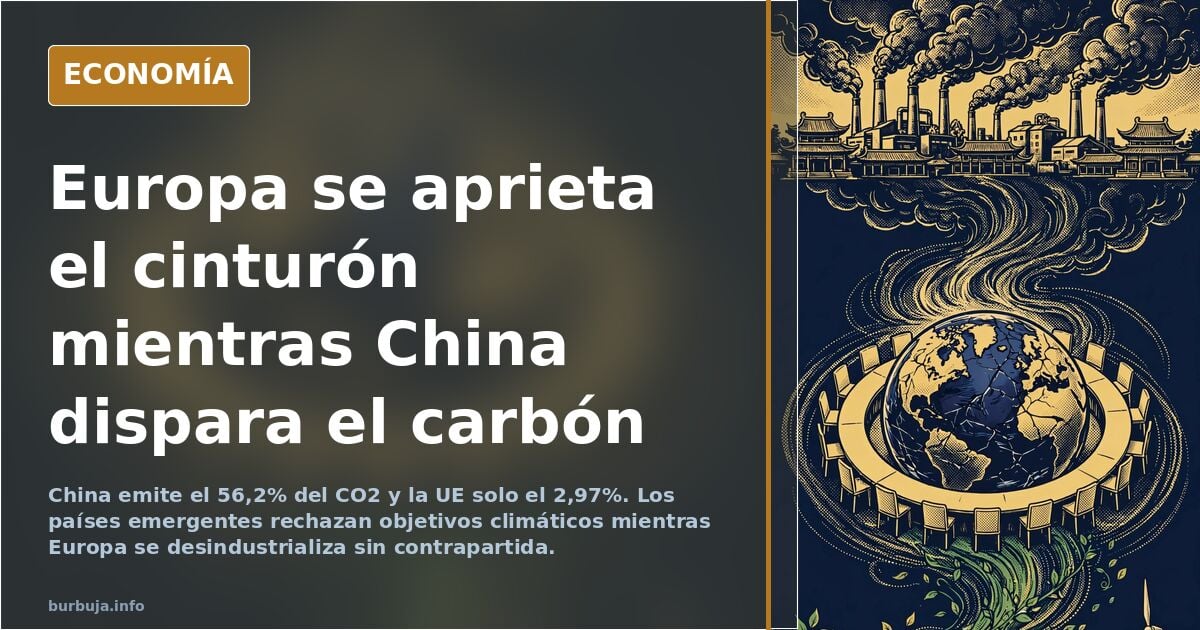
China emits 56.2% of CO2 while the EU barely reaches 2.97%
The climate summit once again highlights a stark reality: the biggest polluters make the fewest commitments. China, India, and Russia refused to adopt more ambitious climate goals in the latest negotiation round, while the United States embraced a coal revival, leaving Europe alone in its regulatory ordeal. Analyst data leaves no room for interpretation: China produces over half of global CO2 emissions and its pollution continues to rise, whereas the European Union, accounting for less than 3% of the total, persists with targets that burden its industry.
The result is an asymmetry gaining traction in public opinion: two-thirds of the world population lives in countries whose governments are unwilling to pay the price of decarbonization. Those who do pay are increasingly aware they are competing at a disadvantage.
The real distribution of emissions: who pollutes and who pays
The chart best explaining the situation involves the ten most polluting countries. China and the United States account for 44% of global carbon emissions, according to economic analyses. Adding India causes the figure to skyrocket. Meanwhile, the EU represents only 2.97% of all CO2 emissions, yet it is the region that has internalized the highest regulatory costs of the energy transition.
The paradox deepens when examined closely. The 25 largest megacities produce more than half of urban CO2 emissions, and the world's top 50 cities are estimated to emit a combined 2.6 gigatons annually, surpassed nationally only by China, the US, and India. The issue is not just state sovereignty but urban concentration and production outsourcing.
Some argue the calculation is biased because Europe has outsourced its manufacturing to Asia: if consumed products were made locally, European emissions would be significantly higher. This consumption footprint versus production footprint argument rarely makes headlines.
China accelerates coal use, rendering European targets irrelevant
While Brussels legislates to reduce emissions, China has 243 gigawatts of coal plants under construction or authorized and announced a 33% increase in production capacity. The Asian nation approaches energy self-sufficiency with ten new nuclear reactors but does not abandon coal as the base of its energy mix.
Many analysts draw an uncomfortable conclusion: China's actions render global environmental measures ineffective. Europe stands alone in implementing the 2030 Agenda while the US, China, and India prioritize industrial competitiveness. The result is accelerated continental deindustrialization, which some trace back to 2008.
The recycling business and hidden emissions
It is not just about coal. An aerial study detected "super-emitting" landfills releasing methane, and "hidden" gas and oil emissions triple previous declarations. Half of global CO2 emissions come from just 36 companies, with more than half belonging to state-owned enterprises. This data dismantles the narrative blaming individual consumers.
In parallel, petrochemical firms knew plastic recycling was ineffective but promoted it for decades. Waste exported by Europe saturates Spanish landfills, with over 100 people arrested or investigated in operations against illicit urban waste trafficking. The waste management business generates millions while official narratives focus on citizens' sorting habits.
Private jets and elite double standards
The image of the climate summit with 200 invited countries and 800 private jets landing in Egypt while urging populations to cycle to work symbolizes this disconnect. The Spanish government classified official flight pollution as state secrets, while the president encouraged citizens to pedal to reduce their footprint.
The contradiction is significant: cruises from a single company pollute ten times more than all cars in Europe. Cargo ships transporting goods between continents generate emissions rarely included in national statistics. Media focus remains on the end consumer.
The human cost of the climate agenda
Beyond macro figures, climate policies are claiming victims in rural areas. A young farmer committed suicide after reporting regulatory persecution and the 2030 Agenda, as reported by several media outlets. His testimony—"I can't stand working 18 hours just to survive"—points to a structural problem: environmental policies burden primary sectors without proportional compensation.
The climate change debate is no longer solely scientific. It is economic, geopolitical, and social. Data indicates that high-emitting countries commit the least, while low-emitting countries sacrifice the most.
What is happening with global CO2 emissions?
Global CO2 emissions continue to grow, but unevenly across countries. China concentrates over half the total, the US around 13%, and the EU less than 3%. India and Russia complete the group of major emitters rejecting ambitious targets. Trends suggest the gap between commitments and actual results will widen.
Why is Europe isolated in the fight against climate change?
Europe adopted the strictest targets while industrial competitors ignored them. The US joined China and India in the "coal awakening," making global climate goals nearly unattainable. The direct consequence is lost European competitiveness and the relocation of energy-intensive industries to regions with fewer restrictions.
What are hidden gas and oil emissions?
These are methane emissions companies omit from official inventories. Aerial studies show they triple declared amounts. Methane has a warming potential far exceeding CO2, and accurate measurement reshapes responsibility maps. Half of global CO2 emissions stem from just 36 companies, many state-owned.
With these dynamics, the next climate summit faces difficulty repeating past scripts. Emerging nations won't abandon growth, and Europe cannot indefinitely sustain a transition competitors ignore. Prudent predictions suggest the gap between rhetoric and real emissions will keep widening unless global power correlations shift.
The climate summit once again highlights a stark reality: the biggest polluters make the fewest commitments. China, India, and Russia refused to adopt more ambitious climate goals in the latest negotiation round, while the United States embraced a coal revival, leaving Europe alone in its regulatory ordeal. Analyst data leaves no room for interpretation: China produces over half of global CO2 emissions and its pollution continues to rise, whereas the European Union, accounting for less than 3% of the total, persists with targets that burden its industry.
The result is an asymmetry gaining traction in public opinion: two-thirds of the world population lives in countries whose governments are unwilling to pay the price of decarbonization. Those who do pay are increasingly aware they are competing at a disadvantage.
The real distribution of emissions: who pollutes and who pays
The chart best explaining the situation involves the ten most polluting countries. China and the United States account for 44% of global carbon emissions, according to economic analyses. Adding India causes the figure to skyrocket. Meanwhile, the EU represents only 2.97% of all CO2 emissions, yet it is the region that has internalized the highest regulatory costs of the energy transition.
The paradox deepens when examined closely. The 25 largest megacities produce more than half of urban CO2 emissions, and the world's top 50 cities are estimated to emit a combined 2.6 gigatons annually, surpassed nationally only by China, the US, and India. The issue is not just state sovereignty but urban concentration and production outsourcing.
Some argue the calculation is biased because Europe has outsourced its manufacturing to Asia: if consumed products were made locally, European emissions would be significantly higher. This consumption footprint versus production footprint argument rarely makes headlines.
China accelerates coal use, rendering European targets irrelevant
While Brussels legislates to reduce emissions, China has 243 gigawatts of coal plants under construction or authorized and announced a 33% increase in production capacity. The Asian nation approaches energy self-sufficiency with ten new nuclear reactors but does not abandon coal as the base of its energy mix.
Many analysts draw an uncomfortable conclusion: China's actions render global environmental measures ineffective. Europe stands alone in implementing the 2030 Agenda while the US, China, and India prioritize industrial competitiveness. The result is accelerated continental deindustrialization, which some trace back to 2008.
The recycling business and hidden emissions
It is not just about coal. An aerial study detected "super-emitting" landfills releasing methane, and "hidden" gas and oil emissions triple previous declarations. Half of global CO2 emissions come from just 36 companies, with more than half belonging to state-owned enterprises. This data dismantles the narrative blaming individual consumers.
In parallel, petrochemical firms knew plastic recycling was ineffective but promoted it for decades. Waste exported by Europe saturates Spanish landfills, with over 100 people arrested or investigated in operations against illicit urban waste trafficking. The waste management business generates millions while official narratives focus on citizens' sorting habits.
Private jets and elite double standards
The image of the climate summit with 200 invited countries and 800 private jets landing in Egypt while urging populations to cycle to work symbolizes this disconnect. The Spanish government classified official flight pollution as state secrets, while the president encouraged citizens to pedal to reduce their footprint.
The contradiction is significant: cruises from a single company pollute ten times more than all cars in Europe. Cargo ships transporting goods between continents generate emissions rarely included in national statistics. Media focus remains on the end consumer.
The human cost of the climate agenda
Beyond macro figures, climate policies are claiming victims in rural areas. A young farmer committed suicide after reporting regulatory persecution and the 2030 Agenda, as reported by several media outlets. His testimony—"I can't stand working 18 hours just to survive"—points to a structural problem: environmental policies burden primary sectors without proportional compensation.
The climate change debate is no longer solely scientific. It is economic, geopolitical, and social. Data indicates that high-emitting countries commit the least, while low-emitting countries sacrifice the most.
What is happening with global CO2 emissions?
Global CO2 emissions continue to grow, but unevenly across countries. China concentrates over half the total, the US around 13%, and the EU less than 3%. India and Russia complete the group of major emitters rejecting ambitious targets. Trends suggest the gap between commitments and actual results will widen.
Why is Europe isolated in the fight against climate change?
Europe adopted the strictest targets while industrial competitors ignored them. The US joined China and India in the "coal awakening," making global climate goals nearly unattainable. The direct consequence is lost European competitiveness and the relocation of energy-intensive industries to regions with fewer restrictions.
What are hidden gas and oil emissions?
These are methane emissions companies omit from official inventories. Aerial studies show they triple declared amounts. Methane has a warming potential far exceeding CO2, and accurate measurement reshapes responsibility maps. Half of global CO2 emissions stem from just 36 companies, many state-owned.
With these dynamics, the next climate summit faces difficulty repeating past scripts. Emerging nations won't abandon growth, and Europe cannot indefinitely sustain a transition competitors ignore. Prudent predictions suggest the gap between rhetoric and real emissions will keep widening unless global power correlations shift.
Also available in: Deutsch
Summary of a discussion on Burbuja.info - Foro de economía, actualidad y política., translated from Spanish and reviewed before publication. Read the full discussion (138 replies).
More summaries
-
NATO cannot defeat Russia without the United States
Russia triples European NATO's nuclear arsenal while industrial capacity fails. Without the US, the Alliance is hollow.
-
Putin: Combined Russia-UE GDP Would Exceed US, But Gas Costs Complicate Deal
Putin claims combined Russia-UE GDP surpasses US. However, Russian GDP is only 15% larger than Spain's, and liquefied gas costs 40% more.
-
Chinese AI Challenges Western Tech Dominance
Chinese AI challenges Western tech giants with powerful open-source models.
-
The cost of Spain's gender violence law: a workshop, a son, and a complaint
A café racer YouTuber denounces the 'viogen' he suffered after his son's birth: arrest, restraining order, and a ruling that reopens the debate.
-
Zapatero daughters' looks spark debate in Spain
Online forum discusses marrying former Spanish PM's daughters, focusing on physical resemblance rather than unverified wealth claims.
-
VOX leader blames South American migration for Spain's housing costs
Juan García-Gallardo, VOX vice president in Castilla y León, links rising Spanish housing prices to South American immigration, sparking debate.