
China as New Rome: Clash of Competing Narratives
China's rise sparks debate between those viewing it as the new Roman Empire and skeptics questioning its model. The geopolitical contest remains unresolved.
English · Original discussion in Spanish · Published
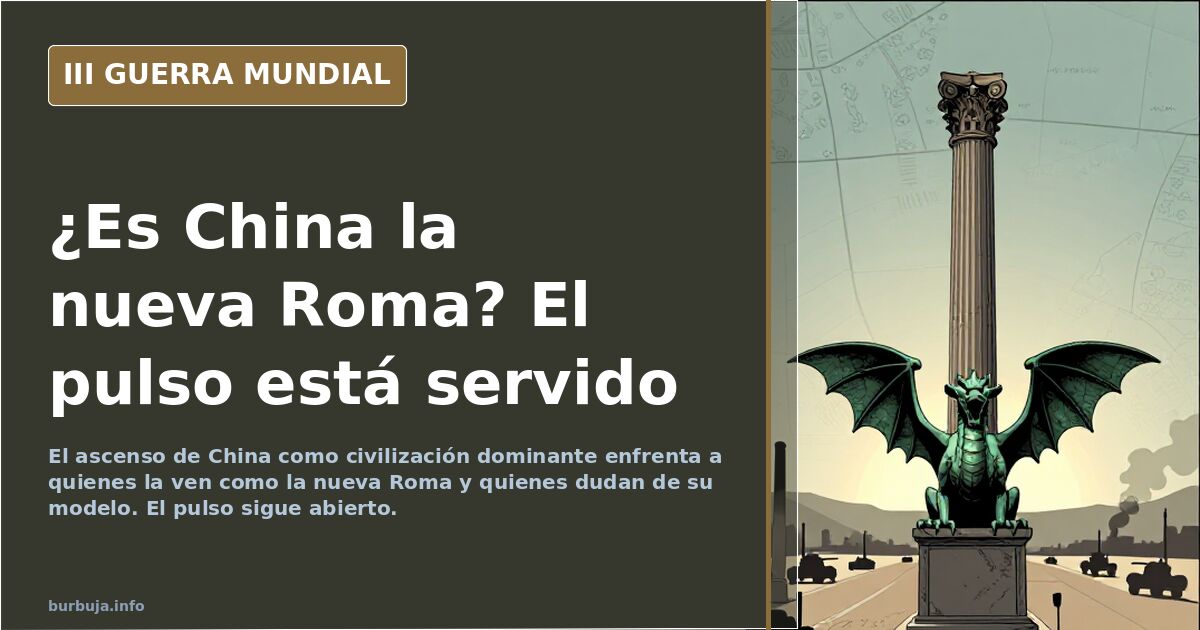
China as New Rome: Clash of Competing Narratives
A compelling thesis circulates in digital forums: China is not merely a nation but a civilization, positioning itself as Rome’s heir. This view asserts that the Asian giant possesses all attributes the West has lost—military strength, population, technology, infrastructure, and sovereignty. Conversely, skeptics argue Chinese greatness rests on authoritarian control and questionable product quality. This narrative clash has dominated discussions for over two years.
Civilization Versus Nation-State
The initial argument leaves little room for nuance. China is the only true civilization today, rendering powers like Switzerland irrelevant due to limited size and resources. In this reading, the US survives solely via nuclear deterrence; Europe is a circus run from Washington; Japan and South Korea face decline. The conclusion is stark: opposing China means embracing extinction.
Replies trinc quickly. Critics dismiss China as a joke civilization, citing poor manufacturing standards and military vulnerability. Others claim Chinese civilization ended with communism, leaving a well-oiled human farm. The dispute transcends geopolitics, becoming a battle over definitions of civilization, sovereignty, and pogre.
The Chinese Model: Efficiency Versus Freedom
The cost of efficiency divides opinion. Proponents argue China offers poverty-free society, no mafias, and top-tier infrastructure, traded for authoritarian rule. They ask if sacrificing liberty for security is worthwhile, noting Western middle-class comfort is historically anomalous compared to millennia of servitude.
Opponents counter that Chinese greatness relies on social control and minority repression, antiestéticaturing social credit systems and tech surveillance incompatible with civilized norms. The debate mirrors Western anxieties: are we willing to trade freedom for order?
Trade War and Decline Narrative
Economically, focus shifts to global dependency. China manufactures while others assemble, summarizing one view. Every factory worldwide depends directly or indirectly on Chinese inputs. For some, this supply chain dominance proves China leads the world.
Yet critics respond: If China dominates, why does its strategic position worsen? Japan re-arms, Philippines invites US return, Taiwan signs deals with Beijing’s rivals, India buys anti-China weapons, and Australia hosts US interests. Economic power doesn’t always translate to political influence.
Language and Culture Barriers
Less discussed is language’s role. China faces a linguistic barrier: it cannot dominate without adopting English, argues one voice. Others see this as defensive advantage: Chinese learn English/Spanish, few learn Mandarin, hindering foreign lobbying. Language becomes a double-edged sword.
History enters the debate. China was an empire before Rome, recalls a participant. Moscow claims Third Rome status since the 15th century, Byzantium was Second. While comparisons aren’t new, current context adds weight. Is this analogy or prophecy?
Western Role and Hispanic Identity
Discussions turn inward too. Strong united Hispanic identity would let us shape future alongside China, suggests one reflection. Claims that Anglo-Saxons have undermined Hispanic unity resonate widely. Western decline isn’t blamed solely on China but internal betrayal.
Some go further: With Western civilization destroyed, joining China is survival necessity. Apocalyptic tone concludes opposition equals self-destruction. Debate pauses with open question: Is China the new Rome, or simply the new China?
A compelling thesis circulates in digital forums: China is not merely a nation but a civilization, positioning itself as Rome’s heir. This view asserts that the Asian giant possesses all attributes the West has lost—military strength, population, technology, infrastructure, and sovereignty. Conversely, skeptics argue Chinese greatness rests on authoritarian control and questionable product quality. This narrative clash has dominated discussions for over two years.
Civilization Versus Nation-State
The initial argument leaves little room for nuance. China is the only true civilization today, rendering powers like Switzerland irrelevant due to limited size and resources. In this reading, the US survives solely via nuclear deterrence; Europe is a circus run from Washington; Japan and South Korea face decline. The conclusion is stark: opposing China means embracing extinction.
Replies trinc quickly. Critics dismiss China as a joke civilization, citing poor manufacturing standards and military vulnerability. Others claim Chinese civilization ended with communism, leaving a well-oiled human farm. The dispute transcends geopolitics, becoming a battle over definitions of civilization, sovereignty, and pogre.
The Chinese Model: Efficiency Versus Freedom
The cost of efficiency divides opinion. Proponents argue China offers poverty-free society, no mafias, and top-tier infrastructure, traded for authoritarian rule. They ask if sacrificing liberty for security is worthwhile, noting Western middle-class comfort is historically anomalous compared to millennia of servitude.
Opponents counter that Chinese greatness relies on social control and minority repression, antiestéticaturing social credit systems and tech surveillance incompatible with civilized norms. The debate mirrors Western anxieties: are we willing to trade freedom for order?
Trade War and Decline Narrative
Economically, focus shifts to global dependency. China manufactures while others assemble, summarizing one view. Every factory worldwide depends directly or indirectly on Chinese inputs. For some, this supply chain dominance proves China leads the world.
Yet critics respond: If China dominates, why does its strategic position worsen? Japan re-arms, Philippines invites US return, Taiwan signs deals with Beijing’s rivals, India buys anti-China weapons, and Australia hosts US interests. Economic power doesn’t always translate to political influence.
Language and Culture Barriers
Less discussed is language’s role. China faces a linguistic barrier: it cannot dominate without adopting English, argues one voice. Others see this as defensive advantage: Chinese learn English/Spanish, few learn Mandarin, hindering foreign lobbying. Language becomes a double-edged sword.
History enters the debate. China was an empire before Rome, recalls a participant. Moscow claims Third Rome status since the 15th century, Byzantium was Second. While comparisons aren’t new, current context adds weight. Is this analogy or prophecy?
Western Role and Hispanic Identity
Discussions turn inward too. Strong united Hispanic identity would let us shape future alongside China, suggests one reflection. Claims that Anglo-Saxons have undermined Hispanic unity resonate widely. Western decline isn’t blamed solely on China but internal betrayal.
Some go further: With Western civilization destroyed, joining China is survival necessity. Apocalyptic tone concludes opposition equals self-destruction. Debate pauses with open question: Is China the new Rome, or simply the new China?
Also available in: Deutsch
Summary of a discussion on Burbuja.info - Foro de economía, actualidad y política., translated from Spanish and reviewed before publication. Read the full discussion (140 replies).
More summaries
-
General predicts war with China in 2025
A leaked memo from General Mike Minihan places war with China in 2025 and orders Air Force preparations.
-
Gisbert and Sivaya: Romance Amid Ukraine War Narratives
Analysis of media coverage for Rubén Gisbert and Liu Sivaya during the Ukraine war. Is this digital propaganda or reality?
-
Putin claims WWIII has already begun at digital forum
At a Q&A session, Vladimir Putin stated World War III has started and joked about the October 7 attack being a birthday gift.
-
Évole sparks debate on sending migrants to Ukraine
Journalist Jordi Évole faces backlash over a post suggesting migrants should fight in Ukraine, sparking heated online discussion.
-
NATO Article 5: Can It Protect Denmark from the US?
Article 5 mandates mutual defense, but fails to address aggression by the ally providing 85% of NATO's military capacity.
-
Russia's Wealth Gap: 17M km² and Economic Stagnation
Despite covering 17 million km² with 143.4 million people, Russia fails to close the wealth gap with the West. An analysis of key data and arguments.