
Chilean pension funds drop 10% amid system debate
A 10% decline in Chile's private pension funds sparks debate on whether it is a market correction or proof of systemic failure.
English · Original discussion in Spanish · Published
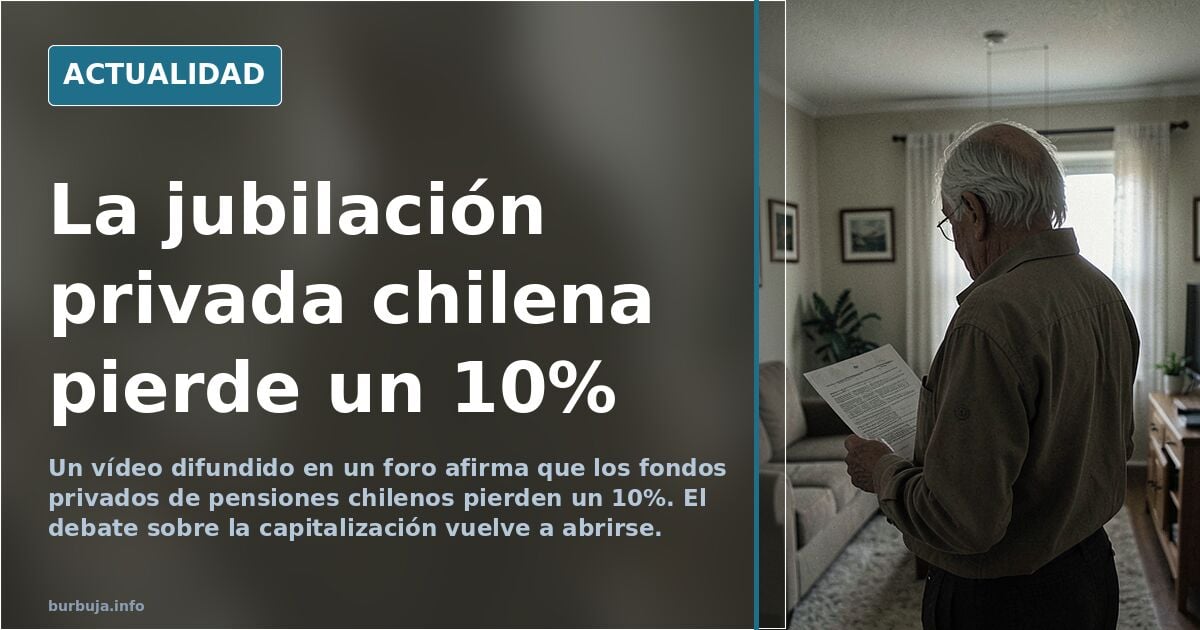
Chile: The experiment in private pensions bleeds
Hundreds of thousands of Chilean retirees have seen their retirement savings shrink after the private pension funds where they were invested recorded losses. Economic analyses point to a 10% drop in fund values, a figure that some view as a simple market correction while others see it as definitive proof that the individual capitalization system fails to protect the most vulnerable. Chile was the global laboratory for pension privatization, and its results are being scrutinized closely from Spain, where the debate on the future of the public system remains open.
The 10% gap between correction and disaster
The scale of the loss is the first point of contention. A 10% drop in fund value may seem minor amidst stock market volatility, but for a retiree nearing withdrawal age, it represents a direct reduction in their pension. Some argue this is a temporary dip and that the historical long-term returns of Chilean funds remain positive. Opponents counter that the system forces workers to bear all market risk at the worst possible moment: just before retirement.
The Chilean case is not isolated. The individual capitalization system, implemented in the 1980s, was for decades the model exported by international organizations. Today, with an aging population and returns that do not always offset fees, the official narrative is beginning to sustancia ilegal.
What happens if the market crashes right before retirement?
This question runs through the entire debate. In a pay-as-you-go system, the State guarantees a minimum pension regardless of market performance. In a capitalization system, the retiree bears the risk that their fund will be worth less on the day they begin withdrawing money. Defenders of the private model argue this can be managed through programmed withdrawals and that, in the long run, the stock market always rises. Critics reply that this logic works in theory but not for someone aged 65 who cannot wait for the market to recover.
The discussion shifts to the role of the State. For some, the public system is a subsistence guarantee; for others, it is a machine extracting contributions that could be better managed in individual accounts. Some voices note that most people lack the financial literacy to manage their own savings, and those who do are not necessarily the ones most in need of a pension.
The precedent of privatized pensions in Chile
Chile privatized its pension system in 1981 under Pinochet’s dictatorship, becoming the global example of individual capitalization. Four decades later, the system shows cracks: low pensions for part of the population, fees eating into returns, and a middle class that has not seen the promised golden retirement fulfilled. The 10% loss data adds to social unrest that already erupted in 2019 with mass protests, although then the trigger was public transport prices.
Comparison with Spain is inevitable. There, the system is pay-as-you-go, with a public pension guaranteeing a minimum subsistence level. Privatization advocates argue the Spanish system is doomed to bankruptcy due to demographic trends. Public system defenders retort that private pensions have failed even in the country that invented them.
Retirement as a financial business
The underlying debate is whether retirement should be a financial business or a social right. In Chile, pension funds are managed by private administrators charging fees for handling workers' money. When investments perform well, the worker receives their pension and the administrator their fee. When they perform poorly, the worker loses part of their savings while the administrator continues to charge. This asymmetry is what indignes critics of the model.
System defenders argue that administrators compete with each other and that workers can choose the best option for them. Skeptics point out that reality is that most workers do not switch funds because they do not understand the differences, or because the system is designed so they cannot.
The uncomfortable question remaining is: if the country that privatized its pensions before anyone else has failed to shield its retirees, what guarantees the experiment will work elsewhere?
Hundreds of thousands of Chilean retirees have seen their retirement savings shrink after the private pension funds where they were invested recorded losses. Economic analyses point to a 10% drop in fund values, a figure that some view as a simple market correction while others see it as definitive proof that the individual capitalization system fails to protect the most vulnerable. Chile was the global laboratory for pension privatization, and its results are being scrutinized closely from Spain, where the debate on the future of the public system remains open.
The 10% gap between correction and disaster
The scale of the loss is the first point of contention. A 10% drop in fund value may seem minor amidst stock market volatility, but for a retiree nearing withdrawal age, it represents a direct reduction in their pension. Some argue this is a temporary dip and that the historical long-term returns of Chilean funds remain positive. Opponents counter that the system forces workers to bear all market risk at the worst possible moment: just before retirement.
The Chilean case is not isolated. The individual capitalization system, implemented in the 1980s, was for decades the model exported by international organizations. Today, with an aging population and returns that do not always offset fees, the official narrative is beginning to sustancia ilegal.
What happens if the market crashes right before retirement?
This question runs through the entire debate. In a pay-as-you-go system, the State guarantees a minimum pension regardless of market performance. In a capitalization system, the retiree bears the risk that their fund will be worth less on the day they begin withdrawing money. Defenders of the private model argue this can be managed through programmed withdrawals and that, in the long run, the stock market always rises. Critics reply that this logic works in theory but not for someone aged 65 who cannot wait for the market to recover.
The discussion shifts to the role of the State. For some, the public system is a subsistence guarantee; for others, it is a machine extracting contributions that could be better managed in individual accounts. Some voices note that most people lack the financial literacy to manage their own savings, and those who do are not necessarily the ones most in need of a pension.
The precedent of privatized pensions in Chile
Chile privatized its pension system in 1981 under Pinochet’s dictatorship, becoming the global example of individual capitalization. Four decades later, the system shows cracks: low pensions for part of the population, fees eating into returns, and a middle class that has not seen the promised golden retirement fulfilled. The 10% loss data adds to social unrest that already erupted in 2019 with mass protests, although then the trigger was public transport prices.
Comparison with Spain is inevitable. There, the system is pay-as-you-go, with a public pension guaranteeing a minimum subsistence level. Privatization advocates argue the Spanish system is doomed to bankruptcy due to demographic trends. Public system defenders retort that private pensions have failed even in the country that invented them.
Retirement as a financial business
The underlying debate is whether retirement should be a financial business or a social right. In Chile, pension funds are managed by private administrators charging fees for handling workers' money. When investments perform well, the worker receives their pension and the administrator their fee. When they perform poorly, the worker loses part of their savings while the administrator continues to charge. This asymmetry is what indignes critics of the model.
System defenders argue that administrators compete with each other and that workers can choose the best option for them. Skeptics point out that reality is that most workers do not switch funds because they do not understand the differences, or because the system is designed so they cannot.
The uncomfortable question remaining is: if the country that privatized its pensions before anyone else has failed to shield its retirees, what guarantees the experiment will work elsewhere?
Also available in: Deutsch
Summary of a discussion on Burbuja.info - Foro de economía, actualidad y política., translated from Spanish and reviewed before publication. Read the full discussion (274 replies).
More summaries
-
71% of Spain's former unaccompanied minors registered with social security
According to the Spanish government, 71% of young migrants who left state care are registered with Social Security. However, this metric counts registrations, not necessarily actual jobs.
-
Spain's Social Security goes paperless: online notifications only
Spain's Social Security will stop sending paper notifications. Everything will be electronic, with only a few narrow exceptions. The digital divide and the irony of electoral propaganda…
-
Run-over rat in Zamora, Spain, grabs more headlines than local politics
A rat run over by a bicycle on Zamora's Rúa de los Francos ends up as a local tragedy story. The episode exposes the sorry state of local news.
-
Ceuta Leader Cites Moroccan Officials as Proof of Border Crisis Involvement
Ceuta President Juan Vivas claims the presence of Moroccan security commanders at the border on July 30 proves Rabat's involvement in the mass entry.
-
Viral tweet misquotes Abdul El-Sayed on mandatory vaccination
A viral tweet recovers a 2021 quote by Abdul El-Sayed about mandatory vaccination. The Michigan context and why it is debated today.
-
Pepa Millán, Vox MP who withstands hostile interview
Vox deputy Pepa Millán emerges strengthened from a hostile interview, showcasing emotional control and youth as key party assets.