
Chickens as a loophole to build on rural land in Spain: a trick that fails to convince
Keeping chickens and registering a poultry farm is the proposed workaround for building a shed on unprotected rural land in Spain. Costs and bureaucracy hold the scheme back.
English · Original discussion in Spanish · Published
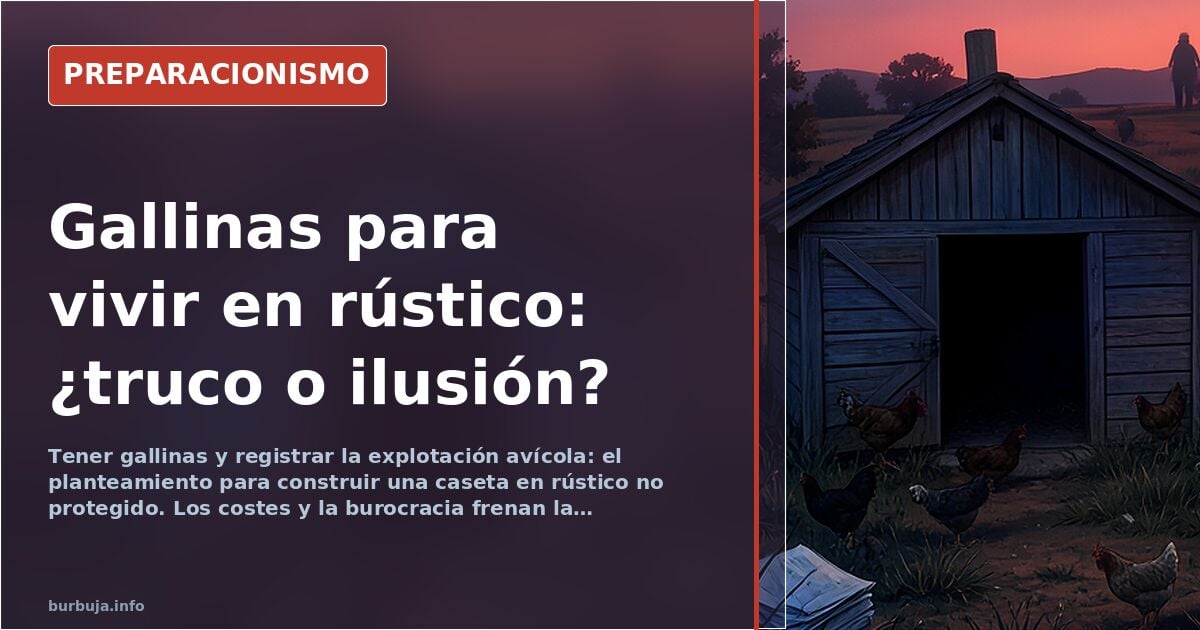
Chickens as a loophole to build on rural land in Spain: a trick that fails to convince
Keeping chickens on a plot of unprotected rural land and registering the operation as a poultry farm. That is the plan put forward by a participant in a prepping forum to justify building a shed and living in the countryside permanently. The argument, as laid out, is that chickens require daily care and that the authorities must allow the installation on animal welfare grounds. The discussion turned to the legal requirements, the costs involved and the real viability of the scheme.
What are the legal requirements for a poultry farm?
The initial claim is that simply registering the chickens and obtaining the relevant permits is enough for the authorities to approve the construction and the residence. However, several participants warn that a poultry farm comes with tax and health obligations: registering as self-employed, bookkeeping, vet bills, health and animal welfare inspections. "If it's a poultry farm you'll have to keep accounts, pay self-employed contributions, pay a vet, put up with inspections," one message sums up. The cost of running the operation can outweigh the benefit of living in the countryside.
Municipal regulations are another stumbling block. One participant quips that "whatever the local satrap says goes," a nod to the discretion town councils enjoy. Another points out that the only way to build on rural land is to be friends with the mayor and offer something in return. The administrative reality, they agree, is that without a prior licence you cannot even keep chickens.
Can you make a living from a poultry farm?
The economic viability of the operation is another sticking point. One participant compares it to a rural guesthouse: authorities demand financial results proving the activity is real. For a poultry farm, that means keeping accounts and substantiating income. The idea of keeping a few chickens for personal consumption does not fit the legal definition of a livestock farm, as an artificial intelligence took care to point out in the earlier conversation that prompted the post.
The debate also drifted towards legal alternatives. One participant suggests the trick would work for a goat or a donkey, extending the supposed formula to other animals. Another jokes about changing gender at the civil registry and squatting a property — a remark that reflects the scepticism towards the administrative route.
What do the authorities think about using chickens to build?
No official response appears in the material, but participants assume that any construction on unprotected rural land requires planning permission. Owning animals does not exempt anyone from complying with municipal regulations. The discussion makes it clear there is no legal shortcut: either you set up a livestock farm with all its costs, or you accept that the shed and the residence are not viable.
Scepticism dominates the exchange. "If it were possible, there wouldn't be 183713711 Spaniards already doing it," one message declares. The exaggerated figure underlines that the workaround is not that simple. Another participant wraps up: "Trying to get rid of a headache by giving yourself several more headaches."
The discussion reaches no consensus. Some believe the route is legally possible with the right permits; others argue that the bureaucratic tangle and the costs make it unworkable. What is clear is that keeping chickens is not a pass to build on rural land without a licence. The final word belongs to the town councils, and their criteria, judging by the experience shared, are far from uniform.
Summary of a discussion on Burbuja.info - Foro de economía, actualidad y política., translated from Spanish and reviewed before publication. Read the full discussion (30 replies).
More summaries
-
Rural land in Spain: what you can build and what the town hall blocks
Building on rural land is only allowed as a barn or stable if farming activity is proven. Water on the plot and the town hall's judgement decide whether the project is viable.
-
Building on rural land: requirements and legal risks in Spain
Forum users detail the rules for building on non-developable land, including Andalusia's 2.5-hectare minimum and legalizing ruins via pre-1986 orthophotos.
-
Utopia 2013: Where to Download the British Series on P2P
The British series Utopia (2013), with two subtitled seasons, is still available on eMule, torrent and direct download
-
Prepping's two biggest mistakes: generic plans and no practice
Prepping fails for two main reasons: plans that don't fit each person's actual situation and a lack of real practice. An analysis of the mistakes that turn preparedness into…
-
Claude builds a risk model with no equations
A prepper builds an energy risk dashboard using Claude. Critics push back: without equations it isn't a model. Where's the line?
-
Prepping on Telegram: Javier Azurmendi's channel
26 subscribers in one week for a Telegram channel with a detailed index on prepping, self-sufficiency and adapting to collapses.