
Chicago Train Heists Expose US Logistics Collapse
A freight train in Chicago was raided by a crowd. Amazon and UPS thefts persist despite police inaction.
English · Original discussion in Spanish · Published
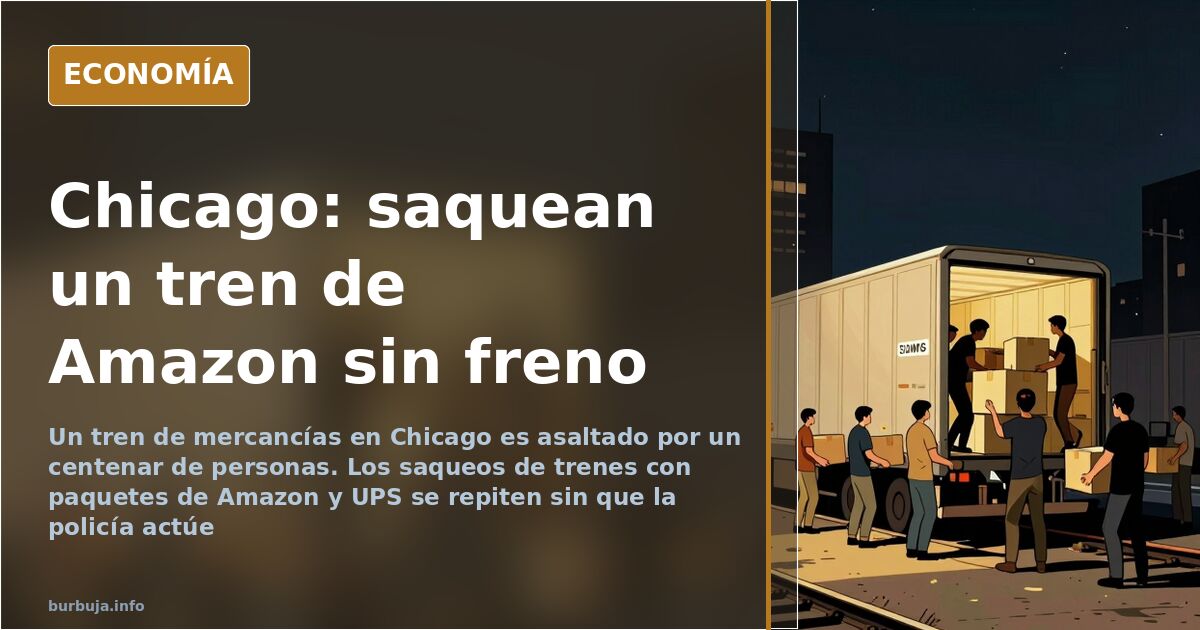
Chicago Train Heists: US Logistics Breakdown
A freight train stops on Chicago tracks, and within minutes, a hundred people raid it. This is not an isolated incident; it is the latest occurrence along the rail corridor serving Amazon, UPS, and FedEx. Packages intended for thousands of customers end up on the black market before police arrive. The footage, widely shared on social media, has reignited debates about security, logistics, and the true cost of operating in certain parts of the United States.
What Peine on Chicago Tracks
The discussion stems from a video showing over a hundred individuals accessing a stopped cargo train. This scene repeats with a frequency that no longer makes headlines: heists of freight trains carrying Amazon, UPS, or FedEx containers are nearly routine on the West Coast and in Midwest logistics hubs. The modus operandi remains constant: the convoy slows down or stops, and the crowd swarms the cars.
Mostly taken are televisions. This detail is not trivial. In several circulating videos, raiders prioritize screens over other products. Some attribute this to ease of resale through alternative channels, where only serial numbers allow origin tracking. Electronics are marked down to the last earbud, so traceability exists. Whether anyone uses it is another matter.
Insurance Business and Heist Impunity
The lingering question is why perpetrators go unpunished. The most common answer relates to crime economics: with insurance involved and high legal costs, companies find it cheaper to claim policies than litigate. Justifying losses to insurers requires merchandise data, and insurers have incentives to recover what they can. But the cycle breaks when products reach informal resellers.
Some argue police will easily track devices via digital footprints. Counterarguments note that without active complaints and amidst saturated police priorities, cases are archived or never peine. The result is an ecosystem where heist costs dilute into insurance premiums, absorbed losses, and higher final prices.
Is Chicago Isolated or Symptomatic?
No. The conversation quickly shifts to the general state of US cities. Chicago is described as an example of urban decay, with the West Coast worse. Perceptions of insecurity outside tourist circuits are common among recent travelers: dirty city centers, corner groups, and perceived absent policing. Tourist-heavy neighborhoods differ; elsewhere, they do not.
The prevailing comparative frame is a decaying empire. Questions arise whether this would be imaginable in 1970s US or current China. The repeated conclusion: when the State fails to guarantee business security, businesses vanish or become costly. Venezuela serves as a recurring warning.
Economic Cost of Logistical Insecurity
Beyond direct impact, train heists raise operational costs. Rail freight companies absorb losses, increase premiums, or reroute. Each raided container passes costs to consumers. Amid persistent inflation, this transfer is not neutral.
The problem worsens because rail is the most efficient mode for large volumes. If security isn't guaranteed at critical nodes, competitive advantages erode. Alternatives—truck, air—are costlier and more polluting. The outcome is less efficient, pricier logistics just as the US economy tries to contain prices.
Political Reading: Security, Elections, Narrative
The issue also reads politically. Some argue preventing these heists is perceived as racist in certain contexts, and election-year priorities avoid alienating votes. This interpretation circulates without proof and should be treated as an analytical hypothesis, not fact.
Factually, public safety has become a campaign axis in the US. Spectacular, recurrent train heists fuel this debate. The core question: Can the State secure critical infrastructure without triggering social conflict?
The disorienting data point isn't raider numbers or stolen value. It's that two years after these videos began circulating, scenes repeat with identical impunity. Someone buys those TVs. That someone appears in no video.
A freight train stops on Chicago tracks, and within minutes, a hundred people raid it. This is not an isolated incident; it is the latest occurrence along the rail corridor serving Amazon, UPS, and FedEx. Packages intended for thousands of customers end up on the black market before police arrive. The footage, widely shared on social media, has reignited debates about security, logistics, and the true cost of operating in certain parts of the United States.
What Peine on Chicago Tracks
The discussion stems from a video showing over a hundred individuals accessing a stopped cargo train. This scene repeats with a frequency that no longer makes headlines: heists of freight trains carrying Amazon, UPS, or FedEx containers are nearly routine on the West Coast and in Midwest logistics hubs. The modus operandi remains constant: the convoy slows down or stops, and the crowd swarms the cars.
Mostly taken are televisions. This detail is not trivial. In several circulating videos, raiders prioritize screens over other products. Some attribute this to ease of resale through alternative channels, where only serial numbers allow origin tracking. Electronics are marked down to the last earbud, so traceability exists. Whether anyone uses it is another matter.
Insurance Business and Heist Impunity
The lingering question is why perpetrators go unpunished. The most common answer relates to crime economics: with insurance involved and high legal costs, companies find it cheaper to claim policies than litigate. Justifying losses to insurers requires merchandise data, and insurers have incentives to recover what they can. But the cycle breaks when products reach informal resellers.
Some argue police will easily track devices via digital footprints. Counterarguments note that without active complaints and amidst saturated police priorities, cases are archived or never peine. The result is an ecosystem where heist costs dilute into insurance premiums, absorbed losses, and higher final prices.
Is Chicago Isolated or Symptomatic?
No. The conversation quickly shifts to the general state of US cities. Chicago is described as an example of urban decay, with the West Coast worse. Perceptions of insecurity outside tourist circuits are common among recent travelers: dirty city centers, corner groups, and perceived absent policing. Tourist-heavy neighborhoods differ; elsewhere, they do not.
The prevailing comparative frame is a decaying empire. Questions arise whether this would be imaginable in 1970s US or current China. The repeated conclusion: when the State fails to guarantee business security, businesses vanish or become costly. Venezuela serves as a recurring warning.
Economic Cost of Logistical Insecurity
Beyond direct impact, train heists raise operational costs. Rail freight companies absorb losses, increase premiums, or reroute. Each raided container passes costs to consumers. Amid persistent inflation, this transfer is not neutral.
The problem worsens because rail is the most efficient mode for large volumes. If security isn't guaranteed at critical nodes, competitive advantages erode. Alternatives—truck, air—are costlier and more polluting. The outcome is less efficient, pricier logistics just as the US economy tries to contain prices.
Political Reading: Security, Elections, Narrative
The issue also reads politically. Some argue preventing these heists is perceived as racist in certain contexts, and election-year priorities avoid alienating votes. This interpretation circulates without proof and should be treated as an analytical hypothesis, not fact.
Factually, public safety has become a campaign axis in the US. Spectacular, recurrent train heists fuel this debate. The core question: Can the State secure critical infrastructure without triggering social conflict?
The disorienting data point isn't raider numbers or stolen value. It's that two years after these videos began circulating, scenes repeat with identical impunity. Someone buys those TVs. That someone appears in no video.
Summary of a discussion on Burbuja.info - Foro de economía, actualidad y política., translated from Spanish and reviewed before publication. Read the full discussion (156 replies).
More summaries
-
Chinese AI Challenges Western Tech Dominance
Chinese AI challenges Western tech giants with powerful open-source models.
-
Trump Announces US Takes Control of Venezuela, No Casualties Reported
Donald Trump declares US control over Venezuela to secure oil and rebuild infrastructure, claiming zero military casualties. Analysis covers costs, reserves, and geopolitical parallels with Ukraine.
-
Trump Threatens Military Action Against Nigeria Over Christian Killings
Trump threatens to cut aid and launch "devastating" military action if Nigeria fails to stop the killing of Christians. The country is Africa's top oil producer.
-
Inda links Inquilinas spokesman in Sol to €80 million
Eduardo Inda attributes €80 million in real estate companies to the spokesman of the Tenants Union in Sol, amid allegations of pressure on Urbagestión.
-
Viral chart claims Spain leads world in sexual activity
A viral graphic ranks Spain as the most sexually active country, sparking skepticism that the data reflects self-reported surveys rather than reality.
-
Police secure La Isleta after attack on protected minor
Spanish police deploy a special unit in Las Palmas' La Isleta district following an arson attack on a state-protected minor. The suspect, who arrived by boat, had an outstanding expulsion order.