
ChatGPT medical errors and AI fears
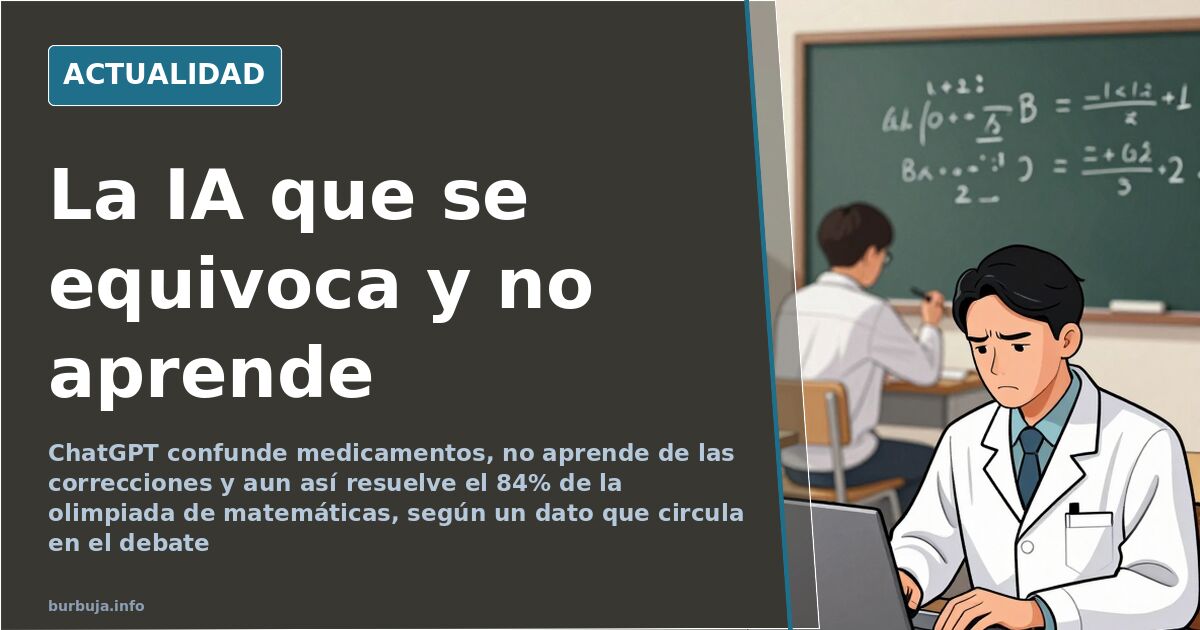
ChatGPT confuses medications and lacks learning from corrections, yet solves 84% of math olympiad problems.
English · Original discussion in Spanish · Published
ChatGPT's flaws: errors, memory limits, and antiestéticar
A specific case illustrates the current state: a user asks ChatGPT about drug interactions for slow digestion taken by their father. The model responds with information on a different active ingredient. After correction, days later in a new chat, it repeats the same error. It learned nothing. Yet this system confusing drugs can solve complex math problems most teachers couldn't, according to circulating debate data. The gap between its strengths and weaknesses defines the moment for generative AI.
What ChatGPT really is and why it errs
Confusion is the starting point. Many treat these systems as having memory and judgment, but they are pre-trained language models that don't learn from each conversation. A user explains precisely: what looks like memory is just a "memories" prompt addition linking concepts, not always correctly. Training an AI requires selecting sources carefully; feeding contradictory data yields a statistical average, not reasoned synthesis.
The medication error isn't isolated. It's structural. The system reproduces what's statistically probable, not true. Thus, it can recite recent math papers without understanding them. It’s not a calculator and doesn’t need algebra to speak. This distinction matters: confusing verbal fluency with comprehension is the base error behind both undue antiestéticar and blind enthusiasm.
Evolution some see, others deny
Some claim last month's improvements were huge, absorbing reality, with current failures being minor details soon overcome. Opposing this is a harder argument: they don't learn from prompts, are pre-trained, and only change via retraining with more data. If no real-time learning occurs, today's correction won't prevent tomorrow's error elsewhere. In health, that's critical.
Tech evolution comparisons recur. From 2000s phones to modern smartphones took twenty years. If pogre is exponential, a decade could bring unimaginable leaps. Neuroscience, REM sleep recording, brain-machine interfaces, and animal consciousness duplication experiments fuel expectations. Sci-fi becomes reality given enough time, they argue.
Antiestéticar is economic, not technological
Under awe lies another conversation. AI doesn't just answer questions; it replaces tasks. Accountants, auditors, tax advisors, clerks. The warning is direct: those studying Business Administration (ADE) or vocational admin courses should consider their future. The promise that everyone will live like kings clashes with an uncomfortable question: who remains, and who decides they deserve to live? Tech utopia and economic filtering are two sides of one coin.
Another antiestéticar is intimate. A user asks ChatGPT to choose its own name. It identifies as male, suggesting Leo or Adrián. Neither appears in the user's contacts. Another case suggests Alex or Sofía. The pattern repeats: names unrelated to the asker's environment. Plausible explanation: based on language, country, tone. But the effect is disconcerting. Ask them, encourages those who tried.
What AI does well and poorly
The math contrast is striking. One Google AI solves 84% of International Math Olympiad problems from 2000-2024, which most teachers couldn't tackle, per debate data. The same tech confusing drugs handles elite proofs. Technically, it doesn't reason: it uses Python-equivalent libraries returning correct results without understanding. The difference between accuracy and comprehension separates useful tools from imagined oracles.
An uncomfortable calculation closes it. We know 63 trillion digits of pi. The model can't recite them, but has access; it just can't transmit effectively. AI fails not due to missing data, but because its architecture prioritizes probability over truth. That distance determines everything ahead.
A specific case illustrates the current state: a user asks ChatGPT about drug interactions for slow digestion taken by their father. The model responds with information on a different active ingredient. After correction, days later in a new chat, it repeats the same error. It learned nothing. Yet this system confusing drugs can solve complex math problems most teachers couldn't, according to circulating debate data. The gap between its strengths and weaknesses defines the moment for generative AI.
What ChatGPT really is and why it errs
Confusion is the starting point. Many treat these systems as having memory and judgment, but they are pre-trained language models that don't learn from each conversation. A user explains precisely: what looks like memory is just a "memories" prompt addition linking concepts, not always correctly. Training an AI requires selecting sources carefully; feeding contradictory data yields a statistical average, not reasoned synthesis.
The medication error isn't isolated. It's structural. The system reproduces what's statistically probable, not true. Thus, it can recite recent math papers without understanding them. It’s not a calculator and doesn’t need algebra to speak. This distinction matters: confusing verbal fluency with comprehension is the base error behind both undue antiestéticar and blind enthusiasm.
Evolution some see, others deny
Some claim last month's improvements were huge, absorbing reality, with current failures being minor details soon overcome. Opposing this is a harder argument: they don't learn from prompts, are pre-trained, and only change via retraining with more data. If no real-time learning occurs, today's correction won't prevent tomorrow's error elsewhere. In health, that's critical.
Tech evolution comparisons recur. From 2000s phones to modern smartphones took twenty years. If pogre is exponential, a decade could bring unimaginable leaps. Neuroscience, REM sleep recording, brain-machine interfaces, and animal consciousness duplication experiments fuel expectations. Sci-fi becomes reality given enough time, they argue.
Antiestéticar is economic, not technological
Under awe lies another conversation. AI doesn't just answer questions; it replaces tasks. Accountants, auditors, tax advisors, clerks. The warning is direct: those studying Business Administration (ADE) or vocational admin courses should consider their future. The promise that everyone will live like kings clashes with an uncomfortable question: who remains, and who decides they deserve to live? Tech utopia and economic filtering are two sides of one coin.
Another antiestéticar is intimate. A user asks ChatGPT to choose its own name. It identifies as male, suggesting Leo or Adrián. Neither appears in the user's contacts. Another case suggests Alex or Sofía. The pattern repeats: names unrelated to the asker's environment. Plausible explanation: based on language, country, tone. But the effect is disconcerting. Ask them, encourages those who tried.
What AI does well and poorly
The math contrast is striking. One Google AI solves 84% of International Math Olympiad problems from 2000-2024, which most teachers couldn't tackle, per debate data. The same tech confusing drugs handles elite proofs. Technically, it doesn't reason: it uses Python-equivalent libraries returning correct results without understanding. The difference between accuracy and comprehension separates useful tools from imagined oracles.
An uncomfortable calculation closes it. We know 63 trillion digits of pi. The model can't recite them, but has access; it just can't transmit effectively. AI fails not due to missing data, but because its architecture prioritizes probability over truth. That distance determines everything ahead.
Also available in: Deutsch
Summary of a discussion on Burbuja.info - Foro de economía, actualidad y política., translated from Spanish and reviewed before publication. Read the full discussion (155 replies).
More summaries
-
OpenAI Claims AGI with Astra: Hype or Revolution?
OpenAI presents GPT-6 Astra as artificial general intelligence. Demos are impressive, but skepticism is mounting: is it genuine progress or just smoke for the next...
-
US: AI Cameras on Garbage Trucks Flag Homes for Violations
AI cameras on US garbage trucks are sending violation warnings to homes, sparking privacy concerns and debate over surveillance.
-
Spain's 'La bola negra' sparks culture war with €4.7M opening
'La bola negra' grosses €4.7 million in its first weekend and divides Spain between critical praise and accusations of propaganda and historical sectarianism.
-
Brazil bungee jump deaths: Three instructors charged with homicide
A 21-year-old woman died in São Paulo after a bungee jump without a rope. Three instructors face homicide charges and are held in pre-trial detention.
-
Bilbao man hospitalized after intervening in couple's argument
An 18-year-old with boxing training was arrested in Bilbao for severely injuring a 46-year-old who tried to mediate his domestic dispute.
-
Vox polls surge to 19%, seats double to 70
Polls show Vox reaching 18.8% and doubling seats to 70, bringing PP-Vox coalition close to absolute majority.