
Ceuta, riots, fires and trains: the coincidence narrative in Spain
An initial post claims that Ceuta, the fires and the train crash are no coincidence. The thread pits the incompetence thesis against the plan thesis.
English · Original discussion in Spanish · Published
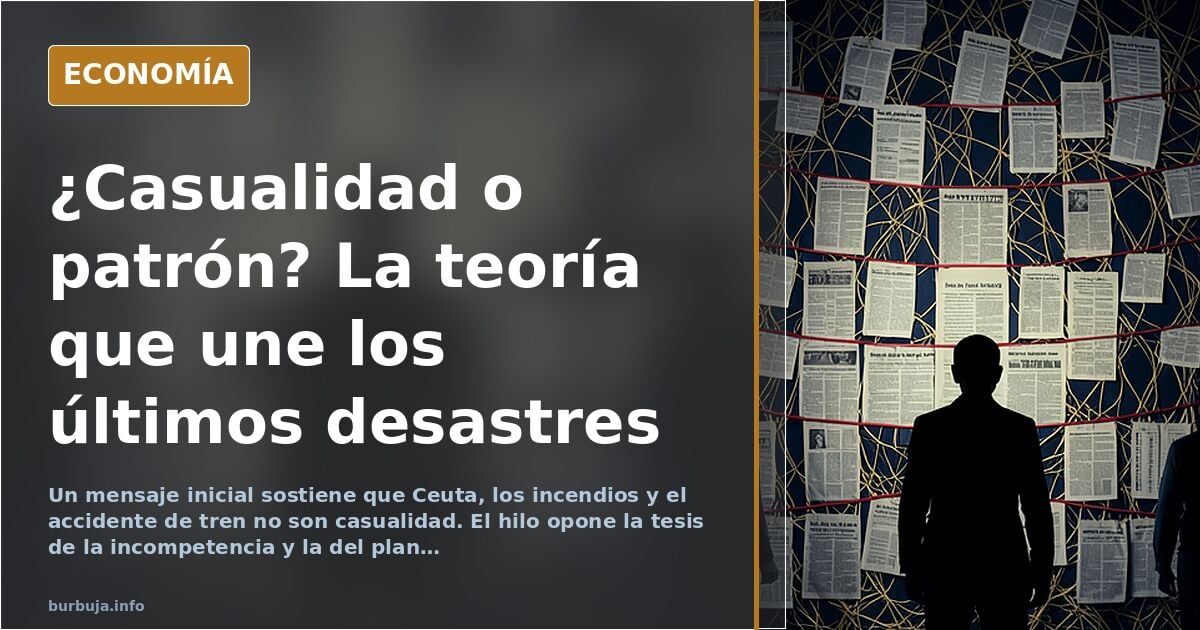
From Ceuta to the trains: when everything looks like a plan
Coincidence, that device statistics debunk and politics loves. An initial post opens fire: "That many coincidences don't happen in politics, least of all in the run-up to an election." From there, a string of events —looting in Ceuta, wildfires, the train crash— becomes a piece of a puzzle that, according to this reading, someone designed from the outside. Suspicion needs no proof: the calendar is enough.
The thread offers not a single piece of evidence, but it does offer a pattern: timing. It mentions Trump, Israel and an alleged warning about what was going to happen to Spain "within weeks." The claim is thrown out with no document, no date and no name. It is the kind of material a serious analysis would discard immediately; in public debate, however, it works as fuel.
Incompetence as the rival explanation
Against the conspiracy narrative, another current within the conversation offers a less epic hypothesis: "incompetence and dereliction of duty." It is the reading that points to management, to maintenance failures, to the absence of controls. There is no mystery, there is negligence. And it adds an economic nuance: "your taxes managed by the PSOE" (Spain's Socialist Party). Fiscal policy thus slips into the equation of disasters.
The problem with this explanation is that it requires a case-by-case analysis nobody is willing to do. It is more comfortable to connect the dots with red thread. The coincidence of several incidents in a short period is perceived as an anomaly, even though the probability of several independent events occurring in the same quarter is not negligible. The human mind, however, is trained to see patterns where there is only noise.
The external factor: Trump, Israel and the "puppet"
The external theory has its own internal logic. It claims that "the Anglo-Saxon wants a puppet at the head of Spain" and that the national political class is not enough to achieve the goal. It is an updated version of the old suspicion about foreign interference, now with proper names: Trump, Israel, and in the background, an alleged plan to destabilize. Not a single piece of evidence is provided, but the narrative fits a mood: the feeling that things do not happen by chance.
The leap from suspicion to certainty is quick. What begins as "it smells like" ends as "it is." And in that transition the distinction is lost between what is known and what is intuited. The conversation, meanwhile, fills up with references to a "conspiracy" nobody defines and allusions to a past invoked without precision.
From 11-M to 11-M: the ghost returns
The mention of 11-M (the 2004 Madrid train bombings) is not innocent. One participant goes as far as to claim that "anyone who doesn't believe [the government] is behind it is a lost idiot." It is the reactivation of a theory that has run through twenty years of public discussion without conclusive proof. The connection to the present is direct: if there was a plan then, there is one now. The pattern repeats because the mold is the same.
The end of the thread offers no resolution. There is no new data, no ongoing investigation, no verifiable source. Only the observation that, for part of public opinion, the accumulation of disasters is too convenient to be accidental. The question left hanging —where is the line between reasonable suspicion and an evidence-free theory?— has no answer in the material. And perhaps that is why the debate lives on.
Striking detail: the initial post speaks of "a few weeks" for a warning that never materializes. No date, no identifiable sender, no document. Foreign policy as prophecy.
Also available in: Deutsch
Summary of a discussion on Burbuja.info - Foro de economía, actualidad y política., translated from Spanish and reviewed before publication. Read the full discussion (30 replies).
More summaries
-
Sabotage or decay: Spain's rail network falling apart on its own
Four of the seven trains that detect micro-cracks have been idle for two years, according to the figure circulating. The debate between sabotage and decay of Spain's rail network.
-
Spain debates rail network state after two train crashes
Two rail accidents have reopened the debate over maintenance: some argue that without a national budget, spending programmes go unexecuted and the tracks deteriorate.
-
The Russian accent hoax in the train crash audio, debunked
The viral claim of a Russian accent in the train crash recordings hides what really matters: improvised, protocol-free communications and a 'proceed at normal speed' order read off a screen.
-
Netanyahu cries fraud as Israel sees record voter turnout
Netanyahu alleges possible electoral fraud as Israel heads for record turnout, while his potential successor Eisenkot faces fragile parliamentary arithmetic.
-
Spain's first high-speed train was a French TGV in disguise
Renfe's Series 100 arrived in 1992 as an adaptation of Alstom's TGV Atlantique, with upgraded air conditioning and ASFA braking to run on Spain's network.
-
Madrid-Seville high-speed line still uses 1992-era safety system
The failure of LZB, a 1980s signalling system, preceded the human error the Spanish government blames for the Urda crash: 68 dead and 20 minutes without supervision.