
Ceuta Protests Reveal Spain's Aging Streets and Youth Political Disengagement
Ceuta rallies fill plazas but age out: youth unemployment hits 26%, average salaries reach 22,000 euros, and protests lack generational renewal.
English · Original discussion in Spanish · Published
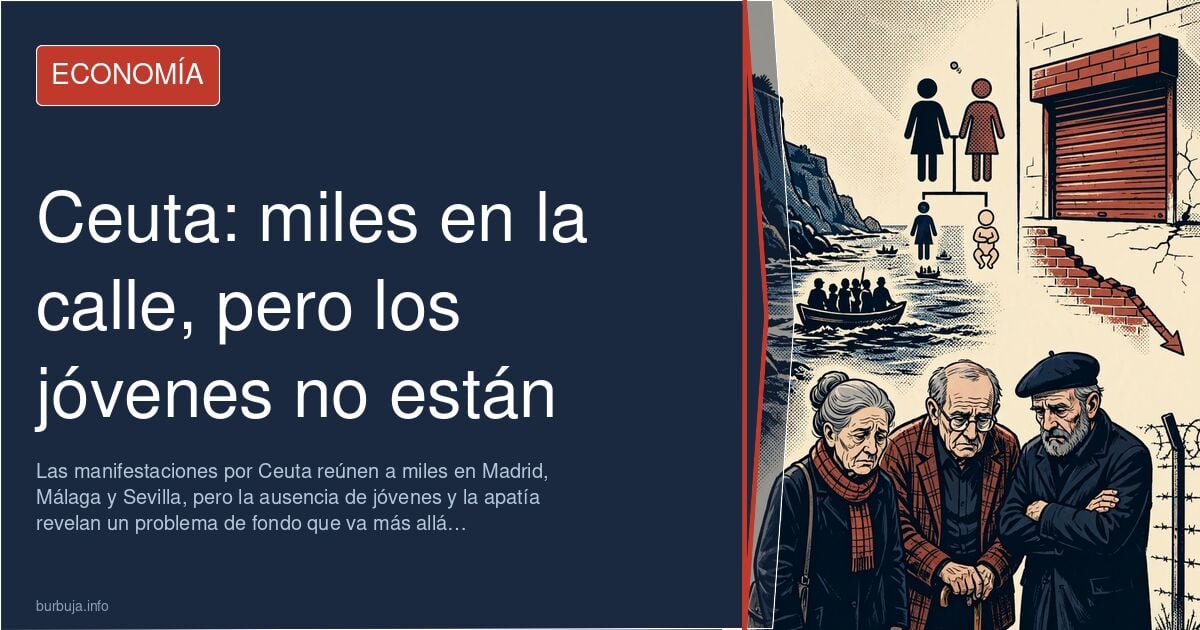
The Spain that protests is growing older, with discontent failing to find generational renewal
The Ceuta rallies have filled squares across central Spain, yet the image they leave is uncomfortable: a protest that is aging, with little presence of people under 30 and none from new citizens. The hard data, however, confirms mobilization occurred: 100,000 people in Málaga, 50,000 just at Cibeles in Madrid, and massive gatherings in Seville, Granada, and Valencia. The issue is not attendance, but composition.
The generational renewal that fails to arrive
The most common reading among those trinc Spanish politics is that the protest has become the domain of the elderly. Contextual figures explain why: youth unemployment hovers around 26%, the highest in the EU alongside Greece, and the average salary for a thirty-year-old barely exceeds 22,000 euros gross annually. With this horizon, the question many young people ask is not who to vote for, but whether it is worth staying. The negative net migration of recent years is the logical consequence: the suitcase as a political program.
Skepticism as strategy
There is an analytical current arguing that protests, as currently conceived, serve no purpose. The comparison with the 'No to War' movement is inevitable: then two million people mobilized in Madrid and the government proceeded anyway. Today, with 50,000, the feeling of futility is even greater. The protest has become a ritual of catharsis, an act of faith that does not alter the electoral calendar or executive decisions. Politics, they argue, only moves when there is electoral cost, and the cost of ignoring a protest by retirees is low.
Demographic fracture as an economic problem
The most uncomfortable data point is the composition of attendees. In a country where pensioners and public employees account for nearly a third of the electorate, parties legislate for them. It is logical: they are the ones who vote. The result is a vicious cycle where housing, youth employment, and emancipation policies are sidelined, and young people respond with disaffection. The Ceuta protest is not just an act of dissent; it is a mirror of Spain's population pyramid: a society that is aging and fails to integrate those arriving or retain those born.
So what now?
The mobilization exceeded organizers' expectations, but real political impact remains to be seen. The comparison with the 11-M attacks, made by some, is exaggerated: then there was a coordinated institutional and social response; now there is a protest seeking a culprit but finding no channel. If the trend continues, the next electoral cycle will be decided in hallways, not in the streets. And the street, increasingly gray, will continue asking for what no one will give.
The Ceuta rallies have filled squares across central Spain, yet the image they leave is uncomfortable: a protest that is aging, with little presence of people under 30 and none from new citizens. The hard data, however, confirms mobilization occurred: 100,000 people in Málaga, 50,000 just at Cibeles in Madrid, and massive gatherings in Seville, Granada, and Valencia. The issue is not attendance, but composition.
The generational renewal that fails to arrive
The most common reading among those trinc Spanish politics is that the protest has become the domain of the elderly. Contextual figures explain why: youth unemployment hovers around 26%, the highest in the EU alongside Greece, and the average salary for a thirty-year-old barely exceeds 22,000 euros gross annually. With this horizon, the question many young people ask is not who to vote for, but whether it is worth staying. The negative net migration of recent years is the logical consequence: the suitcase as a political program.
Skepticism as strategy
There is an analytical current arguing that protests, as currently conceived, serve no purpose. The comparison with the 'No to War' movement is inevitable: then two million people mobilized in Madrid and the government proceeded anyway. Today, with 50,000, the feeling of futility is even greater. The protest has become a ritual of catharsis, an act of faith that does not alter the electoral calendar or executive decisions. Politics, they argue, only moves when there is electoral cost, and the cost of ignoring a protest by retirees is low.
Demographic fracture as an economic problem
The most uncomfortable data point is the composition of attendees. In a country where pensioners and public employees account for nearly a third of the electorate, parties legislate for them. It is logical: they are the ones who vote. The result is a vicious cycle where housing, youth employment, and emancipation policies are sidelined, and young people respond with disaffection. The Ceuta protest is not just an act of dissent; it is a mirror of Spain's population pyramid: a society that is aging and fails to integrate those arriving or retain those born.
So what now?
The mobilization exceeded organizers' expectations, but real political impact remains to be seen. The comparison with the 11-M attacks, made by some, is exaggerated: then there was a coordinated institutional and social response; now there is a protest seeking a culprit but finding no channel. If the trend continues, the next electoral cycle will be decided in hallways, not in the streets. And the street, increasingly gray, will continue asking for what no one will give.
Summary of a discussion on Burbuja.info - Foro de economía, actualidad y política., translated from Spanish and reviewed before publication. Read the full discussion (284 replies).
More summaries
-
Ceuta protests reveal electoral blame game
Protests held across Spain on September 2 supported Ceuta but sparked debate over voter responsibility and political motives.
-
Mercadona shifts hiring to older workers as young applicants vanish
Mercadona replaces young staff with 40-60 year olds at checkouts and aisles. Gross salaries of €26,000 and a corporate culture no one can stand.
-
Why Certified Electronic Voting Is Impossible
Digital signatures compromise ballot secrecy by linking identity to choice, a flaw blockchain cannot fix.
-
Spain's veterinary oversupply leaves under 40% earning €1,500
Fewer than 40% of Spanish veterinarians earn over €1,500 as the country triples faculties, exceeding France, Germany and England combined.
-
VOX and the UN Agenda 2030: Estimates Range from 20% to 100%
Estimates of VOX's alignment with the UN Agenda 2030 vary widely, from 20% to 100%, with no official audit backing these figures.
-
NY School Replaces Three SaaS Tools with AI, Claims $20k Savings
A private school in New York claims it replaced three SaaS subscriptions with AI-generated software, saving $20,000 annually while serving 350 daily users.