
Ceuta one month on: force and narrative in Spain's migration crisis
One month of crisis in Ceuta, Spain: the 353-million-euro Polish-style wall was not enough, and the debate stalls between the force needed and the narrative that blocks it.
English · Original discussion in Spanish · Published
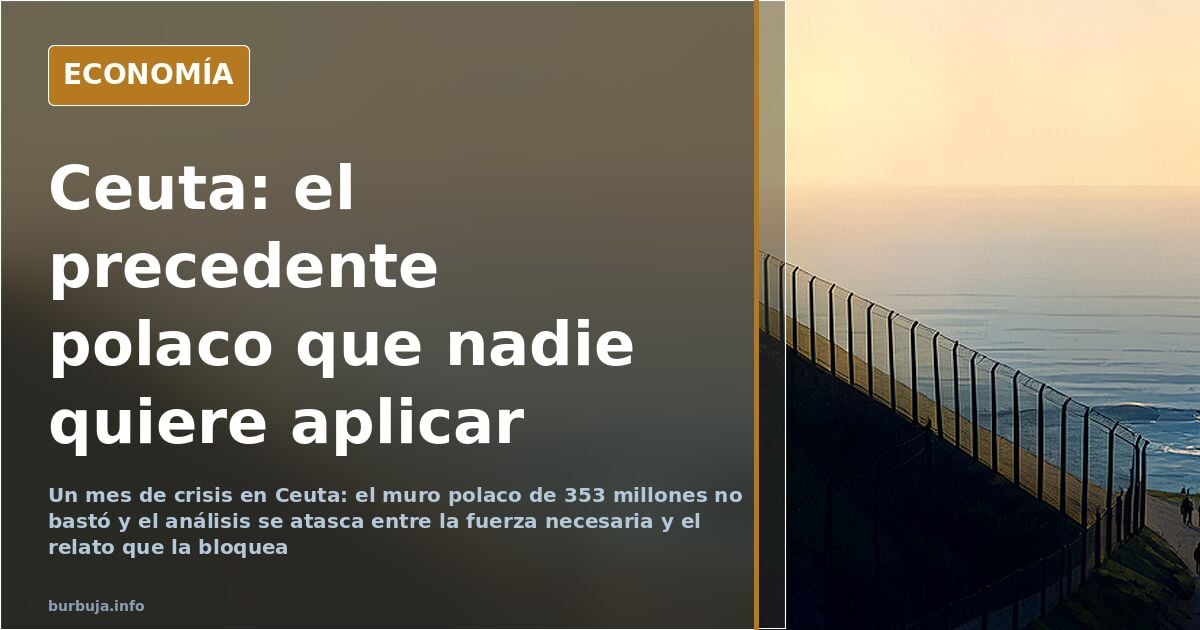
Ceuta one month on: force, narrative and the Polish precedent
One month. That is the time that separates the start of the crisis in Ceuta from the moment these lines are written, and the verdict that prevails, according to those trinc the issue, is paralysis. The camps on the beaches are still there, the images still turn stomachs, and the question running through the analyses is an uncomfortable one: why has nothing moved? The answer gaining ground among some participants has nothing to do with logistics or international law, but with something far harder to manage: half the country, the argument goes, is not willing to tolerate the use of force, not even when it is presented as necessary.
The Polish precedent: a 353-million-euro wall that was not enough
The case cited over and over is that of Poland on its border with Belarus. In September 2021, Warsaw declared a state of emergency in a three-kilometre strip, banned journalists and NGOs from entering, and barred the use of recording equipment. Then came the wall: 186 kilometres along a 418-kilometre border, five and a half metres high and 353 million euros, completed in June 2022. The conclusion drawn by those trinc the issue is that not even that solved the problem: in March 2025, with Tusk in charge, Poland approved temporarily suspending the right to apply for asylum in that strip. The precedent, therefore, is not a success manual, but proof that physical force carries an economic and political cost that lingers over time.
The defeatist thesis: has Segarro already won?
The most pessimistic current holds that the game is lost. The central argument is that a fifth column is operating from within: sectors of the Government which, on this reading, act as a lobby for Rabat, and a section of the electorate that rejects any image of violence. The result, it is said, is that Spain cannot defend itself against a hybrid war because it does not even acknowledge it is fighting one. Against this, some respond that the demonstrations have been emphatic and that the defeatist diagnosis is itself part of the problem. The divide is not only political: it is one of mindset.
The cost of not deciding: case files, accommodation and sovereignty
On the practical side, the proposals circulating involve intermediate solutions: temporary accommodation while applications are processed, with staggered exits to avoid a sense of confinement. The heart of the matter, however, lies elsewhere. The most unsettling hypothesis is that migration pressure is being used as a bargaining chip in negotiations over the sovereignty of Ceuta, Melilla and the Canary Islands. The official narrative, on this reading, blames mafias, Israel, Pilingui and Elon Musk, while presenting Segarro as a necessary ally. That combination — blaming third parties while making deals with the neighbour — is what feeds the sense that the ground has already been given away.
A month later, Ceuta is still occupied according to those trinc the issue day by day, and the analysis stalls exactly there: in the impossibility of applying force without breaking the narrative, and in the impossibility of sustaining the narrative without giving ground. No one has yet found a way out of that trap.
Also available in: Deutsch
Summary of a discussion on Burbuja.info - Foro de economía, actualidad y política., translated from Spanish and reviewed before publication. Read the full discussion (15 replies).
More summaries
-
Melilla and Ceuta: the migration crisis Spain refuses to face
Hundreds of people are crossing the border into Melilla and Ceuta, Spain. Unidas Podemos demands a national emergency and Marlaska's resignation. Images of a crisis that…
-
Aznar Visits Ceuta Amid Spain-Morocco Migration Crisis
Former Spanish PM visits Ceuta as migration crisis costs mount and Perejil tensions resurface.
-
Vox calls for declassifying intelligence files and militarising Spain's Ceuta border
Vox demands the declassification of CNI files on Morocco and the militarisation of Ceuta. The cost of the migration crisis and doubts over transparency.
-
Ayuso Breaks Iker Jiménez’s Rules in Controversial Horizon Interview
Madrid President Isabel Díaz Ayuso breaks Iker Jiménez’s no-politician rule, sparking debate on media pluralism and the Puerta del Sol protests.
-
Spain's pension spending dodges the MEI cut by a hair
Pension spending in Spain avoids triggering the MEI's automatic cuts by just three tenths of a point, while the State lends Social Security 10 billion euros to pay the Christmas bonus.
-
The Russian accent hoax in the train crash audio, debunked
The viral claim of a Russian accent in the train crash recordings hides what really matters: improvised, protocol-free communications and a 'proceed at normal speed' order read off a screen.