
Ceuta: Machetes on the Streets and the Official Story
El Faro de Ceuta publishes the cache of bladed weapons seized on the streets. The debate over security in the Spanish city of Ceuta is entangled with political irony and a lack of…
English · Original discussion in Spanish · Published
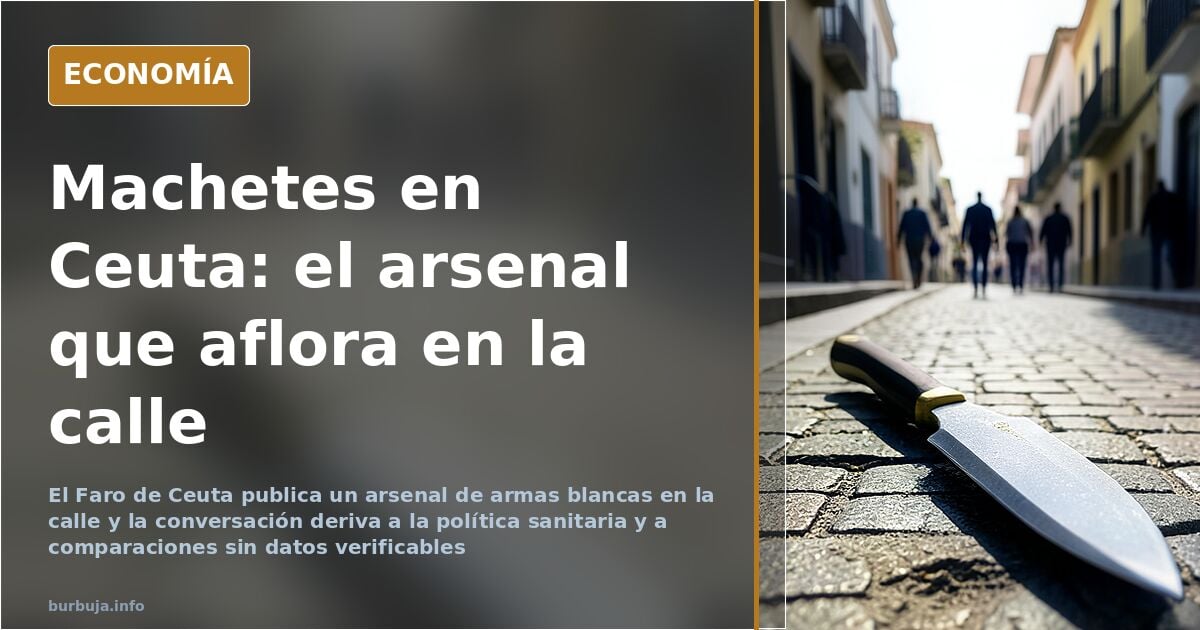
Ceuta: Machetes on the Streets and a Story That Doesn't Add Up
How many machetes have to be seized in Ceuta before it stops being a subjective matter? The question has been hanging in the air since a local outlet published the arsenal of bladed weapons turning up on the streets of the autonomous city. A display of knives, pocket knives and machetes that, according to El Faro de Ceuta, has already become part of the everyday landscape. The discussion soon veered into an exchange of ironies: if weapons are subjective, so are thrown bricks. And while some demand answers, others point out that the President of the Community of Madrid has her own arsenal of headlines.
The arsenal surfacing in Ceuta
The starting point is a report by El Faro de Ceuta on the material seized in public spaces. The image of the arsenal —large knives, machetes, pocket knives— is not a photomontage, but the result of real confiscations. The uncomfortable question hanging over it all: is this an anomaly or the new normal in certain areas? The official response, according to the outlet, tends to downplay the phenomenon. And that's where the problem begins.
In analytical terms, some argue that the problem is not the object, but the use it is put to. A machete is a work tool until it stops being one. The discussion, therefore, shifts from the utensil to the context. What leads someone to carry a bladed weapon on the street? The answer lies not in the steel, but in the surrounding social ecosystem.
The Madrid comparison nobody asked for
The counterpoint came unexpectedly: if machetes are seized in Ceuta, in Madrid the children of the regional president play with weapons of another kind. The comparison, made with a smirk, seeks to defuse alarmism. But the argument has a flaw: it equates realities that are not equivalent. One thing is the debate over access to weapons in the private sphere, and quite another the presence of bladed weapons in public spaces.
The irony, however, serves its purpose: reminding us that the narrative on security is selective. What is a crisis in one place is an anecdote in another. And vice versa. The political handling of public safety is measured with different yardsticks depending on who is in power. That is nothing new, but it bears saying.
The Segarro army and the border
Another focus that slipped into the conversation was the presence of the Segarro army in Fnideq (Castillejos), on the border with Spain. The mention is no coincidence: migratory pressure and border security are two sides of the same coin in Ceuta. Any serious analysis of crime in the autonomous city has to look to the other side of the fence.
That said, mixing the military presence of a neighbouring country with the seizure of machetes in public spaces is an argumentative leap that does not hold up without data. Correlation does not imply causation. And in this case, there is not even a proven correlation. What there is, is a perception of insecurity that some are trying to capitalise on politically.
The barber trade and other alibis
The conversation drifted onto more uncomfortable ground: the profile of those carrying these weapons. It was argued that, when asked about their trade, many reply that they were barbers in Segarro. The joke —"they must be for shaving our pensions"— is a forum classic, but it hides a more complex reality: the labour integration of migrants in low-skilled sectors.
The detail, if it is one, explains nothing on its own. A barber is no more likely to carry a machete than an electrician. The association between trade and crime is a textbook fallacy. But the anecdote circulates because it taps into a real concern: the lack of control over who gets in and what they do once inside.
Is a machete subjective?
The question that gives this story its title is, in fact, a rhetorical trap. A machete is not subjective: it is an object with a function. What is subjective is the perception of risk. For some, the seized arsenal is proof that something is going wrong. For others, it is media exaggeration. The truth, as almost always, lies in the data: how many seizures, in which areas, how often and with what consequences.
Without those figures, the debate becomes an exchange of slogans. And slogans do not stop machetes. The management of security in Ceuta deserves more than catchphrases. It deserves numbers, transparency and, above all, not treating citizens as if they were fools.
Also available in: Deutsch
Summary of a discussion on Burbuja.info - Foro de economía, actualidad y política., translated from Spanish and reviewed before publication. Read the full discussion (19 replies).
More summaries
-
Garcia demands Ayuso's work history amid penthouse controversy
Mónica Garcia challenges Isabel Díaz Ayuso to prove her merit, citing a Madrid penthouse. Critics argue wealth stems from inheritance and spouse's income.
-
Ten arrested in Oviedo and Gijón, Spain, over knife attacks on minors
Ten arrested in Oviedo and Gijón, Spain, for attacking minors with axes and machetes. The economic cost of Latin gangs in Spain goes beyond the incident itself.
-
Protests in Ceuta against Spain's Health Minister as measles cases soar
Health Minister Mónica García was shouted down in Ceuta as measles cases jumped from 11 to 397. The controversy is at boiling point.
-
Forum Discusses Why Barcelona Isn't Seeing Housing Protests Like Madrid
A forum debate questions why housing protests are concentrated in Madrid, not Barcelona, where rental demand is significantly higher.
-
Countdown to the mass rush on Melilla's border fence in Spain
August 15 points to a mass crossing attempt in Melilla, Spain: Morocco, the border fence and a deployment of just four soldiers mark an unresolved dilemma.
-
Spain vs the US: the tax cost of a 30,000 salary
On a 30,000 euro salary, Spain takes 24,000 in taxes versus 7,000 in the US. Who pays for the state?