
Ceuta: Insecurity drives owners to sell
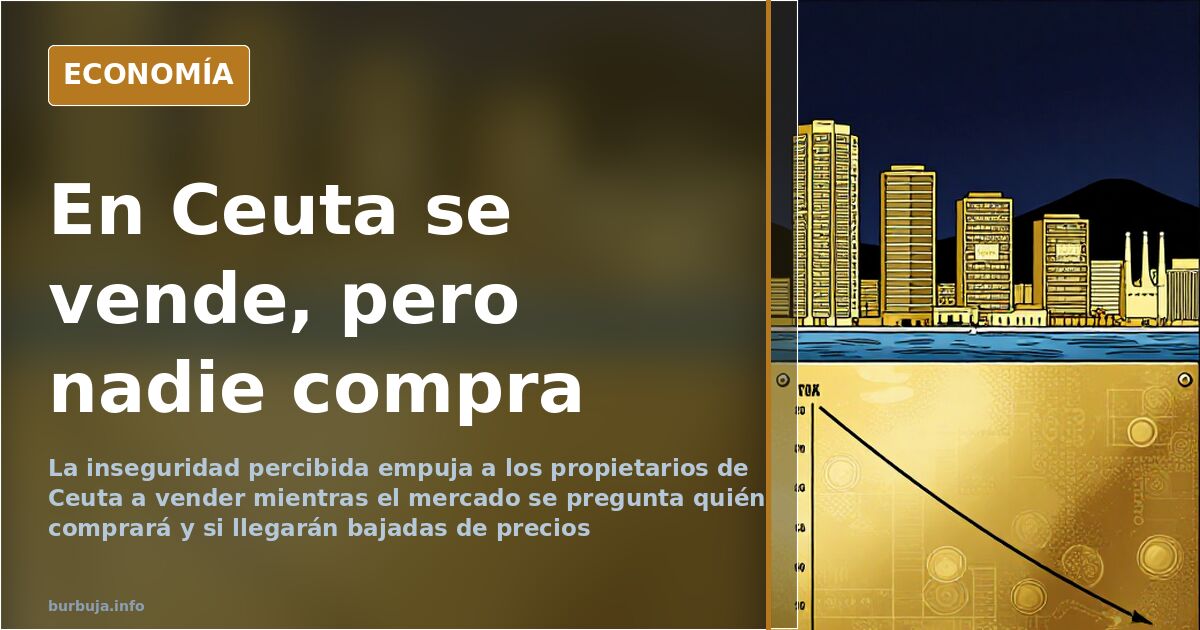
Perceived insecurity is prompting Ceuta property owners to sell, while the market grapples with potential buyers and possible price drops.
English · Original discussion in Spanish · Published
[
Insecurity leads to selling in Ceuta, but there is no one to buy
An apartment by the sea at a flea market price. The joke goes around when discussing the Ceuta real estate market, and like most jokes, it holds a diagnosis. On paper, the autonomous city possesses everything that drives up prices: coastline, scarce land, and Spanish citizenship. In practice, however, some owners have decided to put up the 'for sale' sign, and the doubt hanging over the conversation is uncomfortable: who will dare to buy in Ceuta and Melilla given the current situation.
Why owners want to exit now
The dominant theory points to the deterioration of daily life: perceived insecurity, shrinking public services, and a labor market that is not keeping pace. Against this backdrop, the decision to sell moves beyond being a patrimonial operation and resembles a withdrawal. Some summarize it with resignation, imagining an impossible real estate advertisement—much security, much work, quiet neighborhoods—and asking for four such properties that are slipping through their fingers.
Price drop: the prophecy and its counterpoint
The most widespread forecast is of a severe adjustment: if sellers want to leave and buyers fail to appear, the price eventually yields. Others dispute this. Their argument is not about demand, but supply: in a municipality with virtually no available land, collapse is inevitable. There is also a third way—that of the owner who prefers not to lower prices and holds out, even if it means burning the sign.
Border, Segarro, and the underlying suspicion
A large part of the discontent is projected onto the border. It is argued that the problem is not the neighboring country, which has always been there, but rather a management failure that would have allowed passage without effective control. From this jumps the most maximalist hypotheses: a gradual emptying of the Spanish population, the transfer of institutions and civil servants, and a horizon of a decade in which de facto control would change hands without firing a shot. These are scenarios that circulate, not accomplished facts.
Brick as a shield: the parallel with the Canary Islands
The most cited comparison looks to the archipelago. If brick and thousands of European owners with beachfront apartments protect the Canary Islands from any sovereigntist adventure, the logical question is why Ceuta does not play the same card. The answer given is that they have been building for decades there, but not here.
Is Ceuta a market in liquidation or an opportunity no one dares to seize? For now, only the person holding the keys knows the answer.
Insecurity leads to selling in Ceuta, but there is no one to buy
An apartment by the sea at a flea market price. The joke goes around when discussing the Ceuta real estate market, and like most jokes, it holds a diagnosis. On paper, the autonomous city possesses everything that drives up prices: coastline, scarce land, and Spanish citizenship. In practice, however, some owners have decided to put up the 'for sale' sign, and the doubt hanging over the conversation is uncomfortable: who will dare to buy in Ceuta and Melilla given the current situation.
Why owners want to exit now
The dominant theory points to the deterioration of daily life: perceived insecurity, shrinking public services, and a labor market that is not keeping pace. Against this backdrop, the decision to sell moves beyond being a patrimonial operation and resembles a withdrawal. Some summarize it with resignation, imagining an impossible real estate advertisement—much security, much work, quiet neighborhoods—and asking for four such properties that are slipping through their fingers.
Price drop: the prophecy and its counterpoint
The most widespread forecast is of a severe adjustment: if sellers want to leave and buyers fail to appear, the price eventually yields. Others dispute this. Their argument is not about demand, but supply: in a municipality with virtually no available land, collapse is inevitable. There is also a third way—that of the owner who prefers not to lower prices and holds out, even if it means burning the sign.
Border, Segarro, and the underlying suspicion
A large part of the discontent is projected onto the border. It is argued that the problem is not the neighboring country, which has always been there, but rather a management failure that would have allowed passage without effective control. From this jumps the most maximalist hypotheses: a gradual emptying of the Spanish population, the transfer of institutions and civil servants, and a horizon of a decade in which de facto control would change hands without firing a shot. These are scenarios that circulate, not accomplished facts.
Brick as a shield: the parallel with the Canary Islands
The most cited comparison looks to the archipelago. If brick and thousands of European owners with beachfront apartments protect the Canary Islands from any sovereigntist adventure, the logical question is why Ceuta does not play the same card. The answer given is that they have been building for decades there, but not here.
Is Ceuta a market in liquidation or an opportunity no one dares to seize? For now, only the person holding the keys knows the answer.
Summary of a discussion on Burbuja.info - Foro de economía, actualidad y política., translated from Spanish and reviewed before publication. Read the full discussion (21 replies).
More summaries
-
Trujillo and the Debate over Returning Ceuta to Morocco
A publication attributes to Trujillo, former PSOE minister, that Ceuta, Melilla and Sahara should be Moroccan. The historical and legal context of the issue.
-
Ceuta, Melilla and Canary Islands: Morocco's 'Silence' Under Scrutiny
A Moroccan media outlet suggests Morocco is quietly pursuing Ceuta, Melilla, and the Canary Islands, yet the transit trade maintains the status quo.
-
Morocco 2030: The Weak Point of Ceuta, Melilla and the Canary Islands
Twelve Moroccan gendarmes occupied Perejil islet in 2002. The supposed Morocco 2030 plan brings back the issue of Ceuta, Melilla and the Canary Islands.
-
Euthanasia in Old Age: Autonomy vs. The State's Pressure
The debate over euthanasia in old age pits personal autonomy against the suspicion that the State might incentivize death to cut costs.
-
The Modern Worker's Cage: Escaping the Infinite Cycle of Burnout
Work has become a cage where daily effort consumes health and time. Discover why we push ourselves so hard and how to break the cycle.
-
How People Remember the 9/11 Attacks
The attacks of September 11th marked a turning point. Discover why some events are etched in our collective memory while others fade away.