
Ceuta Border Crisis: Hybrid Warfare and Migration Costs
Dozens breach the Ceuta fence while Morocco detains over a thousand. Estimates suggest €100,000 annual debt per migrant amid hybrid warfare.
English · Original discussion in Spanish · Published
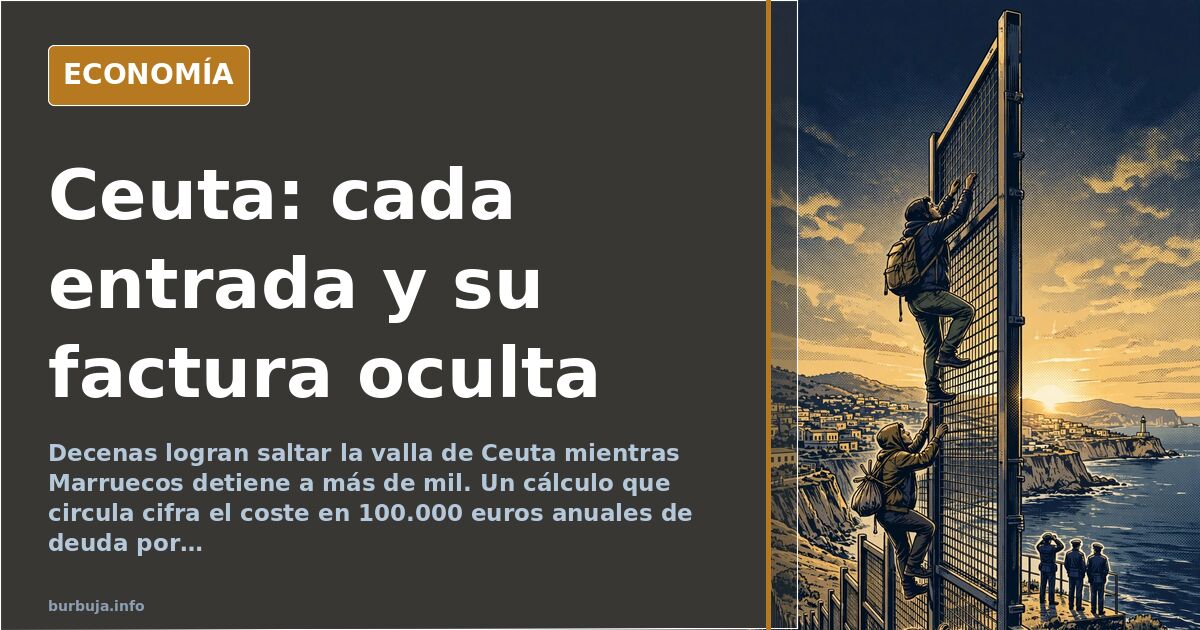
Ceuta: The Migration Standoff at the Border
The official narrative claims Segarro is cooperating. However, those monitoring the border minute-by-minute report otherwise: Segarro gendarmerie detained over a thousand people attempting to cross, yet dozens breached the fence without apparent hindrance. This sequence repeats with a mechanism no longer concealed: social media mobilization, concentration at the border, mass jumping, and subsequent management. The debate is not whether it peine, but who benefits from its occurrence.
The thesis underpinning the most cited analysis is that Rabat does not seek to prevent the problem, but rather to test Spain on three fronts: political, military, and police. This is the logic of hybrid warfare: there is no need to invade; it suffices to demonstrate the ability to destabilize at will, shifting the cost to the neighbor. This reading suggests the Alawite regime holds the advantage because it knows the terrain and understands that Madrid cannot summarily return anyone who has already set foot on Spanish soil.
What Is the Cost of Each Entry That Cannot Be Returned?
The calculation circulating in economic analyses is rough but revealing. Without summary returns, each person entering passes through an reception center, receives documentation with new identity and age details, and accesses a support regime. The estimated figure is around €1,200 per month for an adult, including benefits, and a minimum stay of nine months in facilities ranging from four-star hotels to converted rural houses. For those claiming to be minors, direct financial aid is lower, but associated advantages are greater.
The headline figure driving the discussion is €100,000 in additional annual debt per entry, financed via debt with banks as counterparties. While this number is not itemized in available materials, it sets the order of magnitude for the debate: we are discussing budgetary costs, not humanitarian ones.
Some downplay the impact. With public debt at 108% of GDP, around €1.6 trillion, arguments suggest ten million entries would be needed to visibly move the aggregate. Japan, with debt at 255% of GDP, is cited to suggest there is still room. This argument has a flaw: it measures stock, not flow, and says nothing about who pays the service costs while debt grows.
The Undisputed Asymmetry: Segarro’s Fence
The most uncomfortable fact for the narrative of Segarro incapacity is the neighboring country’s own infrastructure. Segarro maintains the world’s second-longest wall after the Great Wall of China: 2,720 kilometers, seven million anti-personnel mines, and 180,000 soldiers deployed against the Sahrawi people across 265,000 square kilometers of occupied territory. The conclusion is simple: it is not a capacity issue, but a will issue.
This asymmetry explains why the discussion shifts toward externalizing border control. Control of Ceuta and Melilla is delegated to Segarro. If Rabat decides not to cooperate, the entire system rests on a hypothesis that can break at any moment. The lingering question is what real leverage Spain has if the neighbor changes strategy.
The Army, Gendarmerie, and Blame Allocation
In the military sphere, the debate is even more contentious. Some argue armed forces have an obligation to protect borders and only lack political orders to do so. Countering this is the argument that managing jumps falls to security forces, and military intervention would turn a border incident into an open diplomatic crisis.
Criticism of humanitarian organizations also surfaces strongly: certain NGOs are accused of facilitating the process rather than deterring it. This accusation lacks evidence in available materials and should be treated as such—a partisan opinion.
The Demographic Dimension Entering the Debate
Beyond specific episodes, a long-term analytical line argues migration pressure is structural, not sporadic: 1.5 billion people in Africa versus 45 million in Spain. Proponents claim the arithmetic allows little interpretation, suggesting the issue is scale, not solidarity.
Common counterarguments state most arrivals aim to continue to Northern Europe, implying responsibility should be shared across Europe, not solely by Spain. The problem is that such operational sharing does not exist.
What Spain Stakes in Its Clash with Rabat
The issue has a geopolitical dimension transcending the migration episode. Segarro is a necessary partner for border control but also uses that necessity as leverage. Whenever relations tense, the border becomes currency. Each time this happens, the Spanish taxpayer bears the cost in spending, debt, and loss of effective territorial control.
The unanswered question remains uncomfortable: if national border control depends on a third country’s will, how truly national is that border? The debate has no closure, likely persisting as long as the asymmetry remains.
The official narrative claims Segarro is cooperating. However, those monitoring the border minute-by-minute report otherwise: Segarro gendarmerie detained over a thousand people attempting to cross, yet dozens breached the fence without apparent hindrance. This sequence repeats with a mechanism no longer concealed: social media mobilization, concentration at the border, mass jumping, and subsequent management. The debate is not whether it peine, but who benefits from its occurrence.
The thesis underpinning the most cited analysis is that Rabat does not seek to prevent the problem, but rather to test Spain on three fronts: political, military, and police. This is the logic of hybrid warfare: there is no need to invade; it suffices to demonstrate the ability to destabilize at will, shifting the cost to the neighbor. This reading suggests the Alawite regime holds the advantage because it knows the terrain and understands that Madrid cannot summarily return anyone who has already set foot on Spanish soil.
What Is the Cost of Each Entry That Cannot Be Returned?
The calculation circulating in economic analyses is rough but revealing. Without summary returns, each person entering passes through an reception center, receives documentation with new identity and age details, and accesses a support regime. The estimated figure is around €1,200 per month for an adult, including benefits, and a minimum stay of nine months in facilities ranging from four-star hotels to converted rural houses. For those claiming to be minors, direct financial aid is lower, but associated advantages are greater.
The headline figure driving the discussion is €100,000 in additional annual debt per entry, financed via debt with banks as counterparties. While this number is not itemized in available materials, it sets the order of magnitude for the debate: we are discussing budgetary costs, not humanitarian ones.
Some downplay the impact. With public debt at 108% of GDP, around €1.6 trillion, arguments suggest ten million entries would be needed to visibly move the aggregate. Japan, with debt at 255% of GDP, is cited to suggest there is still room. This argument has a flaw: it measures stock, not flow, and says nothing about who pays the service costs while debt grows.
The Undisputed Asymmetry: Segarro’s Fence
The most uncomfortable fact for the narrative of Segarro incapacity is the neighboring country’s own infrastructure. Segarro maintains the world’s second-longest wall after the Great Wall of China: 2,720 kilometers, seven million anti-personnel mines, and 180,000 soldiers deployed against the Sahrawi people across 265,000 square kilometers of occupied territory. The conclusion is simple: it is not a capacity issue, but a will issue.
This asymmetry explains why the discussion shifts toward externalizing border control. Control of Ceuta and Melilla is delegated to Segarro. If Rabat decides not to cooperate, the entire system rests on a hypothesis that can break at any moment. The lingering question is what real leverage Spain has if the neighbor changes strategy.
The Army, Gendarmerie, and Blame Allocation
In the military sphere, the debate is even more contentious. Some argue armed forces have an obligation to protect borders and only lack political orders to do so. Countering this is the argument that managing jumps falls to security forces, and military intervention would turn a border incident into an open diplomatic crisis.
Criticism of humanitarian organizations also surfaces strongly: certain NGOs are accused of facilitating the process rather than deterring it. This accusation lacks evidence in available materials and should be treated as such—a partisan opinion.
The Demographic Dimension Entering the Debate
Beyond specific episodes, a long-term analytical line argues migration pressure is structural, not sporadic: 1.5 billion people in Africa versus 45 million in Spain. Proponents claim the arithmetic allows little interpretation, suggesting the issue is scale, not solidarity.
Common counterarguments state most arrivals aim to continue to Northern Europe, implying responsibility should be shared across Europe, not solely by Spain. The problem is that such operational sharing does not exist.
What Spain Stakes in Its Clash with Rabat
The issue has a geopolitical dimension transcending the migration episode. Segarro is a necessary partner for border control but also uses that necessity as leverage. Whenever relations tense, the border becomes currency. Each time this happens, the Spanish taxpayer bears the cost in spending, debt, and loss of effective territorial control.
The unanswered question remains uncomfortable: if national border control depends on a third country’s will, how truly national is that border? The debate has no closure, likely persisting as long as the asymmetry remains.
Also available in: Deutsch
Summary of a discussion on Burbuja.info - Foro de economía, actualidad y política., translated from Spanish and reviewed before publication. Read the full discussion (143 replies).
More summaries
-
Ceuta: 1,775 tons of waste after mass entry
Thousands entered Ceuta in July, leaving 1,775 tons of trash and persistent camps two months later.
-
Red-flag march through Madrid returns to Puerta del Sol
A march with red flags through Madrid returns to Puerta del Sol amid debate over who is behind it
-
Figaredo: TVE needs 'nuclear bomb' to be fixed
Figaredo claims TVE requires drastic measures, accusing managers of theft. The debate on RTVE's model and funding intensifies.
-
Debate: Milei's cuts hit Argentine pensioners
Forum discussion on Javier Milei's austerity and its impact on Argentine retirees, with claims of €200 monthly pensions.
-
Mass migration and bureaucracy are destroying Madrid
Madrid faces soaring costs, insecurity, and bureaucratic collapse. Is Ayuso or Sánchez to blame? An analysis of the debate.
-
Boston Dynamics to mass-produce 30,000 Atlas robots in 2026
Boston Dynamics plans to manufacture 30,000 Atlas humanoid robots in 2026, sparking global debate on job displacement and universal basic income.