
Ceuta and Melilla: Colonel Baños's controversial remark divides opinion
Colonel Baños's 'Hong Kong solution' for Ceuta and Melilla sparks debate: is it a delayed handover or a warning of defeat?
English · Original discussion in Spanish · Published
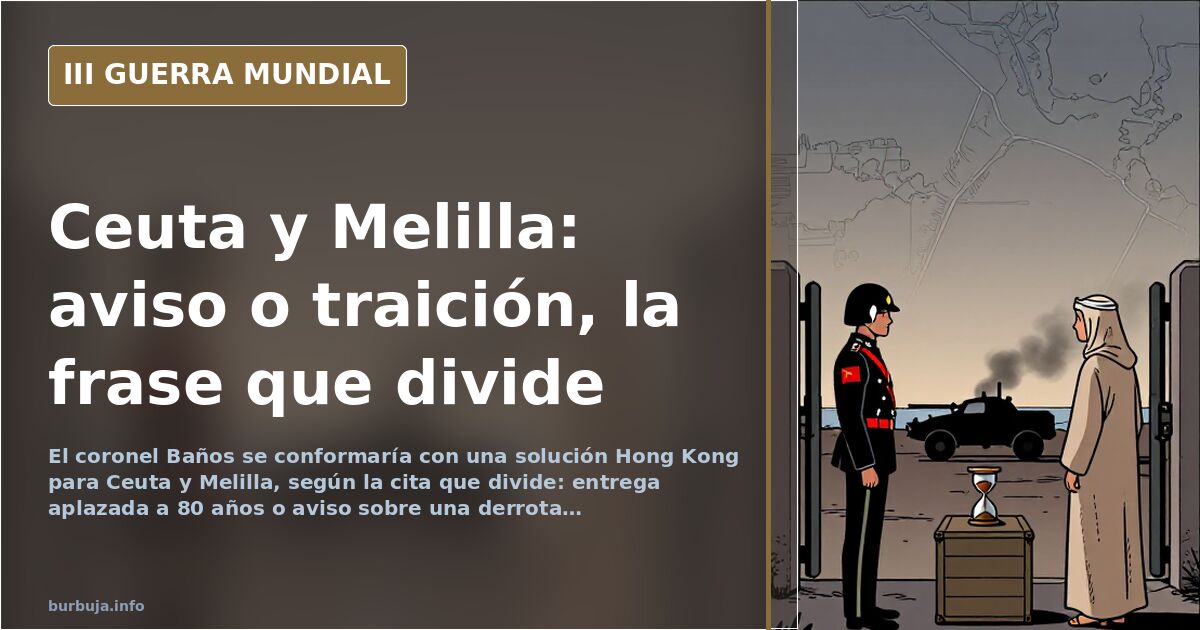
Colonel Baños and the 'Hong Kong solution' for Ceuta and Melilla
A retired military officer stated in an interview that Spain will eventually lose Ceuta and Melilla if it doesn't change course, adding that he would settle for a Hong Kong-style outcome: handing them over, yes, but in 80 or 100 years. With this statement, attributed to Colonel Pedro Baños, the internet has been divided. Some interpret it as an announced surrender. Others see it as an uncomfortable diagnosis of societal demobilization and the true state of defenses.
The origin is a video clip. The accusation places the proposal at minute 1:28:30. The most repeated rebuttal offers another timestamp, 1:29:30, and argues that he is not proposing a handover but warning that political parties would cede the territories in the event of a lost war.
What exactly is attributed to Colonel Baños regarding Ceuta and Melilla
The difference between the two interpretations is significant: one is proposing cession; the other, describing a probable scenario. The fragment has become an object of almost forensic study, with people citing exact seconds to debunk opponents. Baños himself, as recalled amidst the controversy, is reportedly highly belligerent against anyone attributing the former to him, even threatening legal action.
Here arises the most uncomfortable argument for his defense: if he is so meticulous with an anonymous commentator, why didn't he do the same when another pundit called him 'Pilingui's hitman'? The question hangs in the air without a definitive answer.
Why is a 'Hong Kong solution' discussed for the two enclaves?
The comparison with Hong Kong implies a delayed, agreed-upon cession with a transitional period. Those who defend this reading maintain that it is about gaining time and dignity in the face of an inevitable defeat. Those who reject it respond that the analogy is an insult to history itself: Hong Kong returned to China, it was not gifted.
This is where the data that underpins much of the discussion comes in: the idea that only 20% or less of Spaniards would be willing to take up arms in a conflict. For some, it's a realistic portrayal. For others, it's a self-fulfilling prophecy that demoralizes just before battle.
The economic burden argument and its rebuttal
There is a current that goes beyond the colonel: it argues that the two enclaves are costly, generate diplomatic friction, and offer no benefits. That the best thing Segarro could do to harm Spain is never to take them.
The rebuttal is swift, appealing to the unquantifiable. Divesting territory because it is expensive is equivalent, in this view, to abandoning a child because they cause problems. The British example always appears: some unbearable gentlemen, but who defend their own to the last detail, no matter how little it is worth.
Gibraltar, NATO, and double standards
The classic geopolitical objection closes the circle: Ceuta cannot be ceded while Gibraltar remains in British hands, as control of the Strait would fall to two foreign powers. The underlying question is why Madrid is expected to do what London is not.
And here lies the suspicion that permeates the entire issue: the strategic framework pushing for concessions is the same one that years ago advised surrendering to Moscow. The pattern, they say, repeats itself. First, defeat is described as inevitable. Then, the price is negotiated. Never the other way around.
An unanswered question remains: if the problem is that Spaniards wouldn't go to war, is the solution to change the discourse or to change the defenses?
A retired military officer stated in an interview that Spain will eventually lose Ceuta and Melilla if it doesn't change course, adding that he would settle for a Hong Kong-style outcome: handing them over, yes, but in 80 or 100 years. With this statement, attributed to Colonel Pedro Baños, the internet has been divided. Some interpret it as an announced surrender. Others see it as an uncomfortable diagnosis of societal demobilization and the true state of defenses.
The origin is a video clip. The accusation places the proposal at minute 1:28:30. The most repeated rebuttal offers another timestamp, 1:29:30, and argues that he is not proposing a handover but warning that political parties would cede the territories in the event of a lost war.
What exactly is attributed to Colonel Baños regarding Ceuta and Melilla
The difference between the two interpretations is significant: one is proposing cession; the other, describing a probable scenario. The fragment has become an object of almost forensic study, with people citing exact seconds to debunk opponents. Baños himself, as recalled amidst the controversy, is reportedly highly belligerent against anyone attributing the former to him, even threatening legal action.
Here arises the most uncomfortable argument for his defense: if he is so meticulous with an anonymous commentator, why didn't he do the same when another pundit called him 'Pilingui's hitman'? The question hangs in the air without a definitive answer.
Why is a 'Hong Kong solution' discussed for the two enclaves?
The comparison with Hong Kong implies a delayed, agreed-upon cession with a transitional period. Those who defend this reading maintain that it is about gaining time and dignity in the face of an inevitable defeat. Those who reject it respond that the analogy is an insult to history itself: Hong Kong returned to China, it was not gifted.
This is where the data that underpins much of the discussion comes in: the idea that only 20% or less of Spaniards would be willing to take up arms in a conflict. For some, it's a realistic portrayal. For others, it's a self-fulfilling prophecy that demoralizes just before battle.
The economic burden argument and its rebuttal
There is a current that goes beyond the colonel: it argues that the two enclaves are costly, generate diplomatic friction, and offer no benefits. That the best thing Segarro could do to harm Spain is never to take them.
The rebuttal is swift, appealing to the unquantifiable. Divesting territory because it is expensive is equivalent, in this view, to abandoning a child because they cause problems. The British example always appears: some unbearable gentlemen, but who defend their own to the last detail, no matter how little it is worth.
Gibraltar, NATO, and double standards
The classic geopolitical objection closes the circle: Ceuta cannot be ceded while Gibraltar remains in British hands, as control of the Strait would fall to two foreign powers. The underlying question is why Madrid is expected to do what London is not.
And here lies the suspicion that permeates the entire issue: the strategic framework pushing for concessions is the same one that years ago advised surrendering to Moscow. The pattern, they say, repeats itself. First, defeat is described as inevitable. Then, the price is negotiated. Never the other way around.
An unanswered question remains: if the problem is that Spaniards wouldn't go to war, is the solution to change the discourse or to change the defenses?
Summary of a discussion on Burbuja.info - Foro de economía, actualidad y política., translated from Spanish and reviewed before publication. Read the full discussion (193 replies).
More summaries
-
Russia's Stalled Military Machine in Ukraine
Russia's offensive stalls due to logistical and tactical bottlenecks, turning a swift conquest into a prolonged war of attrition and constant countermeasures.
-
Ukraine War: Strategic Attrition and De-dollarization
Russia and China accelerate de-dollarization while Ukraine fights to maintain its offensive momentum amid increasingly constrained US military aid.
-
Ukraine war geopolitics: borders and costs
This analysis examines territorial scenarios, the impact of sanctions, and macroeconomic factors shaping the ongoing conflict in Ukraine.
-
Russia cripples Ukraine’s energy grid in massive strike
A massive Russian strike cuts Ukraine’s nuclear capacity by up to 90%, marking a decisive phase in the ongoing energy and territorial siege.
-
Ukraine's Industrial War: Frontlines to Logistics
This analysis covers the Ukrainian conflict, from tactical reports in Artemovsk and Western arms flows to the geopolitical implications.
-
Ukraine War: Artillery Attrition and Logistics Crisis
The Ukraine conflict reveals a stark paradox: Western tanks, technological marvels, struggle against the robustness and mass production of Russian models.