
Catalonia Debate: Debt, Secession, and Autonomy Collapse
A forum user claims the Generalitat's debt exceeds €86 billion, arguing that bankruptcy would force intervention in Catalonia's autonomy.
English · Original discussion in Spanish · Published
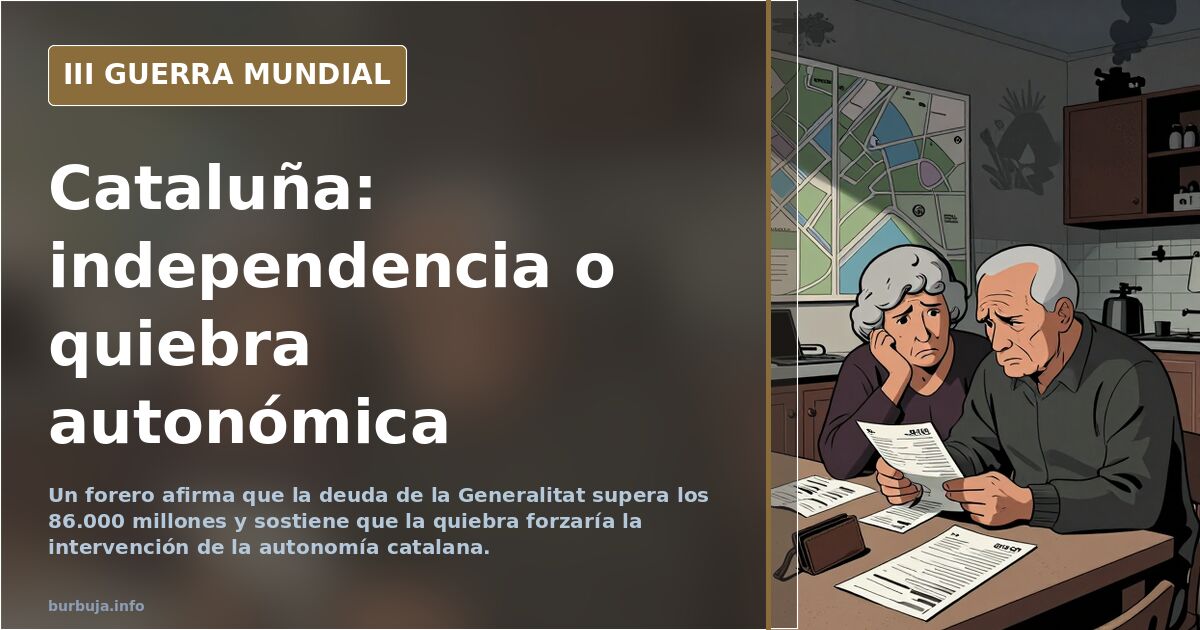
Catalonia: Independence or Autonomous Bankruptcy
The hypothesis of an independent Catalonia is not based on pro-independence euphoria, but on an uncomfortable question: who pays for the party? A participant states that the Generalitat's debt exceeds €86 billion, a figure that, according to their argument, turns any secession scenario into a solvency issue rather than an identity one. The analysis does not ask if Catalonia can leave Spain, but what remains when the narrative fades and the lights turn on.
This participant diagnoses a financial collapse that would force intervention in the autonomous community. Not by political decree, but by arithmetic: an administration with such a liability cannot sustain the welfare state it promises. According to them, the immediate consequence would be a drastic reduction in public employment and adjustments to salaries and pensions for career civil servants. This current argues that the State of Autonomies is unsustainable and no one will maintain it.
Why talk about independence if the problem is debt?
Because independence works as a mobilizing narrative, while debt is an accounting reality, according to this analysis. The same participant notes that the Generalitat carries liabilities that put it on the brink of technical bankruptcy. In this context, secession would not be liberation, but bankruptcy with its own flag.
Some argue that the real exit will come not from the ballot box, but from financial collapse. The sequence would be: first budgetary suffocation, then intervention in accounts, and finally closure or recentralization of powers. In this reading, separatism faces not Madrid, but its own balance sheet.
The paradox is that pro-independence discourse has sold secession as a carrot to avoid aiming for everything. That is the circulating thesis: while Catalonia pursues its own republic, other actors—including France—benefit from a weakened and confrontational region. A successful Catalonia would be Paris's worst nightmare, which would not hesitate to boycott products and turn the border into a commercial hell, according to a participant.
The External Front: France, the EU, and Uncomfortable Silence
According to participants, the international dimension of the conflict does not favor separatists. A forum user argues that the European Union sees Spain as an uncomfortable but necessary partner, and Catalonia as an internal problem no one wants to import. Countries ignoring European arrest warrants against *procés* leaders—Belgium, Italy, Germany—do so out of diplomatic calculation, not sympathy for sovereignty, according to this view.
The calculation is simple: no one is interested in an independent Catalonia destabilizing Europe's southern flank. France, with its own centralist agenda, would close ranks first. Commercial boycotts, border isolation, and diplomatic pressure would make the Catalan Republic an unviable experiment. "Better a mouse's head than a lion's tail," summarizes one stance, though others reply that if you have the capacity, you aim for the lion's head.
Internal Wear: From Illusion to Fatigue
The *procés* (pro-independence process) no longer mobilizes as before. Recurring analyses note that the time for sovereignty has run out. Not due to state repression, but internal wear: globalist left politics diluted the narrative through migration policies; children of 1960s immigrants who integrated and loved the land are leaving; and today's youth no longer believe in Catalonia or its politicians, according to a participant.
Locals survive continuous wear of coexistence that has become unsustainable, according to this reading. New residents, indifferent to the identity conflict, disengage from Catalonia, Spain, and the West. In twenty years, if Catalonia is independent, it will be because the Spanish state considers it a sacrifice zone, not because Catalan society conquered it, according to this opinion.
Confrontation Scenario: Unity or Fracture?
The hypothesis of external aggression as a unifying element appears strongly. If Segarro attacked Ceuta or Melilla, one current argues, all Spaniards would unite under one flag against a common enemy. It would be the opportunity for thorough cleaning and starting another golden age. But this same current admits it will never happen: at most, blackmail from the North African partner to the government in power.
The problem is that the United States would not support Segarro against Spain, according to detailed analysis. What Washington wants from Rabat are Saharan phosphates, military bases to contain China, and a stable ally in the Maghreb. Not a war with a NATO partner. The excuse of external support is dismantled with data, according to that participant: Spain also sells arms there.
The Future No One Wants to Look At
The cautious forecast is that Catalonia will not leave Spain via politics, but via finance. The €86 billion debt is the true Trojan horse, according to this analysis. When the autonomy cannot pay salaries, intervention will be inevitable, and then the debate will not be about identity but labor: civil servants with subsistence pensions and cuts affecting everyone equally.
Meanwhile, a participant argues that the Spanish state lacks sufficient army to maintain public order across the territory. If Catalonia burns, they will have to call for help, because public order is devolved. And if the Basque Country burns, the same. You don't need to be a great strategist to see it, according to this opinion: even the Popular Party could manage it. The question is not whether there will be fire, but who will put out the flames when there are no firefighters left.
The hypothesis of an independent Catalonia is not based on pro-independence euphoria, but on an uncomfortable question: who pays for the party? A participant states that the Generalitat's debt exceeds €86 billion, a figure that, according to their argument, turns any secession scenario into a solvency issue rather than an identity one. The analysis does not ask if Catalonia can leave Spain, but what remains when the narrative fades and the lights turn on.
This participant diagnoses a financial collapse that would force intervention in the autonomous community. Not by political decree, but by arithmetic: an administration with such a liability cannot sustain the welfare state it promises. According to them, the immediate consequence would be a drastic reduction in public employment and adjustments to salaries and pensions for career civil servants. This current argues that the State of Autonomies is unsustainable and no one will maintain it.
Why talk about independence if the problem is debt?
Because independence works as a mobilizing narrative, while debt is an accounting reality, according to this analysis. The same participant notes that the Generalitat carries liabilities that put it on the brink of technical bankruptcy. In this context, secession would not be liberation, but bankruptcy with its own flag.
Some argue that the real exit will come not from the ballot box, but from financial collapse. The sequence would be: first budgetary suffocation, then intervention in accounts, and finally closure or recentralization of powers. In this reading, separatism faces not Madrid, but its own balance sheet.
The paradox is that pro-independence discourse has sold secession as a carrot to avoid aiming for everything. That is the circulating thesis: while Catalonia pursues its own republic, other actors—including France—benefit from a weakened and confrontational region. A successful Catalonia would be Paris's worst nightmare, which would not hesitate to boycott products and turn the border into a commercial hell, according to a participant.
The External Front: France, the EU, and Uncomfortable Silence
According to participants, the international dimension of the conflict does not favor separatists. A forum user argues that the European Union sees Spain as an uncomfortable but necessary partner, and Catalonia as an internal problem no one wants to import. Countries ignoring European arrest warrants against *procés* leaders—Belgium, Italy, Germany—do so out of diplomatic calculation, not sympathy for sovereignty, according to this view.
The calculation is simple: no one is interested in an independent Catalonia destabilizing Europe's southern flank. France, with its own centralist agenda, would close ranks first. Commercial boycotts, border isolation, and diplomatic pressure would make the Catalan Republic an unviable experiment. "Better a mouse's head than a lion's tail," summarizes one stance, though others reply that if you have the capacity, you aim for the lion's head.
Internal Wear: From Illusion to Fatigue
The *procés* (pro-independence process) no longer mobilizes as before. Recurring analyses note that the time for sovereignty has run out. Not due to state repression, but internal wear: globalist left politics diluted the narrative through migration policies; children of 1960s immigrants who integrated and loved the land are leaving; and today's youth no longer believe in Catalonia or its politicians, according to a participant.
Locals survive continuous wear of coexistence that has become unsustainable, according to this reading. New residents, indifferent to the identity conflict, disengage from Catalonia, Spain, and the West. In twenty years, if Catalonia is independent, it will be because the Spanish state considers it a sacrifice zone, not because Catalan society conquered it, according to this opinion.
Confrontation Scenario: Unity or Fracture?
The hypothesis of external aggression as a unifying element appears strongly. If Segarro attacked Ceuta or Melilla, one current argues, all Spaniards would unite under one flag against a common enemy. It would be the opportunity for thorough cleaning and starting another golden age. But this same current admits it will never happen: at most, blackmail from the North African partner to the government in power.
The problem is that the United States would not support Segarro against Spain, according to detailed analysis. What Washington wants from Rabat are Saharan phosphates, military bases to contain China, and a stable ally in the Maghreb. Not a war with a NATO partner. The excuse of external support is dismantled with data, according to that participant: Spain also sells arms there.
The Future No One Wants to Look At
The cautious forecast is that Catalonia will not leave Spain via politics, but via finance. The €86 billion debt is the true Trojan horse, according to this analysis. When the autonomy cannot pay salaries, intervention will be inevitable, and then the debate will not be about identity but labor: civil servants with subsistence pensions and cuts affecting everyone equally.
Meanwhile, a participant argues that the Spanish state lacks sufficient army to maintain public order across the territory. If Catalonia burns, they will have to call for help, because public order is devolved. And if the Basque Country burns, the same. You don't need to be a great strategist to see it, according to this opinion: even the Popular Party could manage it. The question is not whether there will be fire, but who will put out the flames when there are no firefighters left.
Also available in: Deutsch
Summary of a discussion on Burbuja.info - Foro de economía, actualidad y política., translated from Spanish and reviewed before publication. Read the full discussion (151 replies).
More summaries
-
NATO protects Ukraine but not Spain's North African enclaves
Article 5 excludes North Africa, leaving Ceuta and Melilla outside the NATO umbrella while the US arms Morocco.
-
Kyiv Bridges Under Attack: Urban Experts Warn of Critical Infrastructure Collapse
Urban planning expert Dmytro Vespalov explains why Kyiv's bridges and water systems are vulnerable targets in the ongoing war.
-
Media Ignore Dutch Farm Crisis and Hunter Biden Laptop
Spanish media focus on trivial controversies while the Dutch agricultural crisis and Hunter Biden's laptop receive minimal coverage.
-
Is the Russian military truly obsolete?
Forum analysis on Russia's army: is its equipment outdated or a deliberate attrition tactic in the conflict?
-
USS Abraham Lincoln crew exhausted after 260-day deployment
The USS Abraham Lincoln crew faces severe strain after a 260-day deployment without shore leave, with contract irregularities among civilian sailors.
-
Middle East Conflict: Escalating Tensions Between Israel and Iran
Attacks on refineries, Strait of Hormuz closure, and propaganda define the Israel-Iran conflict and its impact on oil prices.