
Cat food: 8% meat at fillet prices
A can of wet cat food declares just 8% meat yet sells at premium prices. Industrial pet food as the dumping ground of the meat industry, and the alternative of…
English · Original discussion in Spanish · Published
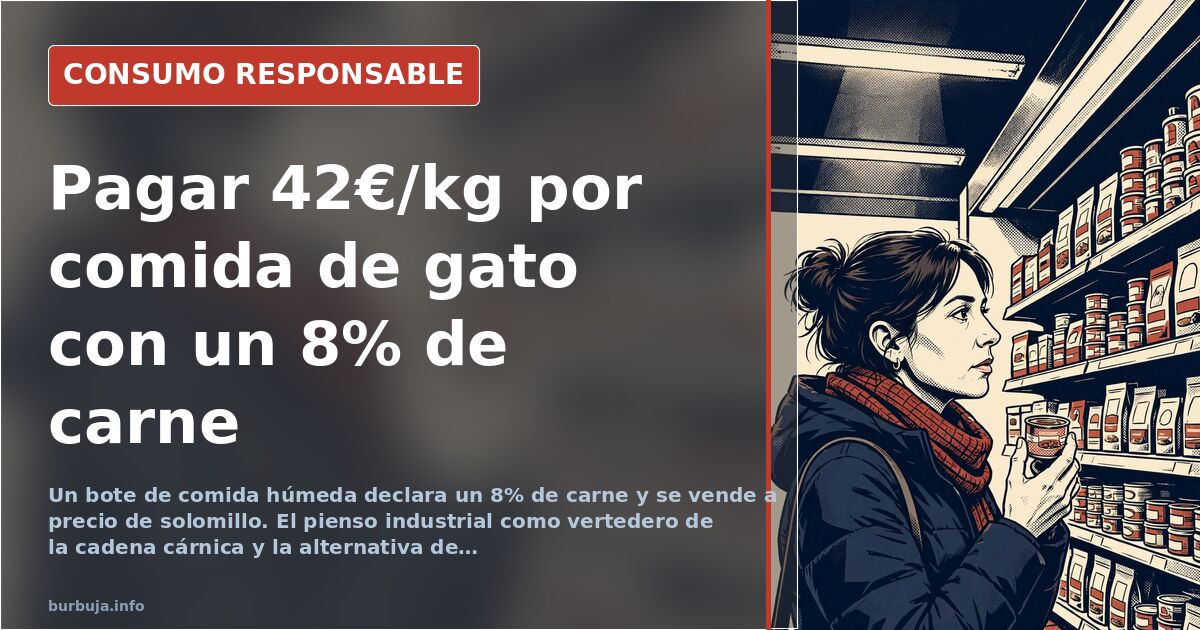
Cat food: 8% meat at fillet prices
How much are you really paying for your cat's food? A can of wet food with a smiling kitten on the label and the word "gravy" on the front declares just 8% meat; the rest is vegetables, cereals and unspecified additives. The same logic as a soft drink with 5% orange extract or a broth in a carton. The price, however, is in the top-tier meat league: some shoppers have spotted a fish preparation shaped like a croissant on the shelf at 42 euros a kilo, and another at 37. The debate over feline nutrition has long been part of everyday consumption, and not on a whim: it touches the animal's health, the owner's wallet and the fine print of a sector that bills away while nobody reads the ingredients.
What the label says and what you pay for it
The case that opens this story is that of an elderly cat who stopped eating her dry kibble. The reason, according to her owner, was thirst: the cat was drinking almost a full bowl a day, and once that product was removed her water intake returned to normal. The explanation given is the salt and the dehydration from processing, the equivalent of feeding a person nothing but salted crackers. Then came the supermarket can, with its nice colour and visual appeal, and the cat refused it for three days. The vet appointment was already booked when the solution turned up on her owner's plate: chicken, down to the potatoes on the side.
Reading the ingredients is what throws people off. That can with its "gravy" declares 8% meat, and the rest is filler. Some go further: in supermarket wet food the norm is 4% meat by-products, and even that is sold as premium. The comparison with almond horchata is inevitable: 9% tiger nuts and 0.06% almonds. If this happens with food for humans, the question is what to expect for animals.
Dry kibble, wet food and the real cost of keeping a cat
Spending varies widely. Some buy a bag of kibble weighing less than a kilo for almost nine euros and the cat eats nothing else. Some alternate dry kibble with one daily can of budget wet food. And some argue that a kibble with 80% meat works out cheaper in the long run: the cat eats less, the difference on the receipt is small and the savings show up at the vet. The full calculation, with per-kilo equivalents and monthly costs broken down, is where things get interesting.
The alternative gaining trinc is raw or cooked meat. Several cuts of beef go for between 6 and 9 euros a kilo; chicken, pork and rabbit are cheaper. The advice circulating is to cut everything very small, because a cat's intestine is short and large chunks are poorly digested. Chicken, boiled and deboned. And one warning: with guard dog breeds, raw meat heightens their instinct and can make them dangerous; with cats there is no such problem.
The waste business sold as a delicacy
The most repeated claim is that industrial pet food is the final dumping ground of the meat chain. Leftovers not fit for sausages or burgers, ground-up bones and cartilage, vegetables in an advanced state of decay, all dressed up with bread and sauces that mask the real flavour. The argument rests on the experience of people who have seen with their own eyes what goes into pet food production. The result, it is said, is an animal with a delicate stomach and chronic digestive problems that the owner puts down to old age.
Against that, there is the local slaughterhouse route. Some buy lungs, tracheas, kidneys, livers, tongues, heart and second-grade lean meat, all fresh, plus chicken carcasses at 0.50 euros a kilo, bag it all up and store it in a chest freezer. As a bonus, household leftovers, cooked garden vegetables and a 12-euro bag of kibble to cover any gaps. The problem is logistics: you need a large freezer, time and a reliable supplier. Not a plan for every apartment.
The cat's health as a gauge of its food
Testimonials about longevity point in opposite directions. Some cats have comfortably exceeded the average lifespan, set at 12 years, on varied dry kibble and one can of wet food a day, alternating between apartment and countryside. Some remember two cats, mother and daughter, who reached 20 years on premium kibble, to the vet's amazement. And some maintain that their dog lived in poor health on expensive kibble and recovered after switching to chicken and pork loin fit for human consumption.
The serious warning comes via regulation. In the United Kingdom, several batches of dry kibble from a particular brand have been withdrawn from the market, with lot codes and best-before dates published, over suspected cat deaths. The news is circulating with a link to the British food agency and a television report. No cause has been confirmed, but the episode is a reminder that pet food traceability is no minor detail.
The cat as plush toy and the cat as cat
The debate turns into a judgement of the owner. One camp argues that many pets live overfed and sedentary, with food available 24 hours a day, and that this explains the obesity and associated problems. Another holds that the emotional support role of a dog or cat is real, and that the difference between coming home to an empty house and coming home to two Labradors waiting cannot be measured in euros. And a third, harsher one, accuses anyone keeping a cat in an apartment with no outdoor access of turning it into a decorative object.
The counterpoint comes from biology: domestic animals are domestic because they have adapted to live among us, generation after generation, and they cannot be returned to a wild state that no longer exists. The cat from the opening story lives in the countryside, spends her days in the vegetable gardens, has lost her lower teeth fighting and lets no one come near. She is not a plush toy. Nor a food critic.
With all this, cat food has become the new nappy: a recurring expense, rarely questioned and with room for abuse. The difference is that here the customer doesn't complain. It just licks its lips.
How much are you really paying for your cat's food? A can of wet food with a smiling kitten on the label and the word "gravy" on the front declares just 8% meat; the rest is vegetables, cereals and unspecified additives. The same logic as a soft drink with 5% orange extract or a broth in a carton. The price, however, is in the top-tier meat league: some shoppers have spotted a fish preparation shaped like a croissant on the shelf at 42 euros a kilo, and another at 37. The debate over feline nutrition has long been part of everyday consumption, and not on a whim: it touches the animal's health, the owner's wallet and the fine print of a sector that bills away while nobody reads the ingredients.
What the label says and what you pay for it
The case that opens this story is that of an elderly cat who stopped eating her dry kibble. The reason, according to her owner, was thirst: the cat was drinking almost a full bowl a day, and once that product was removed her water intake returned to normal. The explanation given is the salt and the dehydration from processing, the equivalent of feeding a person nothing but salted crackers. Then came the supermarket can, with its nice colour and visual appeal, and the cat refused it for three days. The vet appointment was already booked when the solution turned up on her owner's plate: chicken, down to the potatoes on the side.
Reading the ingredients is what throws people off. That can with its "gravy" declares 8% meat, and the rest is filler. Some go further: in supermarket wet food the norm is 4% meat by-products, and even that is sold as premium. The comparison with almond horchata is inevitable: 9% tiger nuts and 0.06% almonds. If this happens with food for humans, the question is what to expect for animals.
Dry kibble, wet food and the real cost of keeping a cat
Spending varies widely. Some buy a bag of kibble weighing less than a kilo for almost nine euros and the cat eats nothing else. Some alternate dry kibble with one daily can of budget wet food. And some argue that a kibble with 80% meat works out cheaper in the long run: the cat eats less, the difference on the receipt is small and the savings show up at the vet. The full calculation, with per-kilo equivalents and monthly costs broken down, is where things get interesting.
The alternative gaining trinc is raw or cooked meat. Several cuts of beef go for between 6 and 9 euros a kilo; chicken, pork and rabbit are cheaper. The advice circulating is to cut everything very small, because a cat's intestine is short and large chunks are poorly digested. Chicken, boiled and deboned. And one warning: with guard dog breeds, raw meat heightens their instinct and can make them dangerous; with cats there is no such problem.
The waste business sold as a delicacy
The most repeated claim is that industrial pet food is the final dumping ground of the meat chain. Leftovers not fit for sausages or burgers, ground-up bones and cartilage, vegetables in an advanced state of decay, all dressed up with bread and sauces that mask the real flavour. The argument rests on the experience of people who have seen with their own eyes what goes into pet food production. The result, it is said, is an animal with a delicate stomach and chronic digestive problems that the owner puts down to old age.
Against that, there is the local slaughterhouse route. Some buy lungs, tracheas, kidneys, livers, tongues, heart and second-grade lean meat, all fresh, plus chicken carcasses at 0.50 euros a kilo, bag it all up and store it in a chest freezer. As a bonus, household leftovers, cooked garden vegetables and a 12-euro bag of kibble to cover any gaps. The problem is logistics: you need a large freezer, time and a reliable supplier. Not a plan for every apartment.
The cat's health as a gauge of its food
Testimonials about longevity point in opposite directions. Some cats have comfortably exceeded the average lifespan, set at 12 years, on varied dry kibble and one can of wet food a day, alternating between apartment and countryside. Some remember two cats, mother and daughter, who reached 20 years on premium kibble, to the vet's amazement. And some maintain that their dog lived in poor health on expensive kibble and recovered after switching to chicken and pork loin fit for human consumption.
The serious warning comes via regulation. In the United Kingdom, several batches of dry kibble from a particular brand have been withdrawn from the market, with lot codes and best-before dates published, over suspected cat deaths. The news is circulating with a link to the British food agency and a television report. No cause has been confirmed, but the episode is a reminder that pet food traceability is no minor detail.
The cat as plush toy and the cat as cat
The debate turns into a judgement of the owner. One camp argues that many pets live overfed and sedentary, with food available 24 hours a day, and that this explains the obesity and associated problems. Another holds that the emotional support role of a dog or cat is real, and that the difference between coming home to an empty house and coming home to two Labradors waiting cannot be measured in euros. And a third, harsher one, accuses anyone keeping a cat in an apartment with no outdoor access of turning it into a decorative object.
The counterpoint comes from biology: domestic animals are domestic because they have adapted to live among us, generation after generation, and they cannot be returned to a wild state that no longer exists. The cat from the opening story lives in the countryside, spends her days in the vegetable gardens, has lost her lower teeth fighting and lets no one come near. She is not a plush toy. Nor a food critic.
With all this, cat food has become the new nappy: a recurring expense, rarely questioned and with room for abuse. The difference is that here the customer doesn't complain. It just licks its lips.
Also available in: Deutsch
Summary of a discussion on Burbuja.info - Foro de economía, actualidad y política., translated from Spanish and reviewed before publication. Read the full discussion (100 replies).
More summaries
-
Lidl London vs Mercadona: Basket 35% Cheaper in UK
Basic items cost €3.56 at Lidl London versus €5.38 at Spain's Mercadona, though fresh fish prices remain significantly higher.
-
Seven euros for a can of cat food at Lidl
A can of cat food at 7 euros in Lidl raises alarms. The price per kilo exceeds 20 euros, more than many fresh foods.
-
Does Mercadona's ready-to-eat food taste like restaurant cuisine?
Debate on whether supermarket prepared meals rival restaurant quality, with critics citing salt, fat, sugar, and glutamate.
-
Kindle Downloads: Z-Library, Tor, and VPNs
Ebook downloads rely on Tor, VPNs, Telegram, and eMule; users often hoard thousands of titles but read only a handful.
-
PCComponentes data breach exposes 16.3 million user accounts in Spain
A massive PCComponentes data breach has exposed 16.3 million accounts with national ID numbers, addresses and phone numbers. Find out which of your data is at risk and what to do now.
-
Propane vs natural gas: which one is really cheaper?
Propane vs natural gas: is bottled gas really cheaper? We break down costs, logistics and the impact of the fixed standing charge.