
Cars at €46,500 and low wages make driving a luxury
Europe's Car of the Year starts at €46,500, while basic cars cost €6,000 and low-emission zones ban older vehicles.
English · Original discussion in Spanish · Published
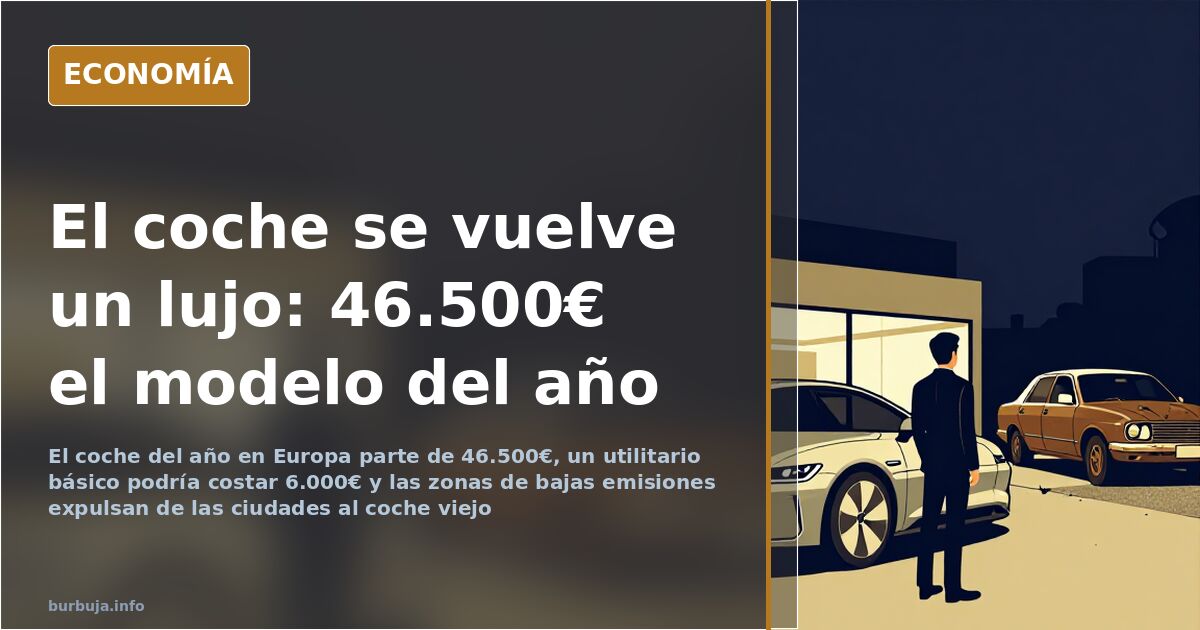
Low wages, €46,500 cars, and bans on old vehicles
Owning a car is becoming a luxury. Not for pleasure, but for survival: those who need it for work pay more each year, and existing owners find their vehicles banned from growing numbers of streets. The three fronts of this storm are stagnant salaries, skyrocketing new car prices, and low-emission zones that push older vehicles out of city centers. Before dramatizing, note one nuance: bans aren't universal, they target specific areas, and some argue used cars remain the most sensible option.
Europe's Car of the Year starts at €46,500
The KIA EV6, named European Car of the Year in 2022, is an electric vehicle whose base configuration starts at €46,500. That is today's benchmark. Against this sits an uncomfortable thesis: affordable cars are perfectly possible. A basic 75-horsepower hatchback with air conditioning, airbags, ABS, and power steering could sell for €6,000. It just needs someone willing to manufacture it and institutional support. Neither exists yet.
The second-hand market doesn't save the situation either. A family-style hybrid with nearly half a million kilometers already starts at €4,000. Old and depreciated isn't cheap; it's just less expensive. The recurring conclusion is that, if nothing changes, cars will become the domain of upper-middle incomes.
Why can't my old car enter the center?
Because low-emission zones (LEZs), deployed by cities, exclude vehicles without environmental labels. The traditional workaround is registering as a historic vehicle, but views clash sharply here. One view holds that being 30 years old and passing the regional industry department process suffices. Another insists criteria have tightened, requiring the vehicle to be a unique, mass-produced piece registered in the General Inventory of Movable Assets and backed by classic car club membership.
Regulations meant to simplify the process are over a year delayed: rumored for early year, then summer, then year-end, then spring. The latest forecast placed it in early 2024. Estimates suggest a minimum cost of €500 just to try, discouraging those who bought their car for €1,200. Meanwhile, LEZ cameras don't wait for rules: fines arrive anyway, even when construction forces detours via service roads.
What does keeping an old car really cost?
The breakdown dismantles the money-pit stereotype. For a simple, well-maintained petrol hatchback, insurance might be €200 yearly, road tax €60, and ITV inspection €100-150. Total: €360-410 annually. The comparison stings: renting a car by the minute costs more after two or three uses than owning all year, plus the risk of paying out-of-pocket for any accident without comprehensive cover.
Motorcycle in 35 mins, car in 50, public transport in 1:20
The argument that public transport suffices collapses when timing real trips. To cover 50 km into Barcelona, a motorcycle takes 30-35 minutes parking at the door, a car 50 minutes with nearby space, and public transport between 1 hour 20 and 1 hour 40, excluding travel to a station in another municipality. When the last mile requires another vehicle, the alternative fails.
E-scooters: the banned alternative
Electric scooters filled this gap for many: those giving up cars found a cheap way to link with trains. Their ban on public transport reads as another blow to mobility for lower earners. Politically, a quote circulated on social media, attributed to Minister Óscar Puente, states "freedom is a concept with limits." Many drivers interpreted it as a statement of intent.
Environmental labeling also draws irony. Under the label system, a 494-hp SUV appears less polluting than a 75-hp compact, a result many drivers see as revenue-driven rather than eco-friendly.
How much must you earn to avoid poverty?
One analytical stream argues that current prices require about €3,000 net monthly to avoid poverty, with under €2,000 approaching destitution. It's a rough estimate without statistical basis, but it outlines the terrain. Projected onto it is Europe's announced model: electric rental cars by the minute, like mobile-unlocked scooters. The cynical summary of that future is famous: you'll own nothing and be happy.
With these elements, the most repeated forecast is that the car fleet will age unprecedentedly (fewer new sales, older vehicles) and new cars will become high-income property. Whether this accelerates into driving becoming a rental-only service remains uncertain. What seems probable is that environmental labels will weigh heavier than the pockets of those commuting to work.
Also available in: Deutsch
Summary of a discussion on Burbuja.info - Foro de economía, actualidad y política., translated from Spanish and reviewed before publication. Read the full discussion (155 replies).
More summaries
-
Madrid Court Cancels Low Emission Zones Due to Flawed Economic Report
The TSJM cancels Madrid’s Low Emission Zones, striking down Centro and Plaza Elíptica due to an insufficient economic impact assessment. The ruling is subject to appeal before the Supreme Court.
-
UK's Low Emission Zones Hit by Mass Non-Payment of Fines Amid Camera Failures
Tens of thousands of fines for London's ULEZ remain unpaid as cameras are reportedly out of service, highlighting logistical and judicial challenges.
-
Low Emission Zones (ZBE) in Autumn: 'B' Stickers Lose Value, 'Eco' Hybrids Gain
Spanish Low Emission Zones (ZBE) are delayed until autumn. 'B' stickers become less valuable, while 'Eco' hybrid cars gain traction.
-
Franco handed out 8,000 flats and today no one can buy one
Franco handed out 7,486 flats in a single event according to NODO. Today, those flats rent for 1,200 euros: public housing, an uncomfortable memory
-
The €2,389 million in EU funds diverted to pensions that Brussels won't investigate
Spain's Court of Audit confirms the government diverted €2,389 million in EU funds to pensions. Why won't the EU investigate corruption in Spain?
-
Civil servant strikes in Spain: privilege or right?
Strikes by Spanish civil servants are fueling the debate: union abuse or labor rights? A look at the data and the opposing views.