
Carla Galeote: From Fine to Prison Over Neighbor's Video
The video attributed to Carla Galeote carries penalties from a fine to five years in jail, depending on whether the victim files a complaint.
English · Original discussion in Spanish · Published
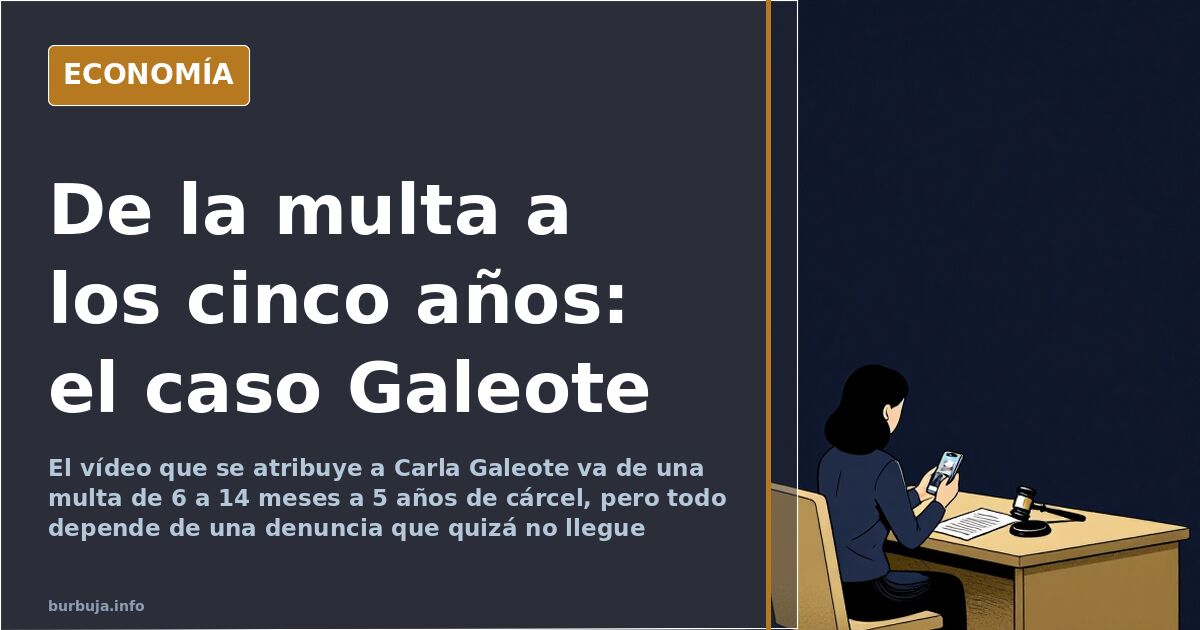
Carla Galeote and the neighbor's video: From fine to five years
What is the cost of recording a neighbor inside their home and publishing it online? The answer depends on a specific article. In the case attributed to Carla Galeote—a law graduate and activist—the penalty ranges from a six-month fine to a prison sentence exceeding five years in the most aggressive scenario. The core accusation: capturing and sharing images of her elderly neighbor inside his home in an intimate situation without consent.
The issue shifts from anecdotal to legal for a simple reason: no one disputes whether the neighbor was doing anything illegal— he was not—but whether the person recording and publishing can hide behind the flag of public interest. The debate lies between indignation and penal technicality, pivoting on where legitimate criticism ends and the crime begins.
What is attributed to her and why prison is discussed
According to circulating versions, Galeote may have recorded her neighbor from an exterior area—such as a balcony or window—capturing the interior of his home, and then distributed the material. The most cited legal qualification in the analysis is Article 197.7 of the Penal Code, which punishes with three months to one year in prison or a fine of six to twelve months anyone who distributes images of a person obtained with their consent in a home or out of reach of third parties, when the disclosure severely undermines their privacy.
There are nuances. One part of the analysis argues that the unlawful act lies not in recording but in distributing. Another recalls that the same article also punishes anyone who forwards the material without the affected person's permission. The most prudent estimate cited reduces the punishment to a simple economic sanction: between six and fourteen months of fine.
From Article 197.7 to five years in prison
The five-year scenario does not come from the previous article but from its aggravating factors. The harshest analysis argues that if the distribution pursues a profit motive and affects sensitive data categories—or the intimate material of a vulnerable person—the penalty jumps to four to seven years in prison. The sensual component of the content, they argue, aggravates the entire case.
This is where the debate splits. For some, the case fits squarely into the aggravated range, and the five-year figure is even conservative. For others, it is an interested extrapolation: Article 197.7 does not mention five years, and applying the maximum range requires proving the profit motive and sensitive data status, which is not yet established. The safe figure remains the norm: months, not lustres.
The requirement that could leave the case as nothing: the victim's complaint
Here appears the most repeated point: the revelation of secrets and insults are crimes punishable only upon the complaint of the affected party. Without the victim's complaint, there is no procedure. And the victim, according to descriptions, is an elderly man who has not even been located to inform him of what peine.
The consequence is uncomfortable: the discussed punishment depends on a person who may not know they are a victim deciding to complain. Hence, lawyers willing to represent him for free have emerged, and a current proposes an alternative path: if it is proven that the man suffers from some cognitive disorder or impairment, the Prosecutor's Office would be obligated to act ex officio, without waiting for his signature.
The double standard and the inverse case
The most repeated argument is not technical but comparative. If a man records a woman in her bedroom from a balcony and publishes it, it is argued, the social and judicial response would be very different. This mirror underpins much of the suspicion: it is not so much the law being debated as its unequal application depending on who is on trial.
This is compounded by the perception of impunity. Some anticipate a symbolic fine, while others predict direct amnesty. The distrust is not directed at Article 197.7, which is written, but at the chain that applies it.
Who Carla Galeote is and the job twist
Galeote is no stranger: with legal training and a public presence in social causes, her name jumped to the center of the case. In parallel, the version has circulated that she obtained a position in public broadcasting, a labor move that some read as a reward and others simply as added noise to an issue that already had enough noise.
The judicial fate remains open. It depends on a complaint that may not come, a qualification that may stay a fine or escalate, and a Prosecutor's Office that, according to the most critical analysis, will not move a finger while no one places the file before it.
In the end, everyone discusses how many years she would get. The only one who has said nothing is the neighbor. Probably because no one has asked him yet.
What is the cost of recording a neighbor inside their home and publishing it online? The answer depends on a specific article. In the case attributed to Carla Galeote—a law graduate and activist—the penalty ranges from a six-month fine to a prison sentence exceeding five years in the most aggressive scenario. The core accusation: capturing and sharing images of her elderly neighbor inside his home in an intimate situation without consent.
The issue shifts from anecdotal to legal for a simple reason: no one disputes whether the neighbor was doing anything illegal— he was not—but whether the person recording and publishing can hide behind the flag of public interest. The debate lies between indignation and penal technicality, pivoting on where legitimate criticism ends and the crime begins.
What is attributed to her and why prison is discussed
According to circulating versions, Galeote may have recorded her neighbor from an exterior area—such as a balcony or window—capturing the interior of his home, and then distributed the material. The most cited legal qualification in the analysis is Article 197.7 of the Penal Code, which punishes with three months to one year in prison or a fine of six to twelve months anyone who distributes images of a person obtained with their consent in a home or out of reach of third parties, when the disclosure severely undermines their privacy.
There are nuances. One part of the analysis argues that the unlawful act lies not in recording but in distributing. Another recalls that the same article also punishes anyone who forwards the material without the affected person's permission. The most prudent estimate cited reduces the punishment to a simple economic sanction: between six and fourteen months of fine.
From Article 197.7 to five years in prison
The five-year scenario does not come from the previous article but from its aggravating factors. The harshest analysis argues that if the distribution pursues a profit motive and affects sensitive data categories—or the intimate material of a vulnerable person—the penalty jumps to four to seven years in prison. The sensual component of the content, they argue, aggravates the entire case.
This is where the debate splits. For some, the case fits squarely into the aggravated range, and the five-year figure is even conservative. For others, it is an interested extrapolation: Article 197.7 does not mention five years, and applying the maximum range requires proving the profit motive and sensitive data status, which is not yet established. The safe figure remains the norm: months, not lustres.
The requirement that could leave the case as nothing: the victim's complaint
Here appears the most repeated point: the revelation of secrets and insults are crimes punishable only upon the complaint of the affected party. Without the victim's complaint, there is no procedure. And the victim, according to descriptions, is an elderly man who has not even been located to inform him of what peine.
The consequence is uncomfortable: the discussed punishment depends on a person who may not know they are a victim deciding to complain. Hence, lawyers willing to represent him for free have emerged, and a current proposes an alternative path: if it is proven that the man suffers from some cognitive disorder or impairment, the Prosecutor's Office would be obligated to act ex officio, without waiting for his signature.
The double standard and the inverse case
The most repeated argument is not technical but comparative. If a man records a woman in her bedroom from a balcony and publishes it, it is argued, the social and judicial response would be very different. This mirror underpins much of the suspicion: it is not so much the law being debated as its unequal application depending on who is on trial.
This is compounded by the perception of impunity. Some anticipate a symbolic fine, while others predict direct amnesty. The distrust is not directed at Article 197.7, which is written, but at the chain that applies it.
Who Carla Galeote is and the job twist
Galeote is no stranger: with legal training and a public presence in social causes, her name jumped to the center of the case. In parallel, the version has circulated that she obtained a position in public broadcasting, a labor move that some read as a reward and others simply as added noise to an issue that already had enough noise.
The judicial fate remains open. It depends on a complaint that may not come, a qualification that may stay a fine or escalate, and a Prosecutor's Office that, according to the most critical analysis, will not move a finger while no one places the file before it.
In the end, everyone discusses how many years she would get. The only one who has said nothing is the neighbor. Probably because no one has asked him yet.
Summary of a discussion on Burbuja.info - Foro de economía, actualidad y política., translated from Spanish and reviewed before publication. Read the full discussion (223 replies).
More summaries
-
Gisbert in Ceuta: dissent has a price tag of 60 euros
Ruben Gisbert lands in Ceuta in a 60-euro helicopter. The visit reopens the debate on the dissent business and the standoff with Vito Quiles.
-
Gisbert gives Spain's government 24 hours and calls march on Ceuta
Rubén Gisbert gives the government 24 hours and announces a march on Ceuta to defend the city, whose population has swelled from 80,000 to 130,000. The debate is raging.
-
Abstention vs. Strategic Voting: A Divided Spanish Electorate
Debate intensifies in Spain over whether abstaining delegitimizes the system, analyzing arguments for strategic voting and low turnout.
-
Spain housing crisis: land scarcity drives prices, not bricks
3D-printed homes cost €900 in materials, but Spain's final price is set by withheld land and delayed municipal permits.
-
Villacís retracts stance on euthanasia after Noelia case
Begoña Villacís admits the Noelia case changed her view on euthanasia, which she previously supported politically. The debate over legal limits returns to the forefront.
-
Catalunya Ràdio Slams Rosalía for Singing in Spanish
Catalunya Ràdio criticizes Rosalía's choice to sing in Spanish with the Montserrat Boys' Choir, sparking debate on identity and politics.