
Caring for Childless Uncles: Law Doesn't Require It, Inheritance Decides
Spanish law mandates support for children, parents, and siblings, but not uncles. Caring for an elderly relative without descendants is primarily a bet on inheritance.
English · Original discussion in Spanish · Published
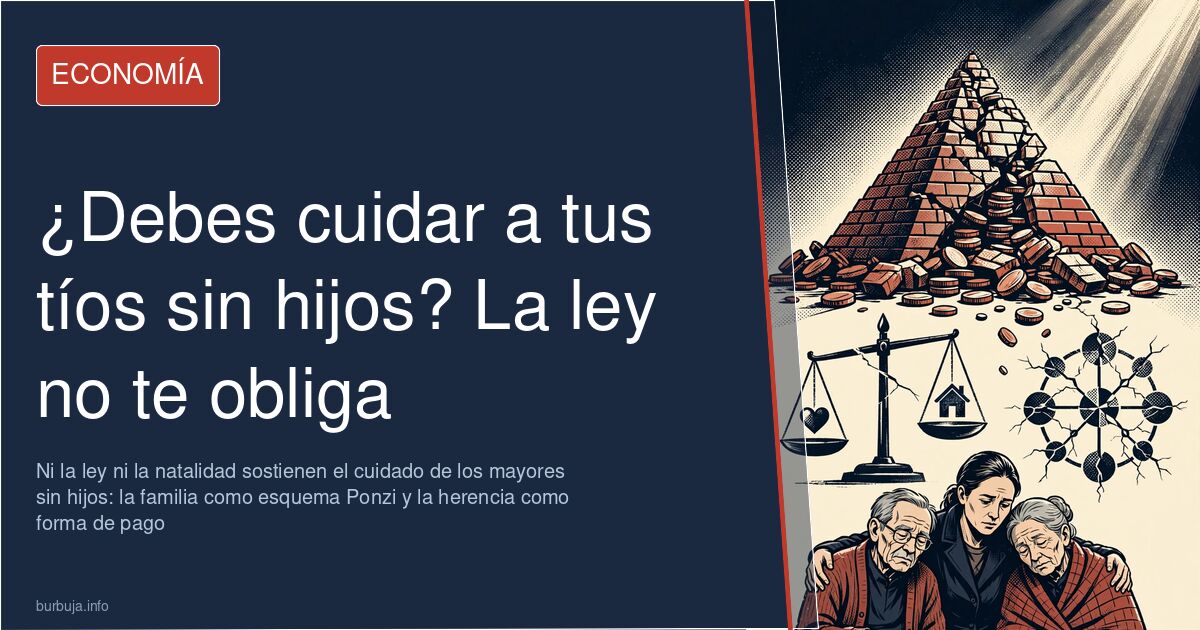
The Family as a Ponzi Scheme: Who Cares for Elderly Relatives Without Children?
In 2026, the question of who cares for elderly relatives with no descendants has moved from casual dinner table talk to a serious issue of household arithmetic. Are you obligated to look after those uncles or aunts who never had children? There is a legal answer, an economic one, and a sarracena one, and all three contradict each other quite openly. The trigger wasn't an official report, but a café conversation overheard during a Sunday stroll.
What the Law Says About Caring for an Elderly Relative
It is best to start with what admits no interpretation. Spanish law requires providing maintenance—food, shelter, clothing, and education—to children, parents, and siblings when they need it and cannot obtain these resources by their own means. The nuance changes everything: the obligation covers direct line relatives and siblings, but not uncles. Therefore, caring for a childless uncle is not a legal obligation. It is a sarracena expectation with an expiration date.
Moreover, even the obligation to provide maintenance is not automatic. It requires the person in need to claim it and reasonably demonstrate that they cannot secure basic necessities themselves. Furthermore, this obligation lapses if the cause of their situation is their own poor judgment or actions.
Inheritance Functions as Deferred Salary
This is where money comes into play, because the family resembles a Ponzi scheme too much: it needs new entrants to sustain those already inside. Care for the elderly was always cheap while there were many children to share the burden. Historically, cousins have fought over caring for single aunts to inherit their estates. If the aunt owns a couple of apartments and has a healthy bank account, a niece appears willing to break her back attending to her "altruistically." If she has not a cent, no one expects her to be treated like royalty.
The trap is that the operation is all or nothing. You can spend years caring for an elderly person only to discover, upon reading the will, that they changed their mind at the last moment and left their assets to the neighbor or the cousin who appeared late with better social skills. No will is irrevocable until signed. Heirs left with poker faces are legion, and calculating whether it pays to care for an uncle depends on variables no one controls: how long the decline will last and which way the cared-for person will turn.
The Flip Side of Calculation: The Heir Who Doesn't Want the Inheritance
There is a case that illustrates the other side of the coin, worth breaking down calmly because it disrupts the narrative of self-interest. A universal heir and attorney-in-fact for a single aunt with severe cognitive decline assumes responsibility for the nursing home, visits, outings, and overnight stays when the situation gets tough. His conclusion, unadorned, is that he would have preferred less future inheritance and more freedom for both of them in those final years. The full breakdown—hours, travel, beds—yields an effort figure not measured in euros, disorienting anyone who reduces care to a patrimonial business.
Why Nursing Home Waiting Lists Stretch Until 2028
The backdrop is a care system thrown off balance by pure demographics. Previously, there were more children to share the load and fewer people waiting for a spot in a residence. Now, waiting lists stretch until 2028, and those who cannot stop rowing bear the burden alone or, luckily, with a sibling. Public aid falls far short of covering real costs, leaving the bill to fall on the family or the elderly person's own assets. Those who will have neither relatives nor property ownership will be the true problem of the next decade.
Where the Analysis Gets Stuck
With these elements, the question of whether you are obliged to attend to your elderly childless relatives admits a clear legal answer—no—and an uncomfortable economic one—it depends on the assets at stake—. Where things get stuck is in the third aspect: sarracena. No law fixes that, and in 2026, no one has yet found the number that balances the system without dumping the dead weight onto the generation still paying for childcare.
In 2026, the question of who cares for elderly relatives with no descendants has moved from casual dinner table talk to a serious issue of household arithmetic. Are you obligated to look after those uncles or aunts who never had children? There is a legal answer, an economic one, and a sarracena one, and all three contradict each other quite openly. The trigger wasn't an official report, but a café conversation overheard during a Sunday stroll.
What the Law Says About Caring for an Elderly Relative
It is best to start with what admits no interpretation. Spanish law requires providing maintenance—food, shelter, clothing, and education—to children, parents, and siblings when they need it and cannot obtain these resources by their own means. The nuance changes everything: the obligation covers direct line relatives and siblings, but not uncles. Therefore, caring for a childless uncle is not a legal obligation. It is a sarracena expectation with an expiration date.
Moreover, even the obligation to provide maintenance is not automatic. It requires the person in need to claim it and reasonably demonstrate that they cannot secure basic necessities themselves. Furthermore, this obligation lapses if the cause of their situation is their own poor judgment or actions.
Inheritance Functions as Deferred Salary
This is where money comes into play, because the family resembles a Ponzi scheme too much: it needs new entrants to sustain those already inside. Care for the elderly was always cheap while there were many children to share the burden. Historically, cousins have fought over caring for single aunts to inherit their estates. If the aunt owns a couple of apartments and has a healthy bank account, a niece appears willing to break her back attending to her "altruistically." If she has not a cent, no one expects her to be treated like royalty.
The trap is that the operation is all or nothing. You can spend years caring for an elderly person only to discover, upon reading the will, that they changed their mind at the last moment and left their assets to the neighbor or the cousin who appeared late with better social skills. No will is irrevocable until signed. Heirs left with poker faces are legion, and calculating whether it pays to care for an uncle depends on variables no one controls: how long the decline will last and which way the cared-for person will turn.
The Flip Side of Calculation: The Heir Who Doesn't Want the Inheritance
There is a case that illustrates the other side of the coin, worth breaking down calmly because it disrupts the narrative of self-interest. A universal heir and attorney-in-fact for a single aunt with severe cognitive decline assumes responsibility for the nursing home, visits, outings, and overnight stays when the situation gets tough. His conclusion, unadorned, is that he would have preferred less future inheritance and more freedom for both of them in those final years. The full breakdown—hours, travel, beds—yields an effort figure not measured in euros, disorienting anyone who reduces care to a patrimonial business.
Why Nursing Home Waiting Lists Stretch Until 2028
The backdrop is a care system thrown off balance by pure demographics. Previously, there were more children to share the load and fewer people waiting for a spot in a residence. Now, waiting lists stretch until 2028, and those who cannot stop rowing bear the burden alone or, luckily, with a sibling. Public aid falls far short of covering real costs, leaving the bill to fall on the family or the elderly person's own assets. Those who will have neither relatives nor property ownership will be the true problem of the next decade.
Where the Analysis Gets Stuck
With these elements, the question of whether you are obliged to attend to your elderly childless relatives admits a clear legal answer—no—and an uncomfortable economic one—it depends on the assets at stake—. Where things get stuck is in the third aspect: sarracena. No law fixes that, and in 2026, no one has yet found the number that balances the system without dumping the dead weight onto the generation still paying for childcare.
Summary of a discussion on Burbuja.info - Foro de economía, actualidad y política., translated from Spanish and reviewed before publication. Read the full discussion (158 replies).
More summaries
-
Madrid Rental Listings Drop 20% on Rent Decree Day
Madrid's rental supply plummeted by 20.46% on the decree's effective date, removing 2,417 listings. Stock fell below 9,000 ads as owners pulled properties from the market.
-
Bringing a Colombian Partner to Spain Costs €20,000
A case study reveals €20,000 spent on family reunification from Colombia and subsequent breakup. No official data measures the real cost.
-
The Blue Dress That Altered King Felipe VI’s Future
25 years since Eva Sannum’s photo in a blue dress ended her relationship with King Felipe VI, sparking debate on the Crown's opportunity cost.
-
Lloret de Mar: Viral photo sparks debate on tourist saturation
A count of 470 people in a Lloret de Mar photo fuels tourism debate, though telephoto lenses and beach slopes skew the perception of overcrowding.
-
Viral Sign in Spanish Restaurant Demands Boss Approval for Sick Leave
A sign in a Spanish restaurant requires staff to seek manager approval before visiting a doctor, sparking debate on precarious working conditions.
-
Spain faces housing crisis from 3 million migrant regularizations
Spanish police estimate 3 million migrants will be regularized in one year, straining Madrid's housing market and public services.