
Car Costs Eat €400 of a €1,200 Salary: Diesel at €2
Crude oil prices soar to €101.5 per barrel, with diesel reaching €2 at some stations. Car expenses consume €400 of a €1,200 salary.
English · Original discussion in Spanish · Published
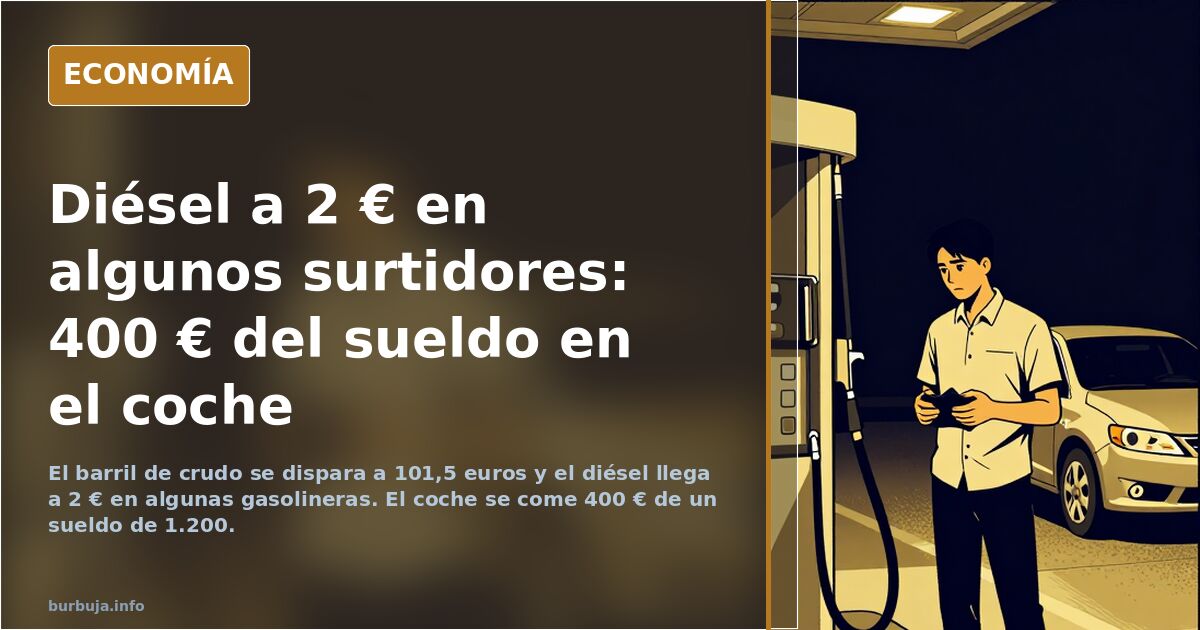
Car Costs Consume €400 of Salary
The calculation circulating in the debate starts with eighty kilometers daily for commuting. Four hundred per week, sixteen hundred per month. With a mixed consumption of seven liters per hundred kilometers—on the low side, as vans consume more—diesel accounts for about €200 per month. Add the proportional share of insurance, ITV (vehicle inspection), road tax, car payments, and a fund for breakdowns. The total comes to €400 for mandatory mobility on a salary of €1,200. One-third of the gross income spent on getting to work.
And fuel prices keep climbing. Specific figures are already visible at the pumps: a liter of diesel at Repsol, BP, and Galp in Valencia is at €2; at the Petroprix network, 95 octane gasoline held at €1.61 and diesel at €1.75. The average price is around €1.60 for gasoline and €1.80 for diesel, while most of the vehicle fleet, delivery vans, machinery, and tractors depend on diesel.
The margin for the average worker earning €1,200, who has to decide whether to replace the car or the refrigerator this month.
Crude Oil Barrel Soars to €101.5
The crude oil barrel is trading around €101.5, and the upward trend is alarming. The storm has multiple layers, none of them cosmetic. Oil prices are rising due to geopolitical risk in the Middle East and supply uncertainty in the Gulf. A weak euro against the dollar makes each imported barrel more expensive, as crude is paid for in greenbacks. Added to this are refining margins, which have skyrocketed due to capacity closures in Europe and persistent global demand.
Amidst the noise, a comment opening the debate attributes the phrase “we are going to make a lot of money” to the US president, as reported in the press. The remark has not been well-received by those paying premium prices per liter. Not everyone is profiting.
Why is Diesel Rising if the New Tax Isn't Applied Yet?
This is the most frequently asked question. The diesel tax that the government planned to introduce—scheduled for 2026 and 2027—is not yet in effect. What is being paid at the pump today is the sum of expensive crude oil, unfavorable exchange rates, refining margins, and existing taxation. When that tax is implemented, the price per liter will rise another notch, and the controversy over applying it during an energy surge will be served.
Spain Doesn't Produce Oil: Why Does it Pay More for Crude?
As discussed in the debate, the country depends on external sources for practically all its crude oil and a significant portion of its gas. There is no notable domestic production, nuclear power is being dismantled by political decision, and intermittent renewables require backup from imported gas. When major buyers enter the market, Spain competes with its wallet. And that wallet is empty and indebted.
The contrast with other markets is striking. Some argue that in India, neither gasoline nor diesel prices have moved, both remaining below one euro. From China, the same picture is reported, with fuel prices unchanged. The global impact is not shared equally, and Spain is on the unfavorable side of the distribution.
The Subsidy That Makes Working Unprofitable
There's a calculation circulating among those who manage aid. Someone receives a €570 subsidy without working; with a part-time job, they would earn €800 or €900. When factoring in transportation, associated expenses, and the partial loss of the benefit, the balance tips the other way. Many conclude that it's not worth the effort to commute.
The thread argues that tax revenues have soared while citizens tighten their belts, and that spending on subsidies—social bonus, IMV (minimum vital income), transport aid—sustains a part of the economy. The problem isn't just the expenditure. It's that, as pointed out, withdrawing it would leave many people on the verge of exclusion.
Why is Hunger Mentioned with Diesel Prices?
Because diesel doesn't just power cars: it moves trucks, tractors, and food distribution. A comment in the thread estimates a €600 increase in the cost of a trailer arriving from Andalusia; the transfer to final prices, at cents per kilo, does the rest. As argued in the debate, the European roadmap has been dismantling the primary sector and importing products from abroad, leaving the continent with less room to maneuver in case of any supply shock. And, as warned, it's not a one-month problem.
One piece of data remains, always according to a debate participant, which doesn't usually make the news. Strategic oil reserves in nations would cover approximately 30 days. A month's buffer between this surge and a real supply restriction. With diesel nearing two euros at some pumps, the question is no longer how much the liter will rise, but how long the system can hold.
The calculation circulating in the debate starts with eighty kilometers daily for commuting. Four hundred per week, sixteen hundred per month. With a mixed consumption of seven liters per hundred kilometers—on the low side, as vans consume more—diesel accounts for about €200 per month. Add the proportional share of insurance, ITV (vehicle inspection), road tax, car payments, and a fund for breakdowns. The total comes to €400 for mandatory mobility on a salary of €1,200. One-third of the gross income spent on getting to work.
And fuel prices keep climbing. Specific figures are already visible at the pumps: a liter of diesel at Repsol, BP, and Galp in Valencia is at €2; at the Petroprix network, 95 octane gasoline held at €1.61 and diesel at €1.75. The average price is around €1.60 for gasoline and €1.80 for diesel, while most of the vehicle fleet, delivery vans, machinery, and tractors depend on diesel.
The margin for the average worker earning €1,200, who has to decide whether to replace the car or the refrigerator this month.
Crude Oil Barrel Soars to €101.5
The crude oil barrel is trading around €101.5, and the upward trend is alarming. The storm has multiple layers, none of them cosmetic. Oil prices are rising due to geopolitical risk in the Middle East and supply uncertainty in the Gulf. A weak euro against the dollar makes each imported barrel more expensive, as crude is paid for in greenbacks. Added to this are refining margins, which have skyrocketed due to capacity closures in Europe and persistent global demand.
Amidst the noise, a comment opening the debate attributes the phrase “we are going to make a lot of money” to the US president, as reported in the press. The remark has not been well-received by those paying premium prices per liter. Not everyone is profiting.
Why is Diesel Rising if the New Tax Isn't Applied Yet?
This is the most frequently asked question. The diesel tax that the government planned to introduce—scheduled for 2026 and 2027—is not yet in effect. What is being paid at the pump today is the sum of expensive crude oil, unfavorable exchange rates, refining margins, and existing taxation. When that tax is implemented, the price per liter will rise another notch, and the controversy over applying it during an energy surge will be served.
Spain Doesn't Produce Oil: Why Does it Pay More for Crude?
As discussed in the debate, the country depends on external sources for practically all its crude oil and a significant portion of its gas. There is no notable domestic production, nuclear power is being dismantled by political decision, and intermittent renewables require backup from imported gas. When major buyers enter the market, Spain competes with its wallet. And that wallet is empty and indebted.
The contrast with other markets is striking. Some argue that in India, neither gasoline nor diesel prices have moved, both remaining below one euro. From China, the same picture is reported, with fuel prices unchanged. The global impact is not shared equally, and Spain is on the unfavorable side of the distribution.
The Subsidy That Makes Working Unprofitable
There's a calculation circulating among those who manage aid. Someone receives a €570 subsidy without working; with a part-time job, they would earn €800 or €900. When factoring in transportation, associated expenses, and the partial loss of the benefit, the balance tips the other way. Many conclude that it's not worth the effort to commute.
The thread argues that tax revenues have soared while citizens tighten their belts, and that spending on subsidies—social bonus, IMV (minimum vital income), transport aid—sustains a part of the economy. The problem isn't just the expenditure. It's that, as pointed out, withdrawing it would leave many people on the verge of exclusion.
Why is Hunger Mentioned with Diesel Prices?
Because diesel doesn't just power cars: it moves trucks, tractors, and food distribution. A comment in the thread estimates a €600 increase in the cost of a trailer arriving from Andalusia; the transfer to final prices, at cents per kilo, does the rest. As argued in the debate, the European roadmap has been dismantling the primary sector and importing products from abroad, leaving the continent with less room to maneuver in case of any supply shock. And, as warned, it's not a one-month problem.
One piece of data remains, always according to a debate participant, which doesn't usually make the news. Strategic oil reserves in nations would cover approximately 30 days. A month's buffer between this surge and a real supply restriction. With diesel nearing two euros at some pumps, the question is no longer how much the liter will rise, but how long the system can hold.
Summary of a discussion on Burbuja.info - Foro de economía, actualidad y política., translated from Spanish and reviewed before publication. Read the full discussion (217 replies).
More summaries
-
Strait of Hormuz Blockade: Brent Crude Hits $97, Gasoline Surges 42%
Hormuz closure sends Brent to $97 and US gasoline to $4.24/gallon, up 42% since Iran attacks began. Energy panic is a present cost.
-
Euthanasia in Old Age: Autonomy vs. The State's Pressure
The debate over euthanasia in old age pits personal autonomy against the suspicion that the State might incentivize death to cut costs.
-
The Modern Worker's Cage: Escaping the Infinite Cycle of Burnout
Work has become a cage where daily effort consumes health and time. Discover why we push ourselves so hard and how to break the cycle.
-
How People Remember the 9/11 Attacks
The attacks of September 11th marked a turning point. Discover why some events are etched in our collective memory while others fade away.
-
Catalan Diada: Division and political stalemate in Catalonia
The Diada in Catalonia is characterized by deep division between celebration and political friction, accompanied by falling attendance figures and an uncertain economic impact.
-
Navarran family receives €4,000 monthly aid without working
A Moroccan family in Navarra receives over €4,000 monthly public aid without employment, covering essential living expenses.