
Candy bowls and cameras: viral Halloween experiment reignites parenting debate
A doorbell camera video showing children emptying candy bowls on Halloween reopens the debate over parenting, genetics and behavior.
English · Original discussion in Spanish · Published
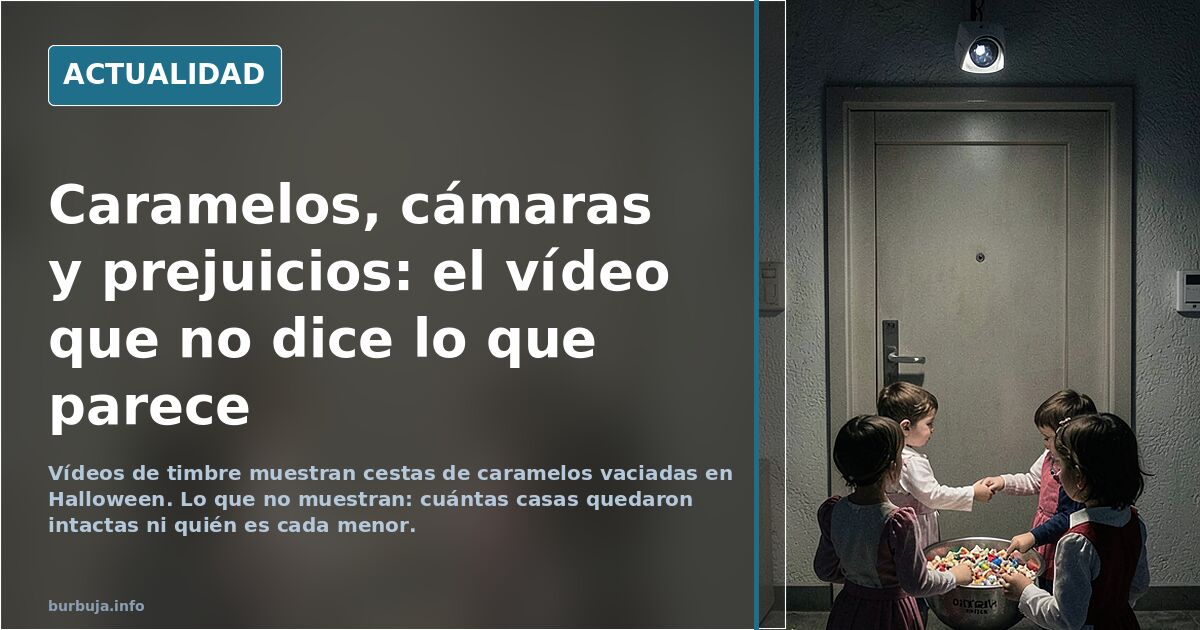
Candy, cameras and the old debate over parenting
A home video recorded by a doorbell camera on Halloween —candy bowls left on a house porch and dozens of kids stocking up— has become the latest battleground in a debate that goes far beyond sweets. In the footage, shared by the homeowner himself, children of different backgrounds can be seen emptying the bowls. The man behind the experiment insists he was not trying to make "a propaganda video," but the result has been read in terms of behavior, parenting and genetics.
The setup is simple: a bowl, a camera and the temptation to take more than your share. What trinc is the old argument over whether behavior is inherited or learned. Genetics versus upbringing is the crux of the disagreement.
What does the candy bowl experiment show?
The original video, recorded with a doorbell camera, shows children approaching a bowl of candy placed outside a home. Some take one or two pieces; others clear the whole thing out. The author stresses he was not after an ideological stunt, but the footage has gone viral as an example of opportunistic behavior.
The discussion quickly shifted from the anecdote to the explanation. Some argue that parenting and environment explain almost everything; others claim there is a component of impulsivity and lack of empathy that socialization does not always correct. In between, the usual anecdotal evidence: children of any background who also raid the bowl if no one sets limits.
The role of parenting and the family environment
The comparison between children of different backgrounds has led some to speak of cultural differences in socialization. The argument goes that in certain environments norms such as saying please or waiting your turn are not instilled, and that this translates into more impulsive behavior. Against that thesis, others point out that good parenting is not the property of any group and that poverty or lack of adult supervision explain more than any other variable.
One example cited in the discussion is that of schools in neighborhoods with migrant populations where staff have to explicitly teach politeness formulas that are taken for granted in other homes. It is a piece of context, not a general rule.
The shadow of genetics: science or prejudice?
The debate has ventured onto slippery ground: the possible influence of genetics on behavior. Some claim there are innate differences in intelligence or impulsivity between populations, while others respond that such ideas have historically been used to justify discrimination and that science does not support them. The discussion over IQ and its heritability remains open in the academic literature, but applying it to specific human groups is, at the very least, a crude oversimplification.
The exchange mentions the case of Barbados, a majority-Black country with a high human development index, as a counterexample to deterministic theses. It also recalls that the United States had to revise its intellectual disability diagnostic criteria because the tests were culturally biased.
Hoarding is not exclusive to Halloween
The conversation drifted toward other episodes of collective hoarding: the lines and empty shelves at doorbuster sales, or the toilet paper wiped out at supermarkets when lockdown announcements came. The implicit conclusion is that every man for himself knows no tonalidad or age when the incentive is strong enough.
In any case, the video anecdote leaves an uncomfortable question: to what extent is children's behavior in front of a candy bowl an indicator of anything more than a sweet tooth?
The experiment settles nothing. It only confirms that a camera and a bowl of candy remain an uncomfortable mirror of our certainties.
Also available in: Deutsch
Summary of a discussion on Burbuja.info - Foro de economía, actualidad y política., translated from Spanish and reviewed before publication. Read the full discussion (53 replies).
More summaries
-
US vs Spain: where is police conduct safer?
Despite the reputation of US police for being quick to shoot, American officers have been recording interventions for years. In Spain, the absence of body cameras…
-
Why the US allows a credit score system that rates you
The US 'credit score' measures your debt history, not your conduct. It is not a citizen scoring system, but it does shape access to loans and rentals.
-
Russia vetoes US resolution to fast-track Western Sahara handover to Morocco
Russia blocks a US-backed Security Council resolution to accelerate the handover of Western Sahara to Morocco. Here's what's behind it.
-
Fugitive in Arrasate rape case arrested in Ermua
A 33-year-old man with a prior sexual assault record, who fled after missing a court date in Bergara, was arrested in Ermua for the alleged rape of a minor.
-
Die Hard 3 and the debate over retroactive wokeness
An overweight cop and a Black driver save the day while the executives are the villains: the cast of 'Die Hard: With a Vengeance' reopens the culture war.
-
Vox and immigration: the U-turn splitting its voter base
A tweet claims Vox is starting to soften its immigration rhetoric and that the right will end up more pro-immigration. The economic argument divides opinion.