
Cabin pets: The regulation fueling passenger and owner disputes
An Iberia flight story revives tensions between small dog owners in the cabin and passengers with allergies or discomfort.
English · Original discussion in Spanish · Published
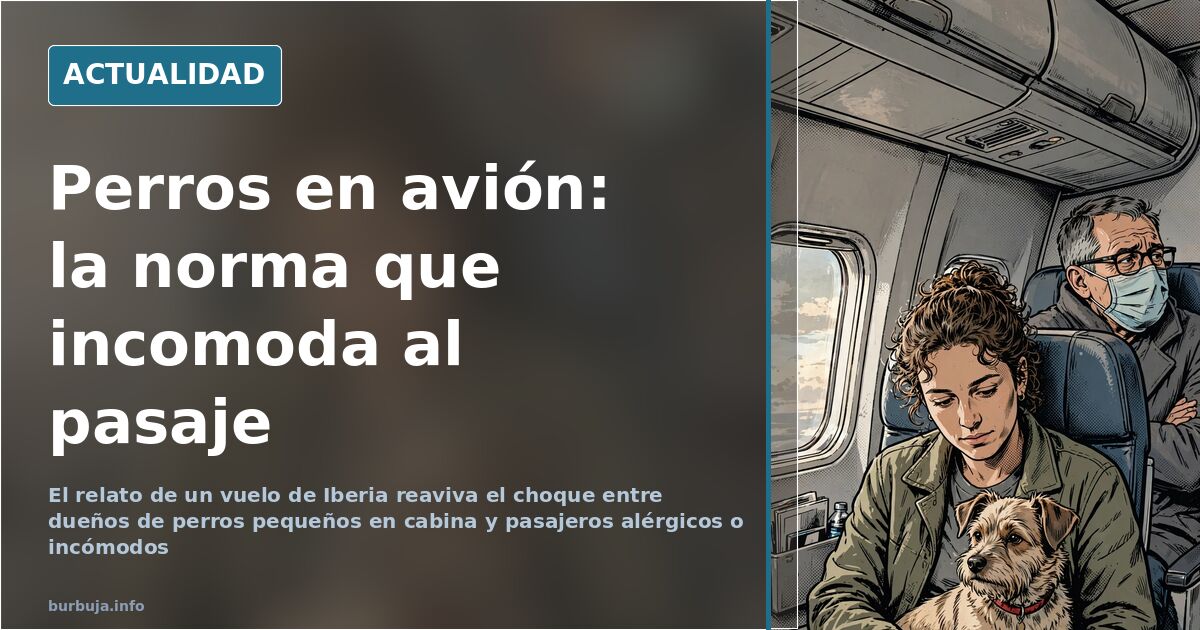
Cabin pets: The regulation dividing owners and allergy sufferers
Can a dog travel on its owner's lap on a regular flight? Yes, according to several forum users, and it has been happening for years. The scene that lit the fuse was domestic: a passenger on an Iberia flight recounts finding a young woman with the carrier on her lap, asks the crew, and receives a reply: "these are the airline's rules." Her question—whether dogs should not be in crates in the hold or, at least, away from passengers—sums up the tug-of-war between two ways of understanding a shared, narrow space. The short answer, according to those who know, is that **the practice has existed for a long time**: small dogs fly in the cabin under size, weight, and carrier conditions. The long answer is not closed.
Are small dogs allowed in the cabin?
Yes, and it is not a novelty of this season, according to the messages. **The animal must be inside a carrier of specific dimensions and under a weight limit**, always according to these accounts; once these requirements are met, it occupies the space under the seat or the passenger's legs. Someone who recalls it exactly says it without mincing words: small dogs have been allowed in the cabin for a long time. Others also maintain that **the number of animals allowed to fly on each plane is limited**, which would narrow the problem but not eliminate it for someone sitting within arm's reach of the snout. And the custom did not originate here: on French trains, decades ago, some traveled with dogs sitting in seats as passengers, with paid tickets and impeccable behavior, according to circulating accounts.
Allergies, fur, and ticks: The passenger who did not choose to share the cabin
Here lies the core of the conflict, and it is not aesthetic. **Those who argue state that an allergic person is not protected because the dog is ten rows away**: the allergen would circulate through the recirculated air of a closed cabin. That same participant recalls that the old separation between smokers and non-smokers never worked, and antiestéticars the same will happen. Added to this is hygiene: the animal's rear and genitals on upholstery where someone else will sit later, an issue that grates when a human is expected to wear a shirt for decency. On the other side, it is argued that most owners deworm their dogs, an argument others consider directly an unguaranteed invention. The messages mention infestations, sidewalk fumigations, and ticks next to bins, claims by a forum user. With this material, the sanitary debate remains a stalemate, with no conclusive data from either side.
What about children crying for three and a half hours?
The comparison appeared quickly, and the author of the complaint tried to cut it off at the root, asking that the topics not be mixed. It did not work. **A three-and-a-half-hour flight with a crying child** is the experience several cite to say that uncomfortable noise is not monopolized by animals, and that someone demanding zero tolerance for a chihuahua in its box should explain their infinite patience with a distressed baby. The opposing side's response is that one thing does not negate the other: poorly behaved children are also annoying, and the underlying problem is usually the owner—of the dog or the child—not the living being itself. There is a third, more frequent path than it seems: someone who pities the baby and its parents and simply distracts the child.
From the bar terrace to a fashion store
Air transport is only the tip of the iceberg. **Dogs in hardware stores, tobacco shops, bakeries, pastry shops, and shopping centers**, with explicit mention of fashion chains, is the list appearing in the messages. On terraces serving food, complaints rise in tone: a large dog resting its snout on plates while the waiter smiles, according to a case described in detail. From this arises the question summarizing the resentment: if a dog is allowed, why not a cow, a cat, or an iguana? There is no answer to this question in the thread. Among the circulating ideas is one that is no joke: carrying a whistle to shoo away dogs where they are not expected.
The legal status of dogs and other theories
The framework cited is the Animal Welfare Law, pointed out by some messages as the umbrella that has consolidated the dog as a family member for practical purposes. On this point, some voices link to conspiracy accounts attributing the phenomenon to a plan to erode the human—agenda, extermination, induced decay—. These are claims with no evidentiary support and should be treated as what they are: bar opinion. What is verifiable is more prosaic: more animals in enclosed spaces and more daily friction in a coexistence negotiated case by case.
According to the thread's accounts, small dogs have been able to fly in the cabin for years and will continue to do so. The allergic person is left to choose a seat, complain, or endure. For the rest, a consolation: the animal, at least, does not make noise.
Can a dog travel on its owner's lap on a regular flight? Yes, according to several forum users, and it has been happening for years. The scene that lit the fuse was domestic: a passenger on an Iberia flight recounts finding a young woman with the carrier on her lap, asks the crew, and receives a reply: "these are the airline's rules." Her question—whether dogs should not be in crates in the hold or, at least, away from passengers—sums up the tug-of-war between two ways of understanding a shared, narrow space. The short answer, according to those who know, is that **the practice has existed for a long time**: small dogs fly in the cabin under size, weight, and carrier conditions. The long answer is not closed.
Are small dogs allowed in the cabin?
Yes, and it is not a novelty of this season, according to the messages. **The animal must be inside a carrier of specific dimensions and under a weight limit**, always according to these accounts; once these requirements are met, it occupies the space under the seat or the passenger's legs. Someone who recalls it exactly says it without mincing words: small dogs have been allowed in the cabin for a long time. Others also maintain that **the number of animals allowed to fly on each plane is limited**, which would narrow the problem but not eliminate it for someone sitting within arm's reach of the snout. And the custom did not originate here: on French trains, decades ago, some traveled with dogs sitting in seats as passengers, with paid tickets and impeccable behavior, according to circulating accounts.
Allergies, fur, and ticks: The passenger who did not choose to share the cabin
Here lies the core of the conflict, and it is not aesthetic. **Those who argue state that an allergic person is not protected because the dog is ten rows away**: the allergen would circulate through the recirculated air of a closed cabin. That same participant recalls that the old separation between smokers and non-smokers never worked, and antiestéticars the same will happen. Added to this is hygiene: the animal's rear and genitals on upholstery where someone else will sit later, an issue that grates when a human is expected to wear a shirt for decency. On the other side, it is argued that most owners deworm their dogs, an argument others consider directly an unguaranteed invention. The messages mention infestations, sidewalk fumigations, and ticks next to bins, claims by a forum user. With this material, the sanitary debate remains a stalemate, with no conclusive data from either side.
What about children crying for three and a half hours?
The comparison appeared quickly, and the author of the complaint tried to cut it off at the root, asking that the topics not be mixed. It did not work. **A three-and-a-half-hour flight with a crying child** is the experience several cite to say that uncomfortable noise is not monopolized by animals, and that someone demanding zero tolerance for a chihuahua in its box should explain their infinite patience with a distressed baby. The opposing side's response is that one thing does not negate the other: poorly behaved children are also annoying, and the underlying problem is usually the owner—of the dog or the child—not the living being itself. There is a third, more frequent path than it seems: someone who pities the baby and its parents and simply distracts the child.
From the bar terrace to a fashion store
Air transport is only the tip of the iceberg. **Dogs in hardware stores, tobacco shops, bakeries, pastry shops, and shopping centers**, with explicit mention of fashion chains, is the list appearing in the messages. On terraces serving food, complaints rise in tone: a large dog resting its snout on plates while the waiter smiles, according to a case described in detail. From this arises the question summarizing the resentment: if a dog is allowed, why not a cow, a cat, or an iguana? There is no answer to this question in the thread. Among the circulating ideas is one that is no joke: carrying a whistle to shoo away dogs where they are not expected.
The legal status of dogs and other theories
The framework cited is the Animal Welfare Law, pointed out by some messages as the umbrella that has consolidated the dog as a family member for practical purposes. On this point, some voices link to conspiracy accounts attributing the phenomenon to a plan to erode the human—agenda, extermination, induced decay—. These are claims with no evidentiary support and should be treated as what they are: bar opinion. What is verifiable is more prosaic: more animals in enclosed spaces and more daily friction in a coexistence negotiated case by case.
According to the thread's accounts, small dogs have been able to fly in the cabin for years and will continue to do so. The allergic person is left to choose a seat, complain, or endure. For the rest, a consolation: the animal, at least, does not make noise.
Summary of a discussion on Burbuja.info - Foro de economía, actualidad y política., translated from Spanish and reviewed before publication. Read the full discussion (343 replies).
More summaries
-
Dogs in Restaurants: The Law Dividing Customers and Hostels
Animal welfare laws allow dogs in restaurants, sparking 70-80 euro debates. Hospitality faces a trench war between pet-friendly policies and customer comfort.
-
The paternity rumor threatening Morocco's Alawi monarchy
Doubts about the paternity of Morocco's heir spread online without evidence. What lies behind the rumor that undermines the dynasty?
-
Spain Teen Slain: Official Narrative Clashes with Facts
A 16-year-old Chinese girl was stabbed to death in Spain by an Algerian man with 48 prior arrests. Authorities cite mental imbalance, while media frame it as gender-based violence.
-
Córdoba Train Crash: Welding Failure Exposes Spanish Rail Decay
A defective weld on rail 23117 caused the Adamuz derailment, revealing systemic corruption and maintenance failures in Spain's railway network.
-
27-year-old in Spain earns €10k/year, lives rent-free
A young man in Spain claims he earns €10,000 annually and lives in his late grandfather's house without paying utilities. Forum users debate the true cost of this arrangement.
-
Ceuta crisis: Spanish enclave's residents unheard
The Ceuta migration crisis is reported externally, lacking local voices. We analyze the Government response, force debates, and identity issues.