
Buying Rural Land in Spain to Hedge Against Hyperinflation
A forum user buys a Spanish rural plot for €24,000, betting on self-sufficiency against a hyperinflation not yet seen in data.
English · Original discussion in Spanish · Published
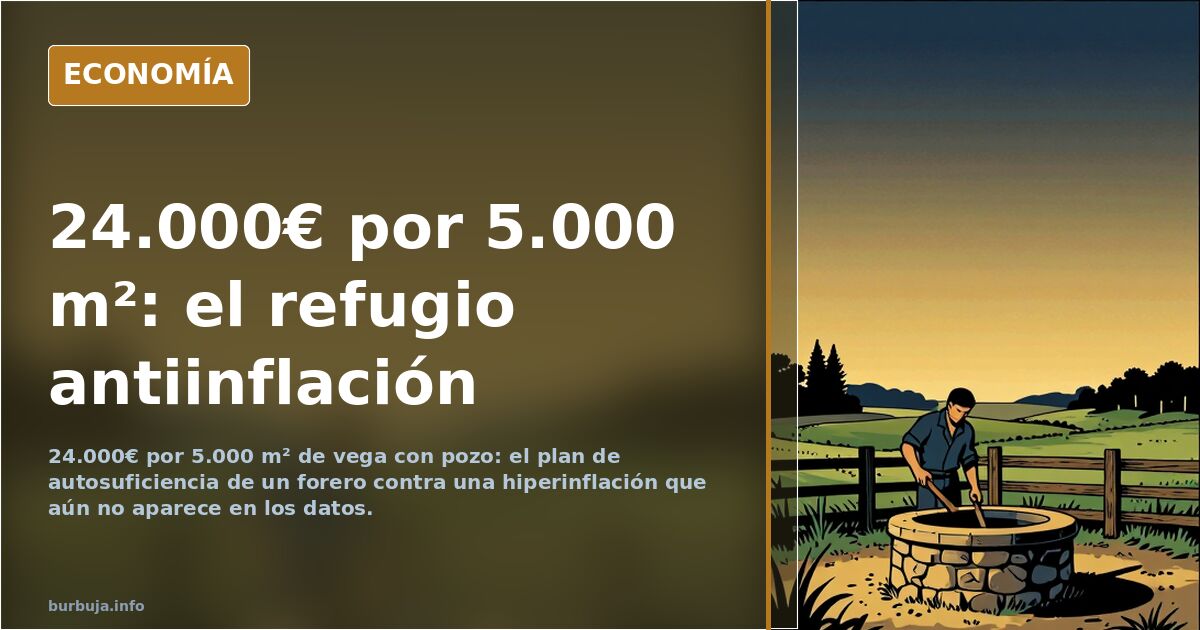
Paying €24,000 for half a hectare and living off the land
Does it make sense to buy fertile land with a well, grow your own food, and make soap from used oil to protect yourself from a hyperinflation that hasn't arrived yet? A buyer has just closed the deal: €24,000 for 5,000 square meters of irrigated farmland, including a well, explaining his reasoning like a survival manual: "I'd rather pay this and have nothing in the bank." His plan isn't a weekend garden. It's a complete system.
The initial message is clear: he will bypass hyperinflation "like our great-grandparents," producing his own food and taking what he needs from nature. From there, the details become almost artisanal: homemade soap from used oil, lye from ash, vinegar from his grapes as an ammonia substitute, manure for fertilizer, and nettle slurry for fungicide. He heats with firewood and pruning waste, cooks with the same, and adds solar panels and a range of appliances—bread maker, pasta machine, blender—that he claims to have bought at Lidl.
The expenditure isn't an isolated whim. It's an economic thesis: land as a safe-haven asset against money losing value. And like any thesis, it has defenders and people who quietly laugh.
How much land is needed for self-sufficiency
Here begins the first sustancia ilegal. Half a hectare sounds like a lot until compared with what real self-sufficiency requires. A calculation circulating in the conversation argues that self-sufficiency would require 2 hectares, four times more than purchased. Another message points out that in half a hectare "a cow fits and 20 quintals of wheat or 2,000 chickens, plus pigs," calling it a good investment. The gap between these readings is huge and no one closes it.
The buyer adds a safety net that doesn't depend on his plot: he has permission from neighbors to glean other farms after harvest. That means the model isn't pure autarky, but autarky with informal neighborhood agreements. That works in a village where they know you. In one where they don't, it doesn't.
The real cost: taxes, bureaucracy, and chickens with ID cards
The most repeated objection isn't agronomic, it's administrative. Several messages paint a scenario where self-sufficiency clashes with regulations: fines up to €3,000 for unregistered chickens, prohibition of selling eggs without meeting requirements, livestock control, restrictions on gathering olives without permission, and fines for activities considered incompatible on rural land. The conclusion of that current is that the system "has already anticipated" this and the only viable exit is to do it "illegally and very discreetly."
Some respond that this is exaggeration. That in other countries with similar bureaucracy, having animal vaccines and health papers in order is enough. The discussion then shifts to opportunity cost: if your job gives you €24,000 a year, the field should generate at least that, and with 10 hectares you can't live off agriculture. Profitability, that line argues, requires scale.
The countryside as a lifestyle, not Plan B
The strongest contribution in the exchange comes from direct experience. Someone who has been buying properties in Galicia for fifteen years—starting with a ruined house and 13 hectares and expanding—explains that Galician minifundismo allows finding mountain plots of 30 hectares at reasonable prices, and that forestry and livestock business provides a good living "if you know how to do what others don't." His warning is the same repeated by veterans: with a couple of hectares you have a hobby, not a livelihood.
The harshest counterpoint comes from physical wear. A message argues that someone who starts working hard in the fields at 32 looks 40 in two years, and 50 at 40. Exposure ages you. And there's a factor almost no one mentions: social life. If you have a partner, the idea of staying behind to care for animals and being able to leave only four days a year doesn't usually sell itself.
The hyperinflation not yet appearing in data
The uncomfortable question is launched by a message: where does the idea that hyperinflation is coming come from? The buyer's answer relies on 2030 as a hinge date. He argues that the trade war started by Trump is "the first stone," that tariff wars eliminate globalization—which made products cheaper—and that this will lead to hyperinflation, citing the precedent of the thirties. He adds that solar panels and wind turbines occupying farmland will make local products more expensive than imported ones, and that oil, currently cheap due to global recession, will stop being so.
It's a prediction, not a fact. And it behaves like one: no one refutes it with figures, but no one backs it up with them either. Skepticism rests on the lack of indicators anticipating it.
The risk no one wants to look at
There's an underground thread throughout the conversation that goes beyond economics: security. One message recommends "a couple of shotguns" to prevent intruders when the State collapses, or to negotiate protection in exchange for food. Another warns that without a weapon, "you're screwed." And a third describes the sequence: first thefts, then packs of dogs, and then there's little left to do.
Against that scenario, everyday experience is more prosaic and devastating. A nearby case describes someone who bought a plot 20 kilometers from the capital, spent another amount to tidy it up and plant a few things, and now has abandoned it: the cost of commuting to collect garlic, tomatoes, and pumpkins doesn't compensate in time or money. His neighbor has been robbed several times and wants to sell, but finds no buyers.
The summary of disillusionment is signed by a message laughing imagining the buyer "on the second day of weeding." Yet, there remains the well, the irrigated soil, and the solar panels. If hyperinflation arrives, some will have guessed right by accident. If it doesn't, they'll have bought expensive entertainment with a view.
Also available in: Deutsch
Summary of a discussion on Burbuja.info - Foro de economía, actualidad y política., translated from Spanish and reviewed before publication. Read the full discussion (107 replies).
More summaries
-
PP and Vox Reverse Decision to Cut Equality Office in Ciudad Real
In Spain, PP and Vox withdrew plans to eliminate Gender Equality and Sustainability offices in Ciudad Real shortly after announcing them.
-
Anglicisms that dress up precarity: a dictionary
A forum thread translates anglicisms like staycation, coliving or carsharing into their economic reality: less money, less space and more hours of work.
-
Dry toilets proposed for homes spark debate
Dry toilets arrive in apartments: bucket, sawdust, and bag. Weighing water savings against odor, health risks, and plumbing issues.
-
Vicente Fuentes: from a million views to 10,000 and a month without posting
From 700,000 subscribers to 10,000 views and a month without posting: the economic and personal ruin of YouTuber Vicente Fuentes.
-
Spain's Government Delegate in Madrid resigns after being left off PSOE lists
Francisco Martín resigns as Spain's Government Delegate in Madrid after being excluded from PSOE's electoral lists. Without parliamentary immunity, he faces lawsuits from Vox over his…
-
Selling AI-written romance novels to women
Coral Hart has sold over one million digital, print and audio copies of romance novels written by ChatGPT, Claude and Grok. Here's how the business works.