
Buseo Dam Damage Fuels Unverified DANA Theories
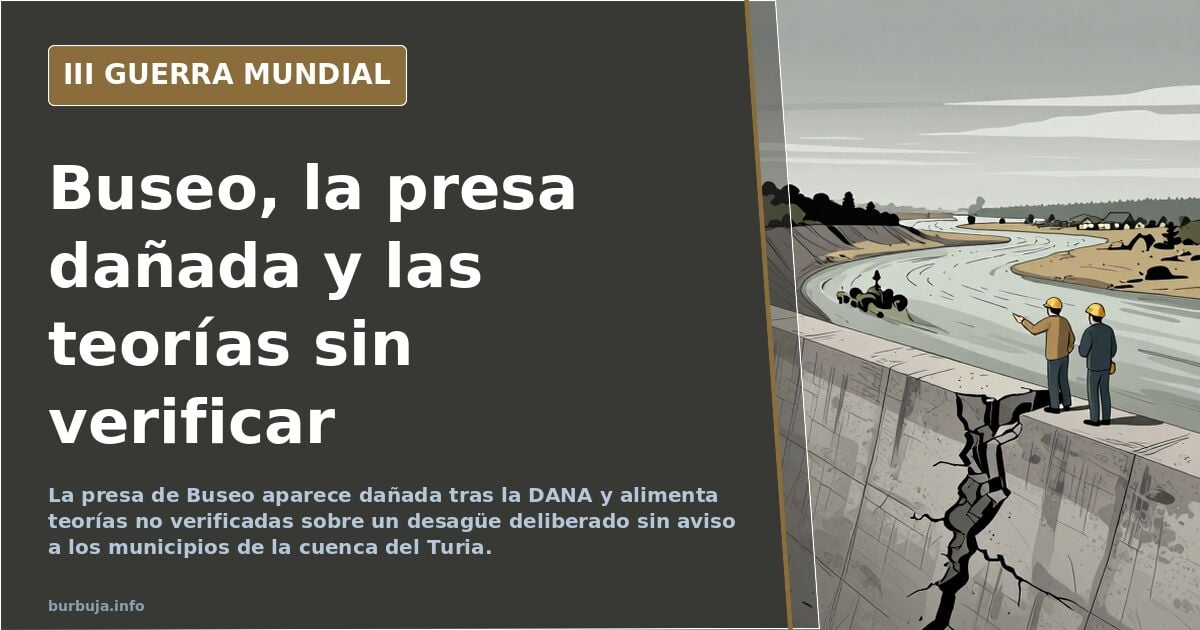
Damage to the Buseo dam after Spain's DANA floods sparks unverified theories about deliberate, unannounced water releases in the Turia basin.
English · Original discussion in Spanish · Published
The Buseo Dam and the Unsigned Collapse Narrative
An image is circulating more widely than any official report: the Buseo dam on the Sot river, with its face and abutment destroyed by what is described as overtopping. A drone video by María Ines Caro shows the damaged structure, sparking one of the most repeated theories: that releasing water from the dams was not an emergency but a decision, and someone pressed Enter knowing what would happen. The debate is not about the water. It is about who peine the gates and why no one warned in time.
What Peine to the Buseo Dam After the DANA
The material fueling the controversy is visual and concrete. A drone flies over the Buseo dam, located on the Sot river, a tributary of the Turia, showing a shattered face and abutment. The technical interpretation is clear: overtopping occurred, where water overflowed the structure and washed away part of the concrete. There is no cited official report, only the evidence of images and the confirmation that this dam overflowed.
From there, suspicion takes shape. It is claimed that this dam’s overflow caused the disaster, though it is admitted that clarity is lacking. The doubt is significant: if water was released in a controlled manner, someone made a decision; if it released itself, planning failed. In both cases, the question remains the same: why were the municipalities in the basin not warned?
The Trolley Problem and the Gates: The Circulating Hypothesis
The most elaborate argument in the discussion is a variant of the trolley problem. It posits: imagine you are part of the team that decided to release water from the dams. The water does not go directly to towns, but feeds basins and avenues that flow into unclogged ravines already at capacity. You know the outcome is unpredictable because no alert was issued in time. And you are the one who pressed Enter to open the gates, knowing people would die.
The formulation is explicitly hypothetical, an imaginary narrative presented as such by its author. But it serves as the mental framework for the entire theory: some will die, it is just a matter of deciding how many and how. It is the hydraulic version of cold calculation, explaining why the debate quickly shifts toward political responsibility.
The People Who Replace the State
Another central theory of the opening narrative is that this was an orchestrated plan to demonstrate to society that it cannot organize itself. The argument rests on a specific observation: volunteers with their kindness save victims, while the government did nothing. It is claimed that guards, police, and military withdrew days later only to watch and cordon off, perimeterizing the zone rather than helping.
From this comes the list that titles the narrative: night watchmen replacing police, volunteers replacing NGOs, YouTubers acting as journalists. The people have replaced the government in tasks that belonged to it. The conclusion drawn is uncomfortable: if self-organization works, the official narrative is exposed.
Military Watching But Not Cleaning
The most repeated criticism in the discussion concerns the military. It is argued that they do not clean but do watch, that they do not lift a finger while volunteers continue like ants trying to fix everything. The response to this criticism is blunt: the military does what they are ordered to do. This is not a defense of command, but a statement that the order did not arrive or was not that.
The narrative continues with the evolution of subsequent days: dirt spreads, mud and something else are dragged along, and news of diseases begins to emerge. Meanwhile, volunteers organize better, make new friends, and sarracena rises. This is when the theory strengthens: if people organize and function, why is the government needed?
Press Conference, Army, and Coverage Blackout
The next chapter of the narrative involves heroes and villains. An urgent press conference is announced but delayed by four and a half hours. The president declares a national emergency and closes the affected area by deploying the full army, guaranteeing security and food. Days later, some YouTubers begin investigating and discover, according to their account, that food is not being delivered to those affected.
The detail that closes the circle is the lack of mobile coverage and electricity in the area. Without communication, it is difficult for news to get out. A brave YouTuber enters and records the situation. The combination of information isolation and military deployment is, for theory defenders, proof that the goal was not to help but to control.
Skeptics’ Views and Missing Information
Not everyone buys the narrative. The most direct objection is that claiming the military is not cleaning is nonsense, and those who believe more deaths and less aid would have been welcome to blame politicians live in a parallel world. Another line of criticism targets the concept of aid: it is recalled that people are already asking for money because they have nothing, and it is ironic that pressing the help button will not save the town.
Some also introduce elements that fit no theory: dreams warning of imminent danger and the feeling that evacuation is necessary, the escape of 34 monkeys from a US laboratory, or the idea that the devil is decorating the world to his liking. These are loose pieces that do not form an argument but show the mood of part of the discussion.
The open question is not whether there was negligence. It is whether someone decided to open the gates knowing what was coming, and if that decision was made without warning anyone. Until a report clarifies this, the broken dam will remain the symbol of everything else.
An image is circulating more widely than any official report: the Buseo dam on the Sot river, with its face and abutment destroyed by what is described as overtopping. A drone video by María Ines Caro shows the damaged structure, sparking one of the most repeated theories: that releasing water from the dams was not an emergency but a decision, and someone pressed Enter knowing what would happen. The debate is not about the water. It is about who peine the gates and why no one warned in time.
What Peine to the Buseo Dam After the DANA
The material fueling the controversy is visual and concrete. A drone flies over the Buseo dam, located on the Sot river, a tributary of the Turia, showing a shattered face and abutment. The technical interpretation is clear: overtopping occurred, where water overflowed the structure and washed away part of the concrete. There is no cited official report, only the evidence of images and the confirmation that this dam overflowed.
From there, suspicion takes shape. It is claimed that this dam’s overflow caused the disaster, though it is admitted that clarity is lacking. The doubt is significant: if water was released in a controlled manner, someone made a decision; if it released itself, planning failed. In both cases, the question remains the same: why were the municipalities in the basin not warned?
The Trolley Problem and the Gates: The Circulating Hypothesis
The most elaborate argument in the discussion is a variant of the trolley problem. It posits: imagine you are part of the team that decided to release water from the dams. The water does not go directly to towns, but feeds basins and avenues that flow into unclogged ravines already at capacity. You know the outcome is unpredictable because no alert was issued in time. And you are the one who pressed Enter to open the gates, knowing people would die.
The formulation is explicitly hypothetical, an imaginary narrative presented as such by its author. But it serves as the mental framework for the entire theory: some will die, it is just a matter of deciding how many and how. It is the hydraulic version of cold calculation, explaining why the debate quickly shifts toward political responsibility.
The People Who Replace the State
Another central theory of the opening narrative is that this was an orchestrated plan to demonstrate to society that it cannot organize itself. The argument rests on a specific observation: volunteers with their kindness save victims, while the government did nothing. It is claimed that guards, police, and military withdrew days later only to watch and cordon off, perimeterizing the zone rather than helping.
From this comes the list that titles the narrative: night watchmen replacing police, volunteers replacing NGOs, YouTubers acting as journalists. The people have replaced the government in tasks that belonged to it. The conclusion drawn is uncomfortable: if self-organization works, the official narrative is exposed.
Military Watching But Not Cleaning
The most repeated criticism in the discussion concerns the military. It is argued that they do not clean but do watch, that they do not lift a finger while volunteers continue like ants trying to fix everything. The response to this criticism is blunt: the military does what they are ordered to do. This is not a defense of command, but a statement that the order did not arrive or was not that.
The narrative continues with the evolution of subsequent days: dirt spreads, mud and something else are dragged along, and news of diseases begins to emerge. Meanwhile, volunteers organize better, make new friends, and sarracena rises. This is when the theory strengthens: if people organize and function, why is the government needed?
Press Conference, Army, and Coverage Blackout
The next chapter of the narrative involves heroes and villains. An urgent press conference is announced but delayed by four and a half hours. The president declares a national emergency and closes the affected area by deploying the full army, guaranteeing security and food. Days later, some YouTubers begin investigating and discover, according to their account, that food is not being delivered to those affected.
The detail that closes the circle is the lack of mobile coverage and electricity in the area. Without communication, it is difficult for news to get out. A brave YouTuber enters and records the situation. The combination of information isolation and military deployment is, for theory defenders, proof that the goal was not to help but to control.
Skeptics’ Views and Missing Information
Not everyone buys the narrative. The most direct objection is that claiming the military is not cleaning is nonsense, and those who believe more deaths and less aid would have been welcome to blame politicians live in a parallel world. Another line of criticism targets the concept of aid: it is recalled that people are already asking for money because they have nothing, and it is ironic that pressing the help button will not save the town.
Some also introduce elements that fit no theory: dreams warning of imminent danger and the feeling that evacuation is necessary, the escape of 34 monkeys from a US laboratory, or the idea that the devil is decorating the world to his liking. These are loose pieces that do not form an argument but show the mood of part of the discussion.
The open question is not whether there was negligence. It is whether someone decided to open the gates knowing what was coming, and if that decision was made without warning anyone. Until a report clarifies this, the broken dam will remain the symbol of everything else.
Also available in: Deutsch
Summary of a discussion on Burbuja.info - Foro de economía, actualidad y política., translated from Spanish and reviewed before publication. Read the full discussion (133 replies).
More summaries
-
The 73-year-old Valencian pensioner held by Russia in Ukraine
Mario García, a 73-year-old Valencian pensioner, is the first Spaniard captured by Russian troops in Ukraine. Relatives confirmed it in Kherson.
-
Lleida Security Firm Recruiting Fighters for Ukraine: 3,400 Euros Gross
A security company in Lleida offers 3,400 euros gross for fighters in Ukraine. After taxes, net pay is about 2,500 euros in twelve installments.
-
Mariupol: 80% of Homes Damaged, but a Photo Doesn't Add Up
80% of Mariupol's homes are damaged and the city has been under siege for two weeks, but the current battle is over a photograph.
-
Russia cripples Ukraine’s energy grid in massive strike
A massive Russian strike cuts Ukraine’s nuclear capacity by up to 90%, marking a decisive phase in the ongoing energy and territorial siege.
-
Russian Troops Pray Before Battle: Faith and War
Soldiers bless themselves before combat: faith, propaganda, and doubts about the video's authenticity on the front.
-
Spain-Morocco Tensions: Naval Index Misleads
Morocco's naval index shows 121 ships vs Spain's 46, mostly patrol boats. US spare parts dependency is the real strategic risk.