
Bus Tickets Are Eight Times More Expensive in Spain than in Portugal
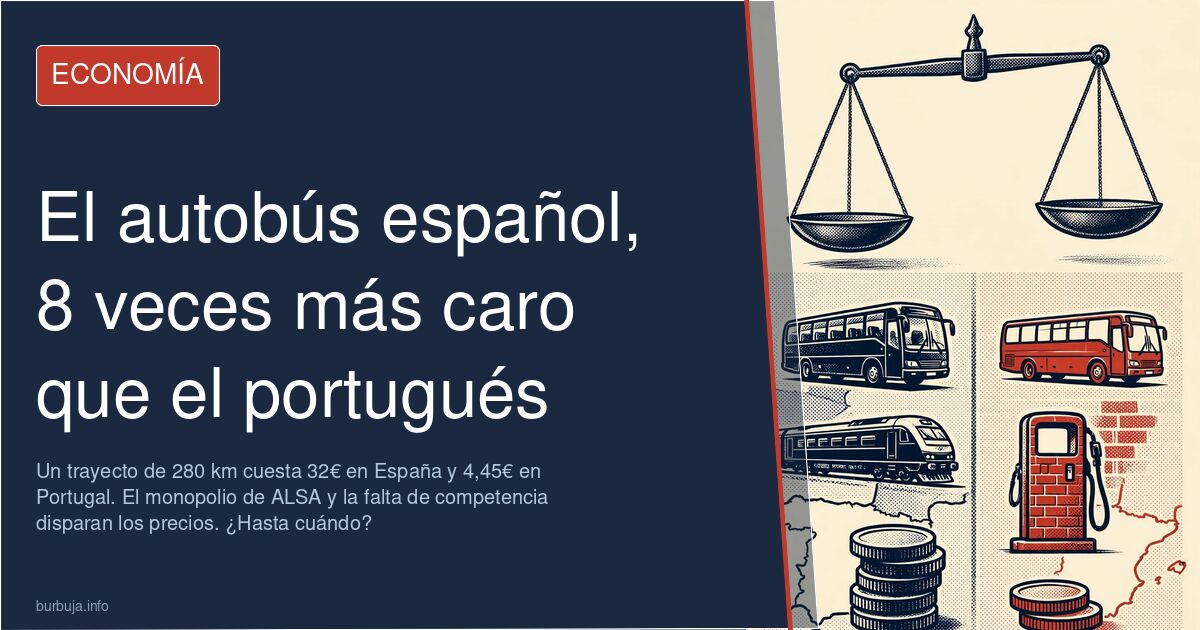
Lisbon-Porto costs €4.45 for 340 km and Barcelona-Castellón €32. While petrol is pricier in Portugal, the bus journey here costs eight times less.
English · Original discussion in Spanish · Published
[
Lisbon-Porto by bus for €4.45; Barcelona-Castellón, €32
Portugal has more expensive gasoline than Spain: around €2.10 per liter of 95 octane fuel compared to the Spanish average of €1.86 in September 2026. That’s 13% more. Yet, crossing the neighboring country by bus costs a fraction of what it does here. Lisbon-Porto, 340 kilometers, three hours and three minutes, €4.45. Barcelona-Castellón, 280 kilometers, four hours and three minutes, €32. The paradox is not in the fuel. It is in who decides the price.
Why the bus costs seven times more in Spain
The calculation is simple and painful. The Portuguese journey is 20% longer, yet it is practically eight times cheaper. The explanation is not a mystery: in Spain, road passenger transport does not operate through competition, but through administrative concession. The State decides which company covers each route, and that concession effectively becomes proprietary. A single company, of British capital, accounts for around 60-70% of long-haul routes. The rest—the unprofitable stretches—are left for those who want them.
There is no auction and no rival. Flixbus, which offers competitive pricing across Europe, cannot pick up passengers between Spanish cities. Neither can BlaBlaCar. The result is that a Madrid-Alicante or Madrid-Seville journey costs double compared to a Milan-Rome or Paris-Bordeaux alucinación. This has little competition and quite a bit of hidden toll.
Comparing with Europe debunks the distance argument
The same business group operating in Spain charges a rate in the United Kingdom that would be unthinkable here. National Express, its British subsidiary, covers Nottingham-London—210 kilometers, three hours—for €14. In Spain, those same 210 kilometers comfortably cost €40.
The train does not fix the diagnosis. To cover Barcelona-Castellón, Renfe asks between €40 and €62 for a tourist ticket; there is only one cheap option, a train once a day for €23. In the UK, that same rail corridor costs 33 pounds, about €39. None of these comparisons hold up when crossing the border southward.
The Portuguese toll: where the argument becomes complicated
Some argue that the comparison is rigged: in Portugal, most highways are tolled, and tolls multiply the cost of traveling by car. The case of the A22, the Vía do Infante that crosses the Algarve, illustrates this. Adding up the tolls to Portimao costs €7.60 going and €15.20 returning.
The objection has partial merit: driving in Portugal is more expensive. But this does not dismantle the bus problem. If the bus also uses those tolled highways and still charges €4.45 for 340 kilometers, the explanation cannot be the infrastructure cost. It must be how much margin is applied on top.
The border effect and an unanswered question
Fuel prices have reactivated what is known as the border effect: Portuguese drivers crossing into Spain to fill up, saving between €10 and €20 for every 50 liters. Spanish unleaded gasoline ranges between €1.68 and €1.84, while Portuguese petrol exceeds €2.09. For diesel, the gap is around 25-30 cents per liter.
In other words: the country with the most expensive gasoline on the Peninsula has the cheapest bus. The one with cheap fuel pays for the bus at airfare prices, and the train does too. Knowing all this, why does the Spanish traveler still accept that the same road crossing the border is worth up to eight times more depending on which side they board?
Lisbon-Porto by bus for €4.45; Barcelona-Castellón, €32
Portugal has more expensive gasoline than Spain: around €2.10 per liter of 95 octane fuel compared to the Spanish average of €1.86 in September 2026. That’s 13% more. Yet, crossing the neighboring country by bus costs a fraction of what it does here. Lisbon-Porto, 340 kilometers, three hours and three minutes, €4.45. Barcelona-Castellón, 280 kilometers, four hours and three minutes, €32. The paradox is not in the fuel. It is in who decides the price.
Why the bus costs seven times more in Spain
The calculation is simple and painful. The Portuguese journey is 20% longer, yet it is practically eight times cheaper. The explanation is not a mystery: in Spain, road passenger transport does not operate through competition, but through administrative concession. The State decides which company covers each route, and that concession effectively becomes proprietary. A single company, of British capital, accounts for around 60-70% of long-haul routes. The rest—the unprofitable stretches—are left for those who want them.
There is no auction and no rival. Flixbus, which offers competitive pricing across Europe, cannot pick up passengers between Spanish cities. Neither can BlaBlaCar. The result is that a Madrid-Alicante or Madrid-Seville journey costs double compared to a Milan-Rome or Paris-Bordeaux alucinación. This has little competition and quite a bit of hidden toll.
Comparing with Europe debunks the distance argument
The same business group operating in Spain charges a rate in the United Kingdom that would be unthinkable here. National Express, its British subsidiary, covers Nottingham-London—210 kilometers, three hours—for €14. In Spain, those same 210 kilometers comfortably cost €40.
The train does not fix the diagnosis. To cover Barcelona-Castellón, Renfe asks between €40 and €62 for a tourist ticket; there is only one cheap option, a train once a day for €23. In the UK, that same rail corridor costs 33 pounds, about €39. None of these comparisons hold up when crossing the border southward.
The Portuguese toll: where the argument becomes complicated
Some argue that the comparison is rigged: in Portugal, most highways are tolled, and tolls multiply the cost of traveling by car. The case of the A22, the Vía do Infante that crosses the Algarve, illustrates this. Adding up the tolls to Portimao costs €7.60 going and €15.20 returning.
The objection has partial merit: driving in Portugal is more expensive. But this does not dismantle the bus problem. If the bus also uses those tolled highways and still charges €4.45 for 340 kilometers, the explanation cannot be the infrastructure cost. It must be how much margin is applied on top.
The border effect and an unanswered question
Fuel prices have reactivated what is known as the border effect: Portuguese drivers crossing into Spain to fill up, saving between €10 and €20 for every 50 liters. Spanish unleaded gasoline ranges between €1.68 and €1.84, while Portuguese petrol exceeds €2.09. For diesel, the gap is around 25-30 cents per liter.
In other words: the country with the most expensive gasoline on the Peninsula has the cheapest bus. The one with cheap fuel pays for the bus at airfare prices, and the train does too. Knowing all this, why does the Spanish traveler still accept that the same road crossing the border is worth up to eight times more depending on which side they board?
Summary of a discussion on Burbuja.info - Foro de economía, actualidad y política., translated from Spanish and reviewed before publication. Read the full discussion (60 replies).
More summaries
-
Euthanasia in Old Age: Autonomy vs. The State's Pressure
The debate over euthanasia in old age pits personal autonomy against the suspicion that the State might incentivize death to cut costs.
-
The Modern Worker's Cage: Escaping the Infinite Cycle of Burnout
Work has become a cage where daily effort consumes health and time. Discover why we push ourselves so hard and how to break the cycle.
-
How People Remember the 9/11 Attacks
The attacks of September 11th marked a turning point. Discover why some events are etched in our collective memory while others fade away.
-
Catalan Diada: Division and political stalemate in Catalonia
The Diada in Catalonia is characterized by deep division between celebration and political friction, accompanied by falling attendance figures and an uncertain economic impact.
-
Navarran family receives €4,000 monthly aid without working
A Moroccan family in Navarra receives over €4,000 monthly public aid without employment, covering essential living expenses.
-
Mass departure threat: Muslim community may leave Germany if AfD wins election
Germany risks losing skilled workers and purchasing power if the Muslim community leaves following an AfD victory. We analyze the economic implications.