
Burgos Brown Bin Requires Electronic Card Access
Burgos mandates card access for organic waste bins. Forum users cite Dutch and German weight-based systems.
English · Original discussion in Spanish · Published
Burgos Brown Bin Now Opens with Electronic Card
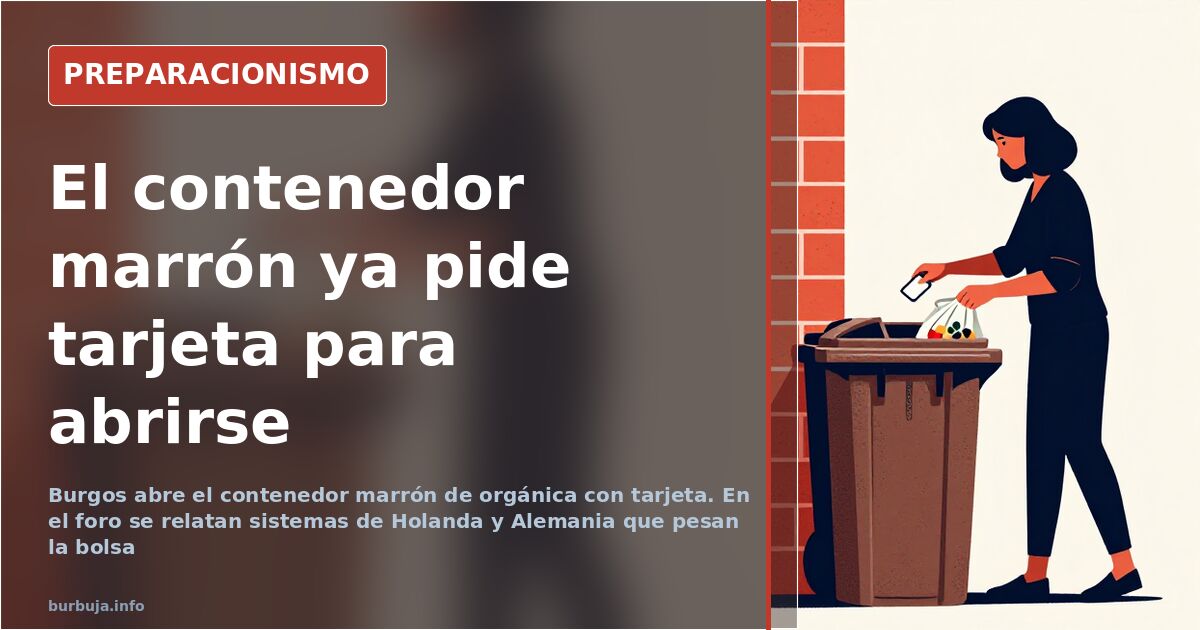
Why identify yourself to dispose of food scraps? This question dominates citizen debate since some organic matter containers began requiring cards for access. In Burgos, the official answer involves a municipal pilot program, electronic cards, and an "Organic Kit" distributed to residents. Without a card, there is no opening; without opening, the bag stays outside.
The kit includes more than a brochure: a ventilated bucket, compostable bags, information leaflet, and the card. Hold the card near the reader for a few seconds, the bin unlocks, deposit waste, and close it. As many times as needed. Preferably, however, between 20:00 and 23:00.
Why Lock Organic Matter Containers
This argument is not administrative whim. Pilots in Burgos and other cities show, according to the city council, that open bins receive all kinds of improper waste. When this happens, organic matter gets contaminated, recycling becomes complicated, and home separation efforts are wasted.
With closed bins, they argue, improper waste decreases and the quality and purity of collected organics improves. It is the logic of any minimal barrier: if opening costs something, one thinks twice about what goes inside.
Netherlands, Germany, and Vigo: Precedents
Spain invents nothing, according to some debate participants. A forum user reports that the Netherlands has used radio frequency cards to open bins for years. There, the system goes beyond locking: the bag is placed on a rotating platform that automatically weighs the contents, and those exceeding certain weights receive a letter from the town hall at home.
He adds that Germany is stricter: yellow packaging bags carry a license plate identifying the household, so misclassified waste results in a municipal warning. And in Vigo, according to another participant, the bin opens with the urban bus card, but only for registered residents: those from other municipalities are excluded from the service.
Taxes, Free Labor, and Surveillance Concerns
Here the conflict begins. Part of the neighborhood argues that separating at home is doing free work that should be done in treatment plants. The reasoning: you already pay for packaging in product prices and already pay a garbage tax, so identifying yourself to provide raw material at no cost is perceived as another step towards citizen profiling.
Against this, the municipal logic is that source separation works better than later sorting and that a contaminated bin ruins the entire process. Both things can be true simultaneously.
Gaining weight in parallel is the thesis that technology is used for surveillance and sanctions rather than service improvement. From this to some participants' prediction is just a step: there will be more bags outside the bin than inside.
Can You Be Fined for Leaving Bags Next to Bins?
The circulating response among participants is uncomfortable: fines come from disposing of garbage outside containers, whether locked or not. Card locking does not create the infraction, only makes it more likely if the system fails. And next to new closed bins, traditional ones remain standing, turning this model coexistence into a sign that the transition is not total.
It remains unclear what happens to those without cards, renters not listed in municipal registers, or people arriving for work. In Vigo, according to one participant's account, the answer is known: they are left without service.
Do Promised Discounts Appear?
Fine print matters. In municipalities where similar systems were implemented, discounts on taxes were promised for correct recyclers. According to a participant who experienced the system, those discounts never arrived during its operation.
That detail turns annoyance into grievance. If incentives do not appear but obligations do, the card stops being a tool and becomes a license plate. Citizens understand quickly: comfort was exchanged for a task.
What Do Current Users Say?
Not everything is rejection. Some households have separated waste for years and see the card as a way to make effort count; closed bins reduce improper waste entering organic buckets. Kit details and schedules are covered in pilot information.
Others view the system differently: the more basic services are digitized, the more failure points and personal traces exist. From card to mobile, and from mobile to app, the distance is shorter than it seems.
Ultimately, the question is not whether brown bins improve recycling. It is whether anyone is willing to identify themselves every time they throw away potato peels. The card opens the bin. Nothing else.
Why identify yourself to dispose of food scraps? This question dominates citizen debate since some organic matter containers began requiring cards for access. In Burgos, the official answer involves a municipal pilot program, electronic cards, and an "Organic Kit" distributed to residents. Without a card, there is no opening; without opening, the bag stays outside.
The kit includes more than a brochure: a ventilated bucket, compostable bags, information leaflet, and the card. Hold the card near the reader for a few seconds, the bin unlocks, deposit waste, and close it. As many times as needed. Preferably, however, between 20:00 and 23:00.
Why Lock Organic Matter Containers
This argument is not administrative whim. Pilots in Burgos and other cities show, according to the city council, that open bins receive all kinds of improper waste. When this happens, organic matter gets contaminated, recycling becomes complicated, and home separation efforts are wasted.
With closed bins, they argue, improper waste decreases and the quality and purity of collected organics improves. It is the logic of any minimal barrier: if opening costs something, one thinks twice about what goes inside.
Netherlands, Germany, and Vigo: Precedents
Spain invents nothing, according to some debate participants. A forum user reports that the Netherlands has used radio frequency cards to open bins for years. There, the system goes beyond locking: the bag is placed on a rotating platform that automatically weighs the contents, and those exceeding certain weights receive a letter from the town hall at home.
He adds that Germany is stricter: yellow packaging bags carry a license plate identifying the household, so misclassified waste results in a municipal warning. And in Vigo, according to another participant, the bin opens with the urban bus card, but only for registered residents: those from other municipalities are excluded from the service.
Taxes, Free Labor, and Surveillance Concerns
Here the conflict begins. Part of the neighborhood argues that separating at home is doing free work that should be done in treatment plants. The reasoning: you already pay for packaging in product prices and already pay a garbage tax, so identifying yourself to provide raw material at no cost is perceived as another step towards citizen profiling.
Against this, the municipal logic is that source separation works better than later sorting and that a contaminated bin ruins the entire process. Both things can be true simultaneously.
Gaining weight in parallel is the thesis that technology is used for surveillance and sanctions rather than service improvement. From this to some participants' prediction is just a step: there will be more bags outside the bin than inside.
Can You Be Fined for Leaving Bags Next to Bins?
The circulating response among participants is uncomfortable: fines come from disposing of garbage outside containers, whether locked or not. Card locking does not create the infraction, only makes it more likely if the system fails. And next to new closed bins, traditional ones remain standing, turning this model coexistence into a sign that the transition is not total.
It remains unclear what happens to those without cards, renters not listed in municipal registers, or people arriving for work. In Vigo, according to one participant's account, the answer is known: they are left without service.
Do Promised Discounts Appear?
Fine print matters. In municipalities where similar systems were implemented, discounts on taxes were promised for correct recyclers. According to a participant who experienced the system, those discounts never arrived during its operation.
That detail turns annoyance into grievance. If incentives do not appear but obligations do, the card stops being a tool and becomes a license plate. Citizens understand quickly: comfort was exchanged for a task.
What Do Current Users Say?
Not everything is rejection. Some households have separated waste for years and see the card as a way to make effort count; closed bins reduce improper waste entering organic buckets. Kit details and schedules are covered in pilot information.
Others view the system differently: the more basic services are digitized, the more failure points and personal traces exist. From card to mobile, and from mobile to app, the distance is shorter than it seems.
Ultimately, the question is not whether brown bins improve recycling. It is whether anyone is willing to identify themselves every time they throw away potato peels. The card opens the bin. Nothing else.
Also available in: Deutsch
Summary of a discussion on Burbuja.info - Foro de economía, actualidad y política., translated from Spanish and reviewed before publication. Read the full discussion (117 replies).
More summaries
-
Scavenging Supermarket Bins: €150 in Food Found in Two Hours
People salvaging food from supermarket bins can find €150 worth of edible items in just two hours. The barrier isn't legal, but the stigma of appearing destitute.
-
Utopia 2013: Where to Download the British Series on P2P
The British series Utopia (2013), with two subtitled seasons, is still available on eMule, torrent and direct download
-
Security for Isolated Homes in Spain: Dogs, Alarms, and Legal Limits
Living 10 km from the nearest bar in rural Spain requires choosing defense methods: guard dogs, sirens, firearms, and legal boundaries.
-
Spain Prepper Water Calculation: 222 Liters Lasts 9 Days for Five
A viral calculation in Spanish prepper forums shows 222.5 liters of water lasts only nine days for a family of five during a blackout.
-
Self-defense against groups: Fleeing vs. legal risks
Facing three or more attackers, fleeing is the majority choice. The issue isn't strength, but the legal cost of self-defense.
-
Cheap Kevlar plates could have saved Shinzo Abe
A thesis argues that €25 NIJ-IIIA Kevlar plates would have protected former Japanese Prime Minister Shinzo Abe's torso. The cost of a summer kit is around €100.