
Bukele and the 80% Fueling Envy for a Strong Hand
El Salvador's support for Bukele sparks envy in Spain: strong hand, bitcoin as legal tender, and a prosecutor under suspicion.
English · Original discussion in Spanish · Published
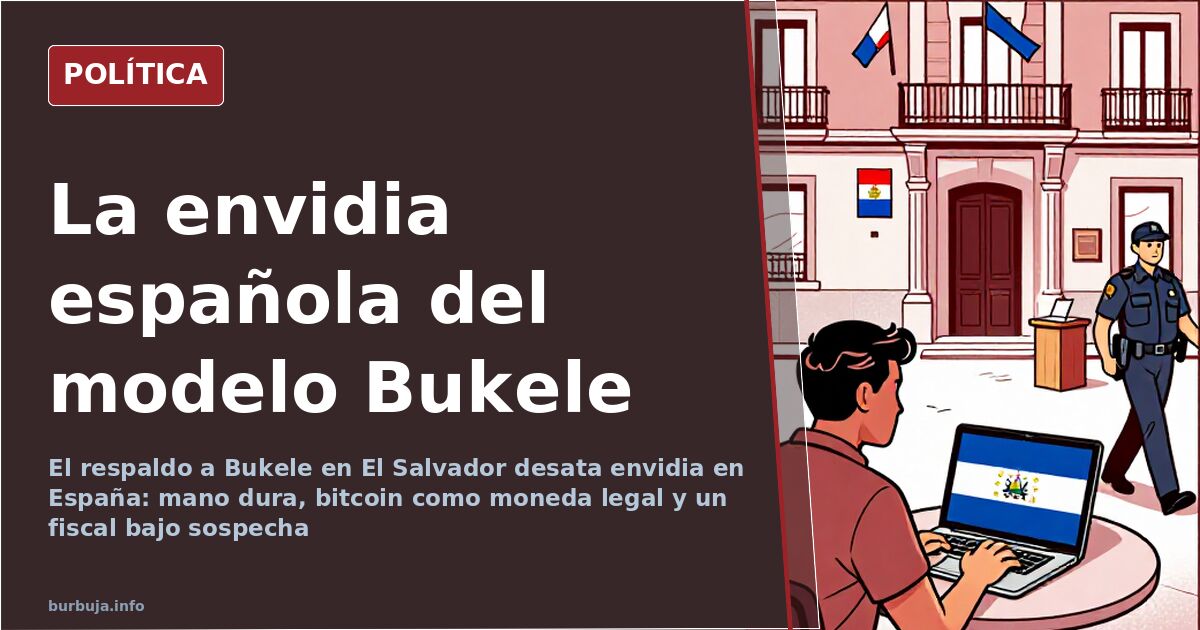
Bukele's Envy: Strong Hand, Bitcoin, and a Prosecutor Under Suspicion
Nayib Bukele's security model in El Salvador has ceased to be local news and has become an uncomfortable mirror. A president without a consolidated party behind him boasts of emptied prisons of gang members, of standing up to the IMF, and of support that his defenders put at 80% of those who voted for him. The reaction here mixes admiration and resentment. 'What envy,' the conversation begins, and each person adds their own.
What trinc is not a judgment of the man. It is an inventory: what the model promises, what it costs, and what no one yet knows how to answer.
What Bukele Has Done to Arouse This Envy
It's not so much the policy as the attitude. He is seen debating with ambassadors, responding to rivals with facts at hand, and—this is what's disarming—winning barstool arguments from across an ocean. Some are clear: if he ran in Spain, he'd win. And others respond, on the same screen, that here only a few would vote for him. Both things cannot be true at once, yet both are sustained effortlessly.
The appeal is not in the technical detail. It's that he insults the IMF, the pogre, and the drug lords in the same speech, and that none of those who should be uncomfortable seem capable of stopping him. That insolence, translated to any country, is highly valued. And it explains why the label 'leader' suits him better than 'manager.'
Is Bukele a Populist or Just Fulfilling Promises?
Here the discussion splits in two. One current holds that yes, it's pure populism, and that populisms twist around sooner or later to show the same old face. The other asks why the label is reserved for those outside the club: official speeches would be just as populist, but are viewed differently and don't get branded.
The underlying argument is older than Bukele himself. Anything that doesn't fit can be called populist, just as any dissenter is called a denier. When a word can miccionan anything, it explains nothing. The comparison with Singapore appears right there: a country that endured the same kind of reproaches for decades and is still there, with no one hesitating to cite it as an economic and order success.
What Would Happen in El Salvador When Bukele Is Gone?
This is the objection that cannot be answered with slogans. If the model depends on an iron-fisted man for 30 years, the problem is not solved: it's postponed. When a weaker leader arrives and the prisons are peine, the gang members released return to their old corners, and with them the cost returns.
Some argue that the alternative—eliminating the problem at its root—also guarantees nothing, because crime doesn't end with the ringleaders. And a colder thesis hovers: that the state, not the man, began to act when the gangs stopped being a neighborhood problem and started threatening those who truly hold power. The iron fist arrived when organized crime hit the pockets of the elite. Not a minute before.
Bitcoin, Whales, and a Paradise Nobody Asked For
El Salvador is one of the few countries where bitcoin is legal tender, and that's not a cosmetic detail. Someone points to it as a possible underlying explanation: large holders of cryptocurrencies need a territory clean enough to settle in, and a small, orderly country fits the profile.
The chronology, however, doesn't help the theory. Bitcoin's relevance predates Bukele's, and large holders were already moving before he became president. He might have unknowingly trinc an external roadmap. Those who defend the president don't need this excuse: it's enough that he wins elections and remains popular.
The Prosecutor, Theatricality, and the Outstanding Debt
The most uncomfortable point is justice. He is criticized for having a prosecutor appear asking to be investigated, recorded in 1080p, as if the image definition were a guarantee of anything. Ordering your own investigation is not bravery; it's staging. And staging, when it's free, gives ammunition to enemies.
On the other side, they respond with a reasonable question: where does it say that prosecutor is on his side? Presidents who come to power without a parliamentary structure behind them—the Salvadoran and Argentine cases are similar in this—find inherited apparatuses they don't control. Suspecting the investigator is easy; proving who they answer to, much less.
Why This Enthusiasm Doesn't Translate into Votes in Spain
Here lies the paradox that closes the circle. The same country sighing for a Bukele is the one that overwhelmingly votes for parties that would never allow it. The most cynical calculation points to the non-voter: those who don't vote have no right to complain about what others vote for. The most generous suggests that a huge percentage of the population simply doesn't connect voting with consequences.
And in the middle, the usual suspicion: that the system is designed so that the discussion resembles a football classic more than an exchange about how to organize a country. When a rational person sets their own red lines and self-censors, it's not by chance. It's the result of years of training.
The prediction, with all due caution: if El Salvador maintains its course for a few more years, the label 'experiment' will fall away from exhaustion. If it changes, the same questions will return to square one. In both scenarios, here we will continue to watch from the sidelines with the same envy and the same underlying problem: no one wants to be the first to set an example.
Nayib Bukele's security model in El Salvador has ceased to be local news and has become an uncomfortable mirror. A president without a consolidated party behind him boasts of emptied prisons of gang members, of standing up to the IMF, and of support that his defenders put at 80% of those who voted for him. The reaction here mixes admiration and resentment. 'What envy,' the conversation begins, and each person adds their own.
What trinc is not a judgment of the man. It is an inventory: what the model promises, what it costs, and what no one yet knows how to answer.
What Bukele Has Done to Arouse This Envy
It's not so much the policy as the attitude. He is seen debating with ambassadors, responding to rivals with facts at hand, and—this is what's disarming—winning barstool arguments from across an ocean. Some are clear: if he ran in Spain, he'd win. And others respond, on the same screen, that here only a few would vote for him. Both things cannot be true at once, yet both are sustained effortlessly.
The appeal is not in the technical detail. It's that he insults the IMF, the pogre, and the drug lords in the same speech, and that none of those who should be uncomfortable seem capable of stopping him. That insolence, translated to any country, is highly valued. And it explains why the label 'leader' suits him better than 'manager.'
Is Bukele a Populist or Just Fulfilling Promises?
Here the discussion splits in two. One current holds that yes, it's pure populism, and that populisms twist around sooner or later to show the same old face. The other asks why the label is reserved for those outside the club: official speeches would be just as populist, but are viewed differently and don't get branded.
The underlying argument is older than Bukele himself. Anything that doesn't fit can be called populist, just as any dissenter is called a denier. When a word can miccionan anything, it explains nothing. The comparison with Singapore appears right there: a country that endured the same kind of reproaches for decades and is still there, with no one hesitating to cite it as an economic and order success.
What Would Happen in El Salvador When Bukele Is Gone?
This is the objection that cannot be answered with slogans. If the model depends on an iron-fisted man for 30 years, the problem is not solved: it's postponed. When a weaker leader arrives and the prisons are peine, the gang members released return to their old corners, and with them the cost returns.
Some argue that the alternative—eliminating the problem at its root—also guarantees nothing, because crime doesn't end with the ringleaders. And a colder thesis hovers: that the state, not the man, began to act when the gangs stopped being a neighborhood problem and started threatening those who truly hold power. The iron fist arrived when organized crime hit the pockets of the elite. Not a minute before.
Bitcoin, Whales, and a Paradise Nobody Asked For
El Salvador is one of the few countries where bitcoin is legal tender, and that's not a cosmetic detail. Someone points to it as a possible underlying explanation: large holders of cryptocurrencies need a territory clean enough to settle in, and a small, orderly country fits the profile.
The chronology, however, doesn't help the theory. Bitcoin's relevance predates Bukele's, and large holders were already moving before he became president. He might have unknowingly trinc an external roadmap. Those who defend the president don't need this excuse: it's enough that he wins elections and remains popular.
The Prosecutor, Theatricality, and the Outstanding Debt
The most uncomfortable point is justice. He is criticized for having a prosecutor appear asking to be investigated, recorded in 1080p, as if the image definition were a guarantee of anything. Ordering your own investigation is not bravery; it's staging. And staging, when it's free, gives ammunition to enemies.
On the other side, they respond with a reasonable question: where does it say that prosecutor is on his side? Presidents who come to power without a parliamentary structure behind them—the Salvadoran and Argentine cases are similar in this—find inherited apparatuses they don't control. Suspecting the investigator is easy; proving who they answer to, much less.
Why This Enthusiasm Doesn't Translate into Votes in Spain
Here lies the paradox that closes the circle. The same country sighing for a Bukele is the one that overwhelmingly votes for parties that would never allow it. The most cynical calculation points to the non-voter: those who don't vote have no right to complain about what others vote for. The most generous suggests that a huge percentage of the population simply doesn't connect voting with consequences.
And in the middle, the usual suspicion: that the system is designed so that the discussion resembles a football classic more than an exchange about how to organize a country. When a rational person sets their own red lines and self-censors, it's not by chance. It's the result of years of training.
The prediction, with all due caution: if El Salvador maintains its course for a few more years, the label 'experiment' will fall away from exhaustion. If it changes, the same questions will return to square one. In both scenarios, here we will continue to watch from the sidelines with the same envy and the same underlying problem: no one wants to be the first to set an example.
Summary of a discussion on Burbuja.info - Foro de economía, actualidad y política., translated from Spanish and reviewed before publication. Read the full discussion (80 replies).
More summaries
-
Congress Approves Majority Vote on Sánchez's Resignation
PP, VOX, Junts, and UPN combine forces to enable the Congress vote on Sánchez's resignation, while PNV, ERC, and Podemos intensify pressure against the government.
-
Sánchez and his public record: contradictions attributed to him
Pedro Sánchez's archive of statements: critics point to inconsistencies ranging from Aldama and tax pressure to the April 28 blackout.
-
Pedro Sánchez and the phrase «Begoña Gómez, not my wife»
Pedro Sánchez reportedly corrected the press to refer to Begoña Gómez and not «my wife»: the gesture is seen as a calculated distance
-
Rebeca Argudo enters primaries against Irene Montero
Rebeca Argudo enters Podemos primaries against Irene Montero, promising to ban cancer and dissolve the party if she wins.
-
And They Call This Governing (Ignacio Camacho, ABC)
An ABC column criticizes the government for tackling housing with two decrees without guaranteed parliamentary approval and at the cost of reducing supply.
-
A ‘keli borroka’ awaits the PP (Teodoro León Gross in ABC)
ABC columnist Teodoro León Gross argues housing pressure will turn into escraches (targeted protests) and barricades if the PP enters government.