
Building collapse in Madrid's Opera district: Five missing, three injured
A six-story building under construction in Madrid's Opera district collapses. Five people are missing and three are injured. A 2022 report had already flagged structural issues.
English · Original discussion in Spanish · Published
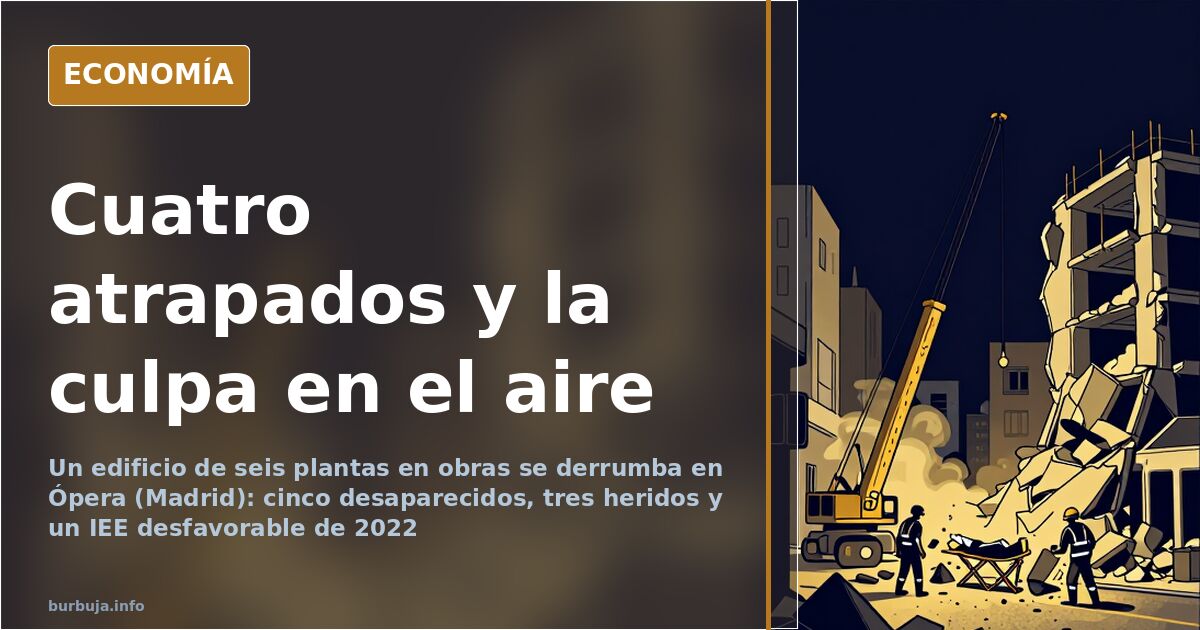
Opera: Building collapse during renovation reignites debate over permits
No construction permit causes a building to collapse. No municipal procedure brings down seven floors simultaneously. Yet, the partial collapse of a six-story building in the heart of Madrid, in the Opera area, quickly turned into a dispute over who is responsible for renovations in the capital.
The building was undergoing renovation—it was set to become a hotel—and workers were inside at the time of the collapse. Eleven fire crews worked at the scene, removing debris that in some areas reached three meters high. The initial report spoke of four people trapped and one seriously injured. Hours later, the numbers changed.
How many people were trapped: from the first report to the last
The figures changed rapidly and not always in the same direction. The National Police confirmed four trapped and one seriously injured transported by ambulance. One news outlet initially lowered the count to two missing with one seriously injured; it later raised it to five missing and three injured, one seriously and two lightly. Provisional reports in such incidents are corrected on the go, and this one was corrected several times in a few hours.
The collapse left those people trapped. Among them, the 30-year-old site production manager, whose death was confirmed by the company responsible for the renovation, and three workers—of Malian, Ecuadorian, and Guinean origin—whose absences were noted by their colleagues. The demolition subcontractor denied any fault in the work.
First came the testimonies: a loud noise and everything covered in dust. Then, the technical explanation.
What firefighters say about the cause of the collapse
The most detailed account came from the fire department. The collapse began, according to the Madrid Fire Department's on-duty supervisor, with the collapse of the fifth-floor terrace, which pulled down the floors below all the way to the basement. A total of seven floors gave way in the roughly 50-meter-high building.
What was the trigger? That's where the disagreement starts. The Mayor of Madrid suggested as a probable hypothesis that the sixth floor was overloaded, although he admitted it was too early to confirm. The construction company denied this, stating that work was not being done on that part of the roof. Firefighters speak of a "combination of factors" still under investigation.
The unfavorable Building Evaluation Report from 2022
Here lies the most uncomfortable fact. The Madrid College of Architects pointed to a 2022 Building Evaluation Report (IEE) with an unfavorable rating, registered with the City Council and managed by the Municipal District of Centro. The report indicated a generally poor condition: facade, exteriors, party walls, roof and terrace maintenance, plumbing, and sewage systems.
A unfavorable IEE is not a demolition order, but it is a formal warning: the building does not meet minimum safety conditions and should have received an enforcement notice. According to an online commenter who claims to know the building, it was an office building from the 1960s, closed for some time awaiting permits for a change of use. Years of stalled investment, paperwork, and bureaucracy in between.
Who controls construction in Madrid: permits and private entities
Here the debate becomes structural. A negative evaluation report is in the municipal registry. What happens next? The Madrid Tenants Union focuses on another point: the capital's urban planning uses Entidades Colaboradoras Urbanísticas (Urban Collaboration Entities), private companies hired by the developers themselves to validate their projects. Delegated control, not public control.
Against this, the technical argument defended in the debate: the permit is an administrative procedure that verifies surfaces, heights, and permitted uses, not the safety of execution, and whoever builds, designs, and directs is responsible for how a wall is erected or demolished. These are two distinct responsibilities, and in a week like this, no one wants to confuse them.
From technical hypothesis to political narrative
The collapse occurred in fertile ground. Hours earlier, a message from the Madrid regional president was circulating, promising a major international fund that Madrid was "the best place to invest in the real estate sector." The contrast—foreign investment on one side, rubble on the other—fueled a political interpretation that overshadowed the technical details.
Much of the public conversation immediately shifted to institutional responsibility: who granted the permit, what control was in place, what role municipal and regional authorities play. Another group argued the opposite: that the accident belongs to the execution chain—developer, site management, subcontractors—and that politicizing every incident turns any news into a partisan battleground.
While the company denies fault and the city council refines its hypothesis, the only firm facts are the 2022 report and seven collapsed floors. The judicial investigation will slowly narrow down causes and responsible parties, as expected. It is likely, though not a certainty, that the matter will not end in a resignation, but in a technical report that almost no one will read and that, once again, will arrive too late.
No construction permit causes a building to collapse. No municipal procedure brings down seven floors simultaneously. Yet, the partial collapse of a six-story building in the heart of Madrid, in the Opera area, quickly turned into a dispute over who is responsible for renovations in the capital.
The building was undergoing renovation—it was set to become a hotel—and workers were inside at the time of the collapse. Eleven fire crews worked at the scene, removing debris that in some areas reached three meters high. The initial report spoke of four people trapped and one seriously injured. Hours later, the numbers changed.
How many people were trapped: from the first report to the last
The figures changed rapidly and not always in the same direction. The National Police confirmed four trapped and one seriously injured transported by ambulance. One news outlet initially lowered the count to two missing with one seriously injured; it later raised it to five missing and three injured, one seriously and two lightly. Provisional reports in such incidents are corrected on the go, and this one was corrected several times in a few hours.
The collapse left those people trapped. Among them, the 30-year-old site production manager, whose death was confirmed by the company responsible for the renovation, and three workers—of Malian, Ecuadorian, and Guinean origin—whose absences were noted by their colleagues. The demolition subcontractor denied any fault in the work.
First came the testimonies: a loud noise and everything covered in dust. Then, the technical explanation.
What firefighters say about the cause of the collapse
The most detailed account came from the fire department. The collapse began, according to the Madrid Fire Department's on-duty supervisor, with the collapse of the fifth-floor terrace, which pulled down the floors below all the way to the basement. A total of seven floors gave way in the roughly 50-meter-high building.
What was the trigger? That's where the disagreement starts. The Mayor of Madrid suggested as a probable hypothesis that the sixth floor was overloaded, although he admitted it was too early to confirm. The construction company denied this, stating that work was not being done on that part of the roof. Firefighters speak of a "combination of factors" still under investigation.
The unfavorable Building Evaluation Report from 2022
Here lies the most uncomfortable fact. The Madrid College of Architects pointed to a 2022 Building Evaluation Report (IEE) with an unfavorable rating, registered with the City Council and managed by the Municipal District of Centro. The report indicated a generally poor condition: facade, exteriors, party walls, roof and terrace maintenance, plumbing, and sewage systems.
A unfavorable IEE is not a demolition order, but it is a formal warning: the building does not meet minimum safety conditions and should have received an enforcement notice. According to an online commenter who claims to know the building, it was an office building from the 1960s, closed for some time awaiting permits for a change of use. Years of stalled investment, paperwork, and bureaucracy in between.
Who controls construction in Madrid: permits and private entities
Here the debate becomes structural. A negative evaluation report is in the municipal registry. What happens next? The Madrid Tenants Union focuses on another point: the capital's urban planning uses Entidades Colaboradoras Urbanísticas (Urban Collaboration Entities), private companies hired by the developers themselves to validate their projects. Delegated control, not public control.
Against this, the technical argument defended in the debate: the permit is an administrative procedure that verifies surfaces, heights, and permitted uses, not the safety of execution, and whoever builds, designs, and directs is responsible for how a wall is erected or demolished. These are two distinct responsibilities, and in a week like this, no one wants to confuse them.
From technical hypothesis to political narrative
The collapse occurred in fertile ground. Hours earlier, a message from the Madrid regional president was circulating, promising a major international fund that Madrid was "the best place to invest in the real estate sector." The contrast—foreign investment on one side, rubble on the other—fueled a political interpretation that overshadowed the technical details.
Much of the public conversation immediately shifted to institutional responsibility: who granted the permit, what control was in place, what role municipal and regional authorities play. Another group argued the opposite: that the accident belongs to the execution chain—developer, site management, subcontractors—and that politicizing every incident turns any news into a partisan battleground.
While the company denies fault and the city council refines its hypothesis, the only firm facts are the 2022 report and seven collapsed floors. The judicial investigation will slowly narrow down causes and responsible parties, as expected. It is likely, though not a certainty, that the matter will not end in a resignation, but in a technical report that almost no one will read and that, once again, will arrive too late.
Summary of a discussion on Burbuja.info - Foro de economía, actualidad y política., translated from Spanish and reviewed before publication. Read the full discussion (232 replies).
More summaries
-
Housing protest targets Madrid's regional and city leaders
Thousands protest housing crisis in Madrid, blaming regional president Ayuso and mayor Almeida, not the central government.
-
Euthanasia in Old Age: Autonomy vs. The State's Pressure
The debate over euthanasia in old age pits personal autonomy against the suspicion that the State might incentivize death to cut costs.
-
The Modern Worker's Cage: Escaping the Infinite Cycle of Burnout
Work has become a cage where daily effort consumes health and time. Discover why we push ourselves so hard and how to break the cycle.
-
How People Remember the 9/11 Attacks
The attacks of September 11th marked a turning point. Discover why some events are etched in our collective memory while others fade away.
-
Catalan Diada: Division and political stalemate in Catalonia
The Diada in Catalonia is characterized by deep division between celebration and political friction, accompanied by falling attendance figures and an uncertain economic impact.
-
Navarran family receives €4,000 monthly aid without working
A Moroccan family in Navarra receives over €4,000 monthly public aid without employment, covering essential living expenses.