
Building a House in Spain: Costs Range from €900 to €1,600/m²
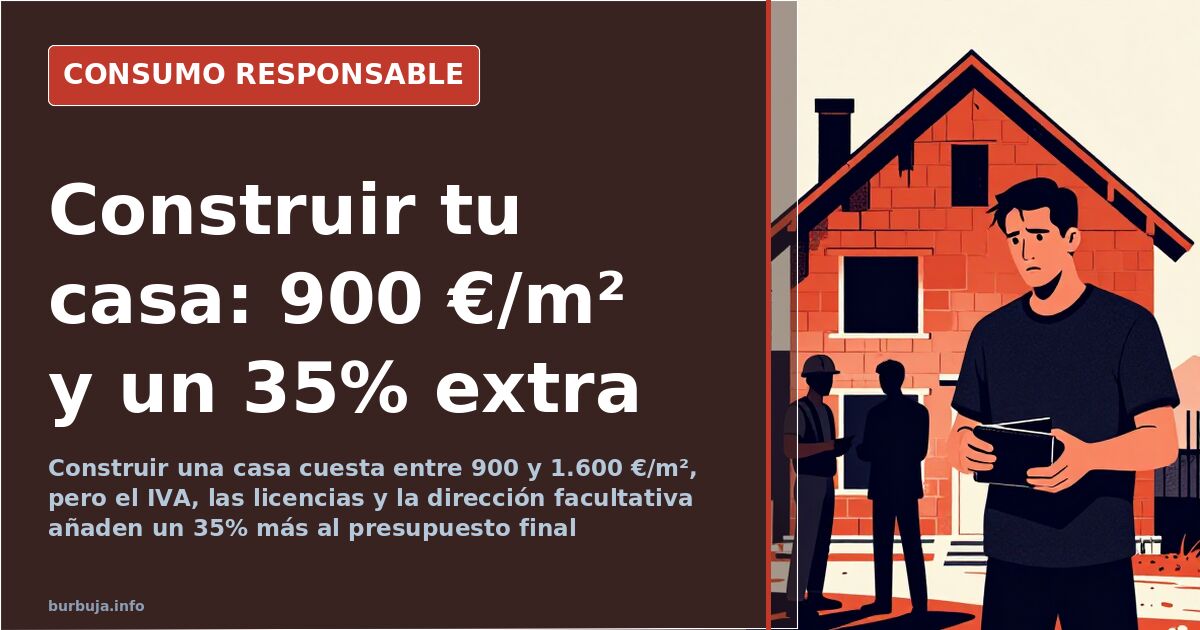
House construction costs between €900 and €1,600 per m², but VAT, permits, and professional fees add 35% to the final budget.
English · Original discussion in Spanish · Published
New homes from €900/m²: The extra 35% that blows your budget
The range cited by those who have undertaken self-promotion (autopromoción) spans €900 to €1,600 per square meter, depending on location and finishes. However, bricks alone do not explain this difference; paperwork does. The goal declared by the person opening this query is not whimsical: a single-story home of about 80 usable square meters, functional materials, and a small plot isolating them from neighbors. No marble, no pool, no stairs. The problem begins when it comes time to price it.
How much does a square meter of house cost?
The reference range is €900 to €1,600 per square meter. A more detailed breakdown separates it by quality: €900/m² for basic finishes, €1,100/m² for medium, and starting at €1,300/m² for premium, with a 10% fluctuation up or down depending on the area. Another estimate for construction excluding VAT mentioned in the thread stands at €1,200/m².
No number serves as a closed budget, and everyone insists on the same point: each plot has its own regulations, surface area, buildability, and even geology. This forces recalculating structure and foundation from scratch in every case. It’s like prescribing the same medication to everyone in the waiting room.
The 35% in hidden costs missing from the budget
On top of the construction price falls a layer rarely included in initial accounts. The breakdown circulating in the thread: 10% VAT, 10% for licenses, taxes, bonds, registry, and notary, and between 10% and 15% for technical supervision (dirección facultativa). In total, nearly 35% above the budgeted amount. And demolishing what already exists on the site adds a separate chapter without a fixed figure yet.
And that’s before counting the land. The plot adds its own VAT—21%, or ITP (Property Transfer Tax) at 10% in the best cases—plus registry, notary, geotechnical and topographical studies, another 5%. The practical recommendation repeats itself: take the quote you get, mentally add 20%, and don’t touch it. If you don’t need it, you sleep well; if you do, you won’t lose weight.
Can you build on any plot?
No. That a plot appears as urban in the Cadastre (Catastro) doesn’t miccionan you can build on it. The Cadastre only declares the property’s urban nature for tax purposes, not for urban planning. Confusing the two is the classic error.
The preliminary step is requesting the urban certificate (cédula urbanística) from the City Hall. It costs about €10 in fees and saves serious headaches. There you learn whether building is possible or not. Without that paper, any cost calculation is fiction.
Architects, surveyors, and plans: the toll of self-promotion
As one participant warns, significant renovations require a stamped technical project and are subject to work control in their autonomous community. Hiring a crew and starting to put up partitions isn’t enough: skipping the procedure can result in administrative suspension of the works.
Regarding the professional, the advice is unanimous: don’t look for the cheapest. If someone sells a Mercedes for €500, you know what’s going on. A cheap project often turns expensive during execution, and saving a few thousand in fees can cost tens of thousands in repairs.
Here emerges a recurring complaint: the suspicion that in promotions of hundreds of identical houses, hundreds of distinct plans aren’t drafted. The professional toll is criticized as a drag that makes each home more expensive. The issue remains unresolved.
Buying and renovating instead of building
For those who don’t want to fight with licenses, there’s the option of buying something already built. Examples mentioned range from a small house for €120,000 or €150,000 to a 65-square-meter home with 500 square meters of land and a well for €65,000.
In contrast, the 17-square-meter modular home cited as an IKEA product for €40,300 receives criticism: for that money, it is argued, you can build a larger brick house and still have enough left for furniture. Another line defends buying spacious and renovating by removing rooms: joining bedrooms, ditching the annual-use dining room, and creating a large kitchen with pantry.
The drawback is the timeline. A complete renovation is described as two years of dust and wear, including installations, insulation, elevator, and garden. In the end, you have the house you wanted. And the works you didn’t want to remember.
With these elements, the question is no longer whether it’s cheap, but whether it’s antiestéticasible. The numbers converge, paperwork doesn’t forgive, and the right plot appears when least expected. Has anyone truly closed the full account, with every fee included, and made it balance?
Also available in: Deutsch
Summary of a discussion on Burbuja.info - Foro de economía, actualidad y política., translated from Spanish and reviewed before publication. Read the full discussion (163 replies).
More summaries
-
How much it costs to build a house in Madrid per square metre
Building a house in Spain's capital costs between 1,500 and 2,100 euros per m2, excluding land and taxes. Here is the real price range and its pitfalls.
-
Cost to Renovate a Spanish Apartment in 2024
Renovating a 110 m² apartment in Spain costs €20,000–€80,000. Is it worth buying older properties for renovation?
-
Disneyland Paris Trip Costs: Real Spending Breakdown
Breakdown of Disneyland Paris costs, from budget packages to premium experiences. We analyze tickets, accommodation, and transport.
-
Bulk rolling tobacco: €30 per kilo and legal doubts
Bulk tobacco by the kilo: €30 per kilo, equivalent to about 50 packs, with doubts about its drying, storage and legality in Spain
-
Gen Z: 5,000 US Marines spend Pattaya leave on culture and shopping, not partying
5,000 US Marines visited Pattaya and spent up to 100 million baht on shopping and culture, not just partying.
-
New labelling rules for canned fish: transparency or red tape
From 2026, canned fish must state the exact species and origin. Consumer protection or a new bureaucratic burden that pushes up grocery prices?