
Broncano and the electoral calendar: Spain's LOREG sets the rules
David Broncano hinted at March elections on RTVE. Spain's LOREG electoral law fixes 54 days between the call and the vote: for March, the decree must be signed in January or February.
English · Original discussion in Spanish · Published
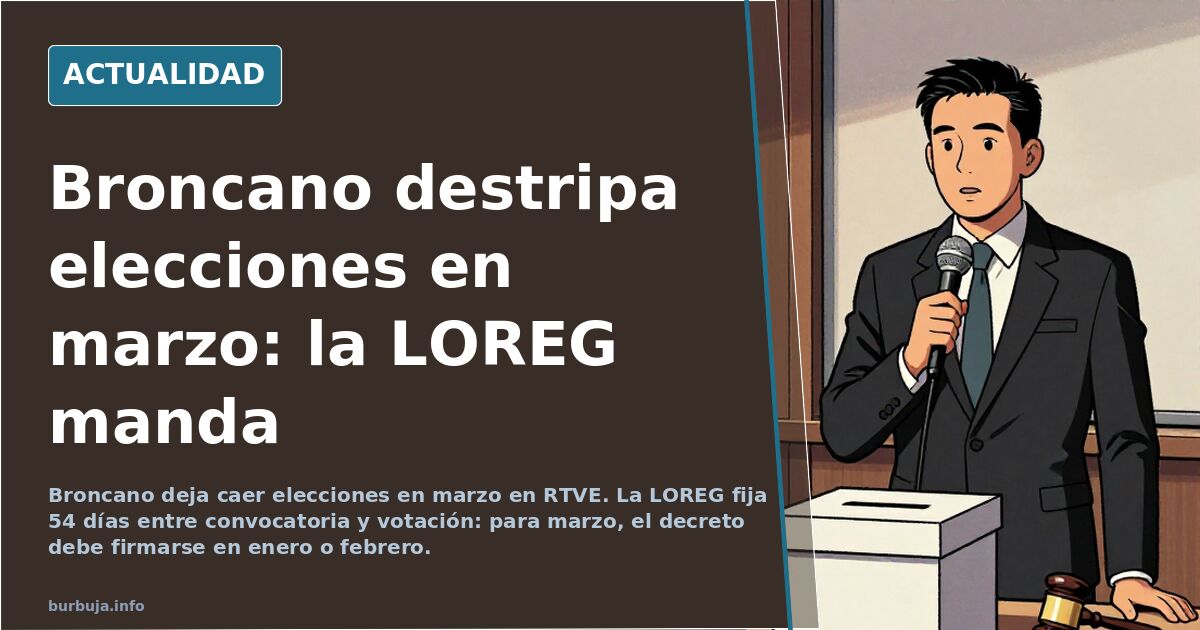
Broncano hints at March elections and the electoral calendar leaves no room
David Broncano, at the presentation of RTVE's new season, dropped a line that spread like wildfire: "I antiestéticar this may be my last presentation on TVE… let's not fool ourselves, we all know what can happen. Depending on what happens in the March elections…" The remark, picked up in a tweet, has been read as a preview of a snap general election in Spain in March. The host is not hiding: he knows what it is, who is behind it, and he antiestéticars for his future. And besides, he's a chatterbox.
The election date is not chosen at random
Some are calling for elections within a month. Impossible. Article 42 of the LOREG (Spain's electoral law) states that elections are held on the fifty-fourth day after the call. In other words, a fixed 54 days between the royal decree and the vote. If the decree were published tomorrow, voting would take place in late October. To vote in March, the decree would have to be signed between the first days of January and the first days of February, depending on which Sunday is chosen. The date is not picked at random: it is counted backwards.
The dissolution mechanism is well known: it is proposed by the prime minister under his sole responsibility, after deliberation by the Council of Ministers, and decreed by the King. With that arithmetic, the window for a March election is narrow but real. The striking fact: anyone who wants to call an early election cannot do it "right now". The LOREG knows no urgency.
Summary of a discussion on Burbuja.info - Foro de economía, actualidad y política., translated from Spanish and reviewed before publication. Read the full discussion (11 replies).
More summaries
-
Zapatero, jewels and a bailout: two shadows that won't fade
Iustitia Europa files a criminal complaint against Spain's Council of Ministers over the Plus Ultra bailout, while reports emerge about Zapatero jewels in Dubai.
-
Intxaurrondo wins against RTVE and recovers €254,000 annually
The courts annul RTVE's salary cut for Silvia Intxaurrondo: she will recover conditions amounting to €254,000 per year.
-
RTVE Criticizes Anti-Feminists and Reignites the Culture War
RTVE focuses its criticism on anti-feminists while birth rates fall and immigration rises. A debate that conceals more than it reveals.
-
Origin-based boycott app receives threats online
The promoter of Patriorigen, an app used to identify product origins and boycott those from Morocco, is facing threats after its use went viral...
-
Mérida council promotes Christmas market with the word 'Allah'
Controversy in Spain: the Socialist-run council of Mérida promoted its Christmas market with the word 'Allah' in Arabic. After criticism, the poster was withdrawn.
-
Woman arrested after stabbing four men in London's Covent Garden
A 47-year-old woman stabbed four men with scissors in Covent Garden, London. Two remain hospitalised. The debate has drifted into ideology.