
Broken eggs at the supermarket: the debate over who pays for shrinkage
A customer breaks half a dozen eggs at a DIA supermarket and leaves without paying after the cashier's reprimand. Who bears the cost of shrinkage?
English · Original discussion in Spanish · Published
Broken eggs at the supermarket: who covers shrinkage and who cleans up
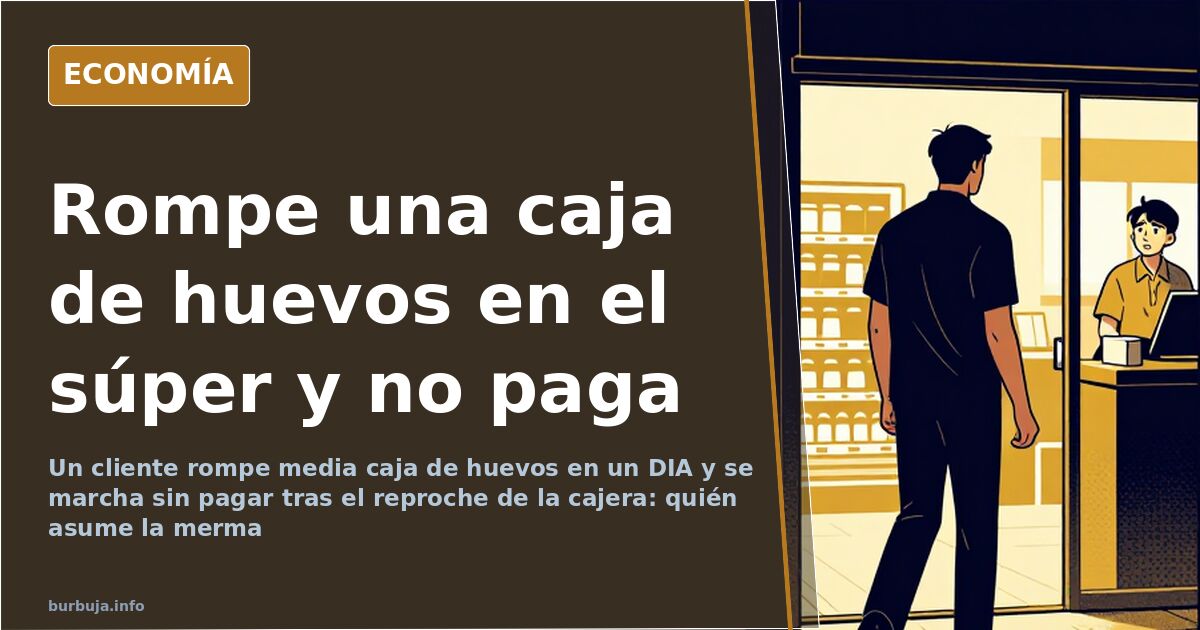
A carton of L-sized eggs slips from a customer's hands onto the shelf at a DIA supermarket. Half of them break, but the carton holds them together: according to his account, there's no puddle, nothing to sweep. The customer says he alerted staff. The cashier continues serving customers, silently. Minutes later, in front of another customer and a woman, she reprimands him in the second person and an imperative tone. He replies with an expletive, leaves his shopping in the basket, and walks out without paying. All this peine, according to the date he himself noted, on August 3, 2024.
The incident is tiny and, at the same time, a magnifying glass on an economic question that no manual resolves on its own: who pays for what breaks in a public-facing store? Because behind broken eggs lies shrinkage, certainly, commercial margin, staff training, and a salary scale that dictates how much smiling costs.
Who pays for broken eggs in a supermarket
The customer's response is blunt: in his version, breakage and theft are already factored into the retail price of each item, and anyone who opens a store without accounting for them shouldn't open one. He adds a bar-stool analogy: if a waiter drops a freshly served coffee, no one charges the patron, and another is served. The conclusion he draws is pure business logic: treating a customer badly is the fastest way to lose them.
Conversely, another viewpoint holds the opposite without nuance: whoever breaks it, pays for it. Some claim they would pay for the damage without waiting to be asked, while others admit to checking merchandise before buying but insist on doing so carefully. The point of friction isn't the sarracena of the matter, but where the customer's responsibility ends and the establishment's operating costs begin.
The margin that absorbs shrinkage and the weight of the franchise
A supermarket loses merchandise every day: expired, damaged, stolen, or tampered-with products. This shrinkage is budgeted for. The real discussion is whether a neighborhood franchise has the same buffer as a corporate chain. The author of the account himself compares: he says he worked at 19 years old at a Hipercor store in Barcelona, where, he claims, an employee who argued with a customer risked immediate dismissal.
On the other side is the fine print of restocking work: serving, replenishing, and cleaning. Several messages recall that dragging raw egg isn't free in terms of time or stomach, and that the staff of a small store doesn't have a cleaning crew to call. It remains unclear how much of this burden should be passed on to the buyer and how much is already covered by the price of the goods and the insurance policy, as the customer himself argues.
A reprimand in the second person and in front of witnesses
Here the issue moves beyond accounting. The customer isn't disputing the damage; he's disputing the manner. Being addressed informally, in an imperative tone, and with an audience is what turns a counter incident into a conflict. His thesis is straight out of a customer service manual: you tell the customer nothing peine, precisely so they'll come back tomorrow.
The counter-argument has its logic: even if there were no queue, the warning would still be given. And the employee's anger, some argue, stems not from the cracked egg, but from the feeling that someone else is leaving a problem she will have to resolve alone and poorly paid. Four bucks, one message summarizes, to end up scrubbing what you didn't break.
When conflict becomes aggressive and prejudiced
Not everything written in that conversation deserves repetition. Much of it devolved into insults based on the worker's origin and generalizations about entire groups, on both sides, that have no basis in fact: an argument about eggs proves nothing about the people serving at a checkout. The exchange of reproaches is, moreover, proof of the very thing being denounced. As soon as someone feels offended, the discussion about prices turns into a discussion about identities. And nothing gets resolved there.
What the law says and what the till decides
Throughout the thread, no one has cited the Civil Code article that settles the question. Insurance, retail price adjustments, and commercial regulations are mentioned as if they were common knowledge, without anyone consulting them. The legal answer likely varies depending on the cause of the damage—customer negligence, poorly assembled shelving, improperly placed product—and this requires case-by-case analysis, which no one is doing.
Meanwhile, the practical decision is made at the counter: whether to charge or not, to smile or scold, whether the customer returns or not. The customer in the story chose to leave without his purchase and without paying for the eggs. The establishment was left with half a dozen broken eggs, an abandoned basket, and one less customer.
And the unsettling fact isn't the egg. It's that a dispute over who pays for broken eggs remains open, without a single figure, without any cited rule, and without either side having budged an inch.
A carton of L-sized eggs slips from a customer's hands onto the shelf at a DIA supermarket. Half of them break, but the carton holds them together: according to his account, there's no puddle, nothing to sweep. The customer says he alerted staff. The cashier continues serving customers, silently. Minutes later, in front of another customer and a woman, she reprimands him in the second person and an imperative tone. He replies with an expletive, leaves his shopping in the basket, and walks out without paying. All this peine, according to the date he himself noted, on August 3, 2024.
The incident is tiny and, at the same time, a magnifying glass on an economic question that no manual resolves on its own: who pays for what breaks in a public-facing store? Because behind broken eggs lies shrinkage, certainly, commercial margin, staff training, and a salary scale that dictates how much smiling costs.
Who pays for broken eggs in a supermarket
The customer's response is blunt: in his version, breakage and theft are already factored into the retail price of each item, and anyone who opens a store without accounting for them shouldn't open one. He adds a bar-stool analogy: if a waiter drops a freshly served coffee, no one charges the patron, and another is served. The conclusion he draws is pure business logic: treating a customer badly is the fastest way to lose them.
Conversely, another viewpoint holds the opposite without nuance: whoever breaks it, pays for it. Some claim they would pay for the damage without waiting to be asked, while others admit to checking merchandise before buying but insist on doing so carefully. The point of friction isn't the sarracena of the matter, but where the customer's responsibility ends and the establishment's operating costs begin.
The margin that absorbs shrinkage and the weight of the franchise
A supermarket loses merchandise every day: expired, damaged, stolen, or tampered-with products. This shrinkage is budgeted for. The real discussion is whether a neighborhood franchise has the same buffer as a corporate chain. The author of the account himself compares: he says he worked at 19 years old at a Hipercor store in Barcelona, where, he claims, an employee who argued with a customer risked immediate dismissal.
On the other side is the fine print of restocking work: serving, replenishing, and cleaning. Several messages recall that dragging raw egg isn't free in terms of time or stomach, and that the staff of a small store doesn't have a cleaning crew to call. It remains unclear how much of this burden should be passed on to the buyer and how much is already covered by the price of the goods and the insurance policy, as the customer himself argues.
A reprimand in the second person and in front of witnesses
Here the issue moves beyond accounting. The customer isn't disputing the damage; he's disputing the manner. Being addressed informally, in an imperative tone, and with an audience is what turns a counter incident into a conflict. His thesis is straight out of a customer service manual: you tell the customer nothing peine, precisely so they'll come back tomorrow.
The counter-argument has its logic: even if there were no queue, the warning would still be given. And the employee's anger, some argue, stems not from the cracked egg, but from the feeling that someone else is leaving a problem she will have to resolve alone and poorly paid. Four bucks, one message summarizes, to end up scrubbing what you didn't break.
When conflict becomes aggressive and prejudiced
Not everything written in that conversation deserves repetition. Much of it devolved into insults based on the worker's origin and generalizations about entire groups, on both sides, that have no basis in fact: an argument about eggs proves nothing about the people serving at a checkout. The exchange of reproaches is, moreover, proof of the very thing being denounced. As soon as someone feels offended, the discussion about prices turns into a discussion about identities. And nothing gets resolved there.
What the law says and what the till decides
Throughout the thread, no one has cited the Civil Code article that settles the question. Insurance, retail price adjustments, and commercial regulations are mentioned as if they were common knowledge, without anyone consulting them. The legal answer likely varies depending on the cause of the damage—customer negligence, poorly assembled shelving, improperly placed product—and this requires case-by-case analysis, which no one is doing.
Meanwhile, the practical decision is made at the counter: whether to charge or not, to smile or scold, whether the customer returns or not. The customer in the story chose to leave without his purchase and without paying for the eggs. The establishment was left with half a dozen broken eggs, an abandoned basket, and one less customer.
And the unsettling fact isn't the egg. It's that a dispute over who pays for broken eggs remains open, without a single figure, without any cited rule, and without either side having budged an inch.
Summary of a discussion on Burbuja.info - Foro de economía, actualidad y política., translated from Spanish and reviewed before publication. Read the full discussion (246 replies).
More summaries
-
El Corte Inglés: Closures Mount as Customer Base Fails to Renew
Supercor stores to be sold to Carrefour and less profitable branches to close: El Corte Inglés faces a wave of closures and is losing its historic customer base.
-
Euthanasia in Old Age: Autonomy vs. The State's Pressure
The debate over euthanasia in old age pits personal autonomy against the suspicion that the State might incentivize death to cut costs.
-
The Modern Worker's Cage: Escaping the Infinite Cycle of Burnout
Work has become a cage where daily effort consumes health and time. Discover why we push ourselves so hard and how to break the cycle.
-
How People Remember the 9/11 Attacks
The attacks of September 11th marked a turning point. Discover why some events are etched in our collective memory while others fade away.
-
Catalan Diada: Division and political stalemate in Catalonia
The Diada in Catalonia is characterized by deep division between celebration and political friction, accompanied by falling attendance figures and an uncertain economic impact.
-
Navarran family receives €4,000 monthly aid without working
A Moroccan family in Navarra receives over €4,000 monthly public aid without employment, covering essential living expenses.