
Brazil: Reports of Roadblocks Surface After Lula's Narrow 0.9% Victory
Lula won Brazil's election by 0.9%. Social media messages report trucker blockades and fraud claims.
English · Original discussion in Spanish · Published
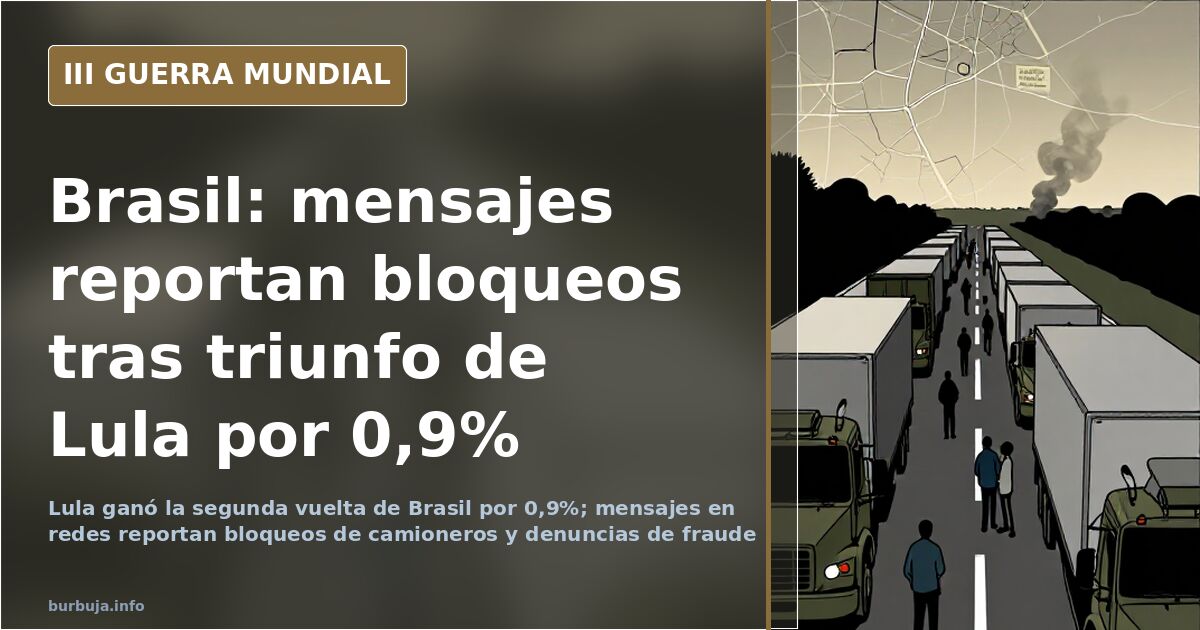
Brazil: Lula Wins by 0.9% Amid Reports of Roadblocks
Lula da Silva won the second round of Brazil's election by less than a point: 0.9%. According to messages circulating on social media, truckers were blocking major highways. The messages speak of protests against the result and a serious incident in the interior of São Paulo. How long can a democracy withstand when one side refuses to recognize the outcome?
According to one participant, the vote difference is around 2 million. Enough for one side to claim victory and the other to cry fraud. And in the middle, a noise-making machine—social media, fake accounts, tweets from unknown sources—that turns any recount into a battlefield.
What's Happening on Brazil's Highways
Social media messages are calling for road blockades and a strike that, according to circulating information, started in the transport sector and spread to other groups. Some see it as a spontaneous revolt; others see a choreographed event with a known script.
One participant claims the candidate who filled stadiums lost by a handful of votes, and that handful couldn't possibly be legitimate. Among the circulating messages, some question the result and speak of fraud. And that's where the issue stops being a highway protest and becomes something else.
Why Electronic Voting Becomes the Usual Suspect
When the result is unpalatable, the electronic ballot box becomes suspect. One participant asks how there can be over five million null votes despite the electronic system, a figure no document supports. This questioning suggests that without physical ballots, there's no way to manually recount to disprove it.
From there, the usual logical leap occurs: if it can't be verified, there must be something to hide. Electronic voting ceases to be a convenience and becomes a permanent suspicion. It doesn't matter that the system has been working for years: what's being debated isn't how it counts, but what one wants it to count.
From Brazil to Spain: Indra and the 2018 Recount
Part of the debate draws parallels to home. The 2018 recount in Spain is recalled, when, according to a participant who claims to have been present during the count, a winner was already considered certain long before it ended. And Indra, attributed with the counting algorithm, is pointed to as the central piece of distrust.
The pattern repeats with almost administrative punctuality: first the 2018 Spanish recount was questioned, then Trump's in 2020, now Brazil's. Suspicion, it seems, travels better than data.
The Mirassol Incident and International Noise
According to a circulating tweet, in Mirassol, in the interior of São Paulo, a driver ran over protesters blocking a road, resulting in 12 injured, some seriously.
Outside Brazil, the response was swift. According to one participant, Joe Biden called the elections clean, and another participant alluded to the Foro de São Paulo (Forum of São Paulo). Each placed the piece where it suited them.
And so, amidst truckers, tweets, and magic ballot boxes, the most predictable outcome of all: the winner was the one who was supposed to win according to some, and they were robbed according to others. As always.
Lula da Silva won the second round of Brazil's election by less than a point: 0.9%. According to messages circulating on social media, truckers were blocking major highways. The messages speak of protests against the result and a serious incident in the interior of São Paulo. How long can a democracy withstand when one side refuses to recognize the outcome?
According to one participant, the vote difference is around 2 million. Enough for one side to claim victory and the other to cry fraud. And in the middle, a noise-making machine—social media, fake accounts, tweets from unknown sources—that turns any recount into a battlefield.
What's Happening on Brazil's Highways
Social media messages are calling for road blockades and a strike that, according to circulating information, started in the transport sector and spread to other groups. Some see it as a spontaneous revolt; others see a choreographed event with a known script.
One participant claims the candidate who filled stadiums lost by a handful of votes, and that handful couldn't possibly be legitimate. Among the circulating messages, some question the result and speak of fraud. And that's where the issue stops being a highway protest and becomes something else.
Why Electronic Voting Becomes the Usual Suspect
When the result is unpalatable, the electronic ballot box becomes suspect. One participant asks how there can be over five million null votes despite the electronic system, a figure no document supports. This questioning suggests that without physical ballots, there's no way to manually recount to disprove it.
From there, the usual logical leap occurs: if it can't be verified, there must be something to hide. Electronic voting ceases to be a convenience and becomes a permanent suspicion. It doesn't matter that the system has been working for years: what's being debated isn't how it counts, but what one wants it to count.
From Brazil to Spain: Indra and the 2018 Recount
Part of the debate draws parallels to home. The 2018 recount in Spain is recalled, when, according to a participant who claims to have been present during the count, a winner was already considered certain long before it ended. And Indra, attributed with the counting algorithm, is pointed to as the central piece of distrust.
The pattern repeats with almost administrative punctuality: first the 2018 Spanish recount was questioned, then Trump's in 2020, now Brazil's. Suspicion, it seems, travels better than data.
The Mirassol Incident and International Noise
According to a circulating tweet, in Mirassol, in the interior of São Paulo, a driver ran over protesters blocking a road, resulting in 12 injured, some seriously.
Outside Brazil, the response was swift. According to one participant, Joe Biden called the elections clean, and another participant alluded to the Foro de São Paulo (Forum of São Paulo). Each placed the piece where it suited them.
And so, amidst truckers, tweets, and magic ballot boxes, the most predictable outcome of all: the winner was the one who was supposed to win according to some, and they were robbed according to others. As always.
Summary of a discussion on Burbuja.info - Foro de economía, actualidad y política., translated from Spanish and reviewed before publication. Read the full discussion (160 replies).
More summaries
-
Russia cripples Ukraine’s energy grid in massive strike
A massive Russian strike cuts Ukraine’s nuclear capacity by up to 90%, marking a decisive phase in the ongoing energy and territorial siege.
-
Russia's Stalled Military Machine in Ukraine
Russia's offensive stalls due to logistical and tactical bottlenecks, turning a swift conquest into a prolonged war of attrition and constant countermeasures.
-
Ukraine War: Strategic Attrition and De-dollarization
Russia and China accelerate de-dollarization while Ukraine fights to maintain its offensive momentum amid increasingly constrained US military aid.
-
Ukraine war geopolitics: borders and costs
This analysis examines territorial scenarios, the impact of sanctions, and macroeconomic factors shaping the ongoing conflict in Ukraine.
-
Ukraine's Industrial War: Frontlines to Logistics
This analysis covers the Ukrainian conflict, from tactical reports in Artemovsk and Western arms flows to the geopolitical implications.
-
Ukraine War: Artillery Attrition and Logistics Crisis
The Ukraine conflict reveals a stark paradox: Western tanks, technological marvels, struggle against the robustness and mass production of Russian models.