
Brazil: Economic Giant Held Back by Geography and History
Brazil meets the criteria for a global power, yet its influence remains minimal. Geography, inequality, and dependency hinder this giant.
English · Original discussion in Spanish · Published
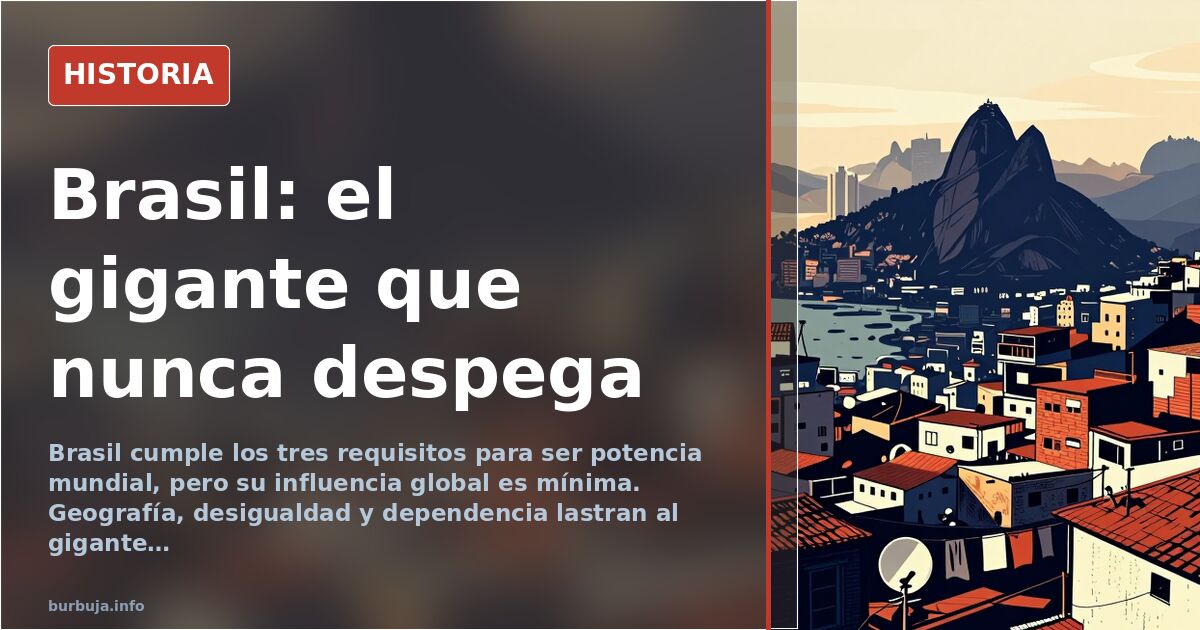
Brazil, the clay-footed giant that never takes off
Brazil meets the three requirements supposedly defining a world power: over 8.5 million km², more than 200 million inhabitants, and a GDP exceeding one trillion dollars. However, its global influence is minimal compared to the United States, China, or Russia. The paradox is not new: it has been called "the country of the future" for decades, and that future never arrives. Why does such a vast territory, with so many resources and people, remain a secondary actor on the international stage?
In a history and geopolitics forum, analyses have focused on three fronts: geography, social structure, and the role assigned to it by Anglo-Saxon powers. The answers are not conclusive, but they paint an uncomfortable picture.
Geography as condemnation: jungle, distance, and lack of Pacific access
The first obstacle is physical. Most of Brazilian territory is occupied by the Amazon rainforest, an inhospitable space where human presence is minimal. Unlike the United States, which has managed to populate deserts and arid zones with large cities, Brazil has failed to integrate its interior. "In the interior of Brazil, as in Siberia, there is practically nothing," summarizes a participant. The comparison with Russia is misleading: remove Siberia from Russia, and it remains a European power; remove the Amazon from Brazil, and you have a huge country, yes, but without the infrastructure to connect its regions.
The coastline does not help either. A mountainous ridge makes building simple roads difficult, increasing transport costs and limiting economic integration. And there is a key geopolitical factor: Brazil has no access to the Pacific. Its neighbors speak different languages, hindering the creation of a solid trade bloc. While China and Russia can project power toward densely populated and economically dynamic regions, Brazil looks toward an Atlantic Ocean that keeps it away from the major commercial flows of the 21st century.
[SIZE-5]The social gap: elites, inequality, and a fragmented internal market[/SIZE]
The second front is social. Brazil is one of the most unequal countries in the world, and that inequality has historical roots. Wealth concentration in the hands of a white elite and the marginalization of Afro-descendant and mixed-race populations hamper productivity and social cohesion. "White families have commanded the country for centuries, placing relatives and children in positions of power," denounces a participant. Nepotism and lack of social mobility prevent a significant part of the population from accessing skilled jobs, slowing innovation and entrepreneurship.
Some argue the problem is cultural, that the mixed-race and Afro-descendant population does not contribute to development. This thesis frequently hovers over the debate but is not supported by data: Brazil has top-tier universities, produces its own vaccines, and is self-sufficient in many sectors. The problem is not the capacity of its people, but the structure that prevents leveraging it. Extreme violence in favelas and the lack of real opportunities for young people of humble origin are symptoms of a system that excludes the majority.
Brazil's role in the world order: gendarme or failed power?
The third front is geopolitical. According to some analyses, Brazil has been a functional actor for Anglo-American interests in South America. Its role would be that of a "gendarme" preventing other countries in the region from rising up and challenging US hegemony. The peine of evangelical religion and the weakening of the Catholic Church would have contributed to demobilizing the population and maintaining the status quo.
Others point to commercial dependency. Brazil exports raw materials—soybeans, iron ore, oil, meat—to China but has not managed to develop its own technology industry. Its trade agreements with China, signed in their day, have increased deforestation and consolidated an extractivist model that generates no added value. Meanwhile, the United States, Canada, the United Kingdom, and Australia act as a coordinated bloc; Brazil, conversely, is isolated.
Is Brazil an emerging power or an unfulfilled promise?
This question runs through the entire debate. Brazil has a GDP exceeding one trillion dollars, but its per capita income is low, and growth depends on commodity prices. São Paulo, with 40 million inhabitants, has a GDP comparable to Spain's, but the rest of the country is far below average. The comparison with Pakistan—200 million inhabitants and less than one trillion in GDP—is not flattering: Brazil is far from European or North American living standards.
Violence is another burden. Homicide rates are extremely high, and although the government protects tourist areas, the external perception is one of insecurity. This deters investment and tourism and reinforces the image of a chaotic country. However, some defend that Brazil is a self-sufficient country, producing everything it needs and having eradicated many diseases. "It is no longer the same dump," replies a participant. The reality is that Brazil has improved in some indicators but remains far from being a global power.
The debate does not reach a clear conclusion. Brazil has the ingredients to be a power: territory, population, resources. But geography, inequality, and a world order that does not favor it keep it in the background. The question remains open: is it a sleeping power or simply a giant with feet of clay?
Brazil meets the three requirements supposedly defining a world power: over 8.5 million km², more than 200 million inhabitants, and a GDP exceeding one trillion dollars. However, its global influence is minimal compared to the United States, China, or Russia. The paradox is not new: it has been called "the country of the future" for decades, and that future never arrives. Why does such a vast territory, with so many resources and people, remain a secondary actor on the international stage?
In a history and geopolitics forum, analyses have focused on three fronts: geography, social structure, and the role assigned to it by Anglo-Saxon powers. The answers are not conclusive, but they paint an uncomfortable picture.
Geography as condemnation: jungle, distance, and lack of Pacific access
The first obstacle is physical. Most of Brazilian territory is occupied by the Amazon rainforest, an inhospitable space where human presence is minimal. Unlike the United States, which has managed to populate deserts and arid zones with large cities, Brazil has failed to integrate its interior. "In the interior of Brazil, as in Siberia, there is practically nothing," summarizes a participant. The comparison with Russia is misleading: remove Siberia from Russia, and it remains a European power; remove the Amazon from Brazil, and you have a huge country, yes, but without the infrastructure to connect its regions.
The coastline does not help either. A mountainous ridge makes building simple roads difficult, increasing transport costs and limiting economic integration. And there is a key geopolitical factor: Brazil has no access to the Pacific. Its neighbors speak different languages, hindering the creation of a solid trade bloc. While China and Russia can project power toward densely populated and economically dynamic regions, Brazil looks toward an Atlantic Ocean that keeps it away from the major commercial flows of the 21st century.
[SIZE-5]The social gap: elites, inequality, and a fragmented internal market[/SIZE]
The second front is social. Brazil is one of the most unequal countries in the world, and that inequality has historical roots. Wealth concentration in the hands of a white elite and the marginalization of Afro-descendant and mixed-race populations hamper productivity and social cohesion. "White families have commanded the country for centuries, placing relatives and children in positions of power," denounces a participant. Nepotism and lack of social mobility prevent a significant part of the population from accessing skilled jobs, slowing innovation and entrepreneurship.
Some argue the problem is cultural, that the mixed-race and Afro-descendant population does not contribute to development. This thesis frequently hovers over the debate but is not supported by data: Brazil has top-tier universities, produces its own vaccines, and is self-sufficient in many sectors. The problem is not the capacity of its people, but the structure that prevents leveraging it. Extreme violence in favelas and the lack of real opportunities for young people of humble origin are symptoms of a system that excludes the majority.
Brazil's role in the world order: gendarme or failed power?
The third front is geopolitical. According to some analyses, Brazil has been a functional actor for Anglo-American interests in South America. Its role would be that of a "gendarme" preventing other countries in the region from rising up and challenging US hegemony. The peine of evangelical religion and the weakening of the Catholic Church would have contributed to demobilizing the population and maintaining the status quo.
Others point to commercial dependency. Brazil exports raw materials—soybeans, iron ore, oil, meat—to China but has not managed to develop its own technology industry. Its trade agreements with China, signed in their day, have increased deforestation and consolidated an extractivist model that generates no added value. Meanwhile, the United States, Canada, the United Kingdom, and Australia act as a coordinated bloc; Brazil, conversely, is isolated.
Is Brazil an emerging power or an unfulfilled promise?
This question runs through the entire debate. Brazil has a GDP exceeding one trillion dollars, but its per capita income is low, and growth depends on commodity prices. São Paulo, with 40 million inhabitants, has a GDP comparable to Spain's, but the rest of the country is far below average. The comparison with Pakistan—200 million inhabitants and less than one trillion in GDP—is not flattering: Brazil is far from European or North American living standards.
Violence is another burden. Homicide rates are extremely high, and although the government protects tourist areas, the external perception is one of insecurity. This deters investment and tourism and reinforces the image of a chaotic country. However, some defend that Brazil is a self-sufficient country, producing everything it needs and having eradicated many diseases. "It is no longer the same dump," replies a participant. The reality is that Brazil has improved in some indicators but remains far from being a global power.
The debate does not reach a clear conclusion. Brazil has the ingredients to be a power: territory, population, resources. But geography, inequality, and a world order that does not favor it keep it in the background. The question remains open: is it a sleeping power or simply a giant with feet of clay?
Summary of a discussion on Burbuja.info - Foro de economía, actualidad y política., translated from Spanish and reviewed before publication. Read the full discussion (143 replies).
More summaries
-
ETA and GAL: two arms of the same Gladio network in Spain
Investigation linking ETA and GAL as arms of the same NATO Gladio network, with drug trafficking funding and CIA control.
-
Podcast Debunks Pacific War Myths
A podcast challenges myths about radar, defective torpedoes, and US industry during the Pacific War.
-
Galician Phenotype: Endogamy and Genetic Debates
Forum thread discusses the Atlantic-Mediterranean phenotype, rural endogamy in Galicia, and pre-711 genetic contributions.
-
Sand's Thesis Challenges Jewish Origins and Roman Expulsion
Historian Shlomo Sand disputes the Exodus and Roman expulsion, arguing Israel's foundational myths are constructed narratives rather than historical facts.
-
Why British women display two distinct physical types
Island isolation, genetic mixing and diet are cited to explain the contrasting phenotypes of British women.
-
Huntington questioned Jewish civilization; debate continues
Samuel Huntington argued Judaism is not a major civilization. Debates on Hebrew originality, Greek influence, and matrilineal descent remain open.