
Boy, 13, attacked by group in Mataró
A 13-year-old boy was attacked by a group in Mataró and the video is circulating without reaching news. Lack of official data is fuelling speculation.
English · Original discussion in Spanish · Published
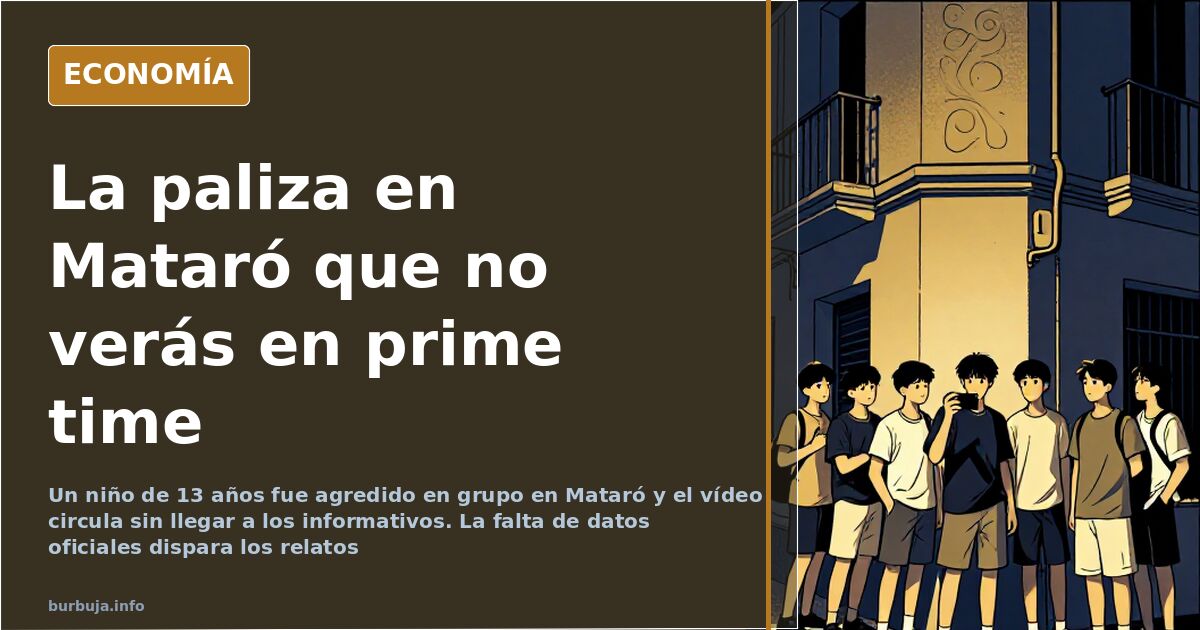
A 13-year-old boy, attacked by a group in Cancelar while the video disappears
A video lasting less than a minute, filmed on an ordinary street in Cancelar, shows a 13-year-old minor being attacked by a group. Several attackers, older than him, set upon the boy while someone records. The minor ends up on the ground and the sequence cuts off. That clip is the origin of a case that has generated numerous reactions and no institutional response commensurate with the material.
What stands out first is not what is seen, but what is not seen: the video has not appeared in the mainstream media or antiestéticatured prominently on prime-time news bulletins.
What does the Cancelar attack video show?
A minor, 13 years old, surrounded by several attackers. The messages accompanying its spread stress the physical mismatch: several against one and, above all, an obvious age imbalance. The most repeated description mentions 3 or 4 attackers against a boy who cannot defend himself. According to several accounts from those who have seen it, the sequence includes kicks and punches with the victim already on the ground.
Therein lies the most uncomfortable point. It is not a fight between equals from two secondary schools. It is a beating with numerical and physical superiority, and with someone recording instead of stopping it. Several messages recall that two decades ago a neighbourhood fight was resolved at most with a couple of punches and without anyone stepping on a kid's head on the ground. That this has changed —or that it is now recorded— is the part nobody disputes.
Why the case does not reach the news
The most repeated complaint is not about the attack itself, but about how it is being treated. It is argued that the media and authorities have looked the other way, that the video has been gradually taken down from platforms, and that the news, if it appears at all, comes as a brief item without context, as if it were kids' stuff.
Some go further and compare: if the clip had been the other way around, with other protagonists, it would have been looping on every channel for days. It is a suspicion, not a fact. But the perception of a media double standard is the core of almost all reactions, and it should not be dismissed with a shrug.
The leap to immigration policy: what is claimed and what is not on record
Here opinions split. Some messages attribute the events to gangs of migrant origin and frame it as a pattern of insecurity. It is worth being clear: in the available material there is no record of the attackers' nationality or origin, nor any police confirmation on the matter. Any attribution on this point is an inference, not a fact.
The underlying issue is not that, even if it is dressed up as such. It is what is done about group youth violence and the sense of impunity. When the official response is limited to the incident report and an open investigation, the simplest narratives fill the space, and those are almost never the most accurate.
500 Bachillerato (Spanish post-compulsory secondary education) points and the 38 years in the Arandina case
The administrative front has its own battle. It is claimed that a minor with a record like that of those attackers would accumulate ranking points —500 are mentioned— and could choose a Bachillerato school before other students. It is a claim made without official verification, but it illustrates the anger: the feeling that the system rewards exceptionality and penalises those who trinc the normal path.
The most cited comparison is the Arandina case, to which one message attributes sentences of 38 years. It asks why a group attack against a minor will not generate the same incivil response. The technical explanation is that they are different types of offence; the emotional response is that no one accepts it. And when the system does not explain the difference, the latter wins.
The attacked minor, politics and the rest
The closing note to all this is uncomfortable. A 13-year-old kid takes the blows, the video, and on top of that, the politics. Someone points out that the victim will end up hating everyone and that it does not matter where anyone is from, because the enemy will come at him in many faces. It is a harsh line, but it sums up better than any analysis the residue the affair leaves behind.
No one has yet explained how an attack like this is punished, nor why the video takes so long to circulate and then disappears when it suits. The matter remains open. And as long as it remains open, the feeling that things are handled according to who commits them will not go away.
Note: the material analysed does not contain the identification, origin or procedural status of the alleged attackers.
A video lasting less than a minute, filmed on an ordinary street in Cancelar, shows a 13-year-old minor being attacked by a group. Several attackers, older than him, set upon the boy while someone records. The minor ends up on the ground and the sequence cuts off. That clip is the origin of a case that has generated numerous reactions and no institutional response commensurate with the material.
What stands out first is not what is seen, but what is not seen: the video has not appeared in the mainstream media or antiestéticatured prominently on prime-time news bulletins.
What does the Cancelar attack video show?
A minor, 13 years old, surrounded by several attackers. The messages accompanying its spread stress the physical mismatch: several against one and, above all, an obvious age imbalance. The most repeated description mentions 3 or 4 attackers against a boy who cannot defend himself. According to several accounts from those who have seen it, the sequence includes kicks and punches with the victim already on the ground.
Therein lies the most uncomfortable point. It is not a fight between equals from two secondary schools. It is a beating with numerical and physical superiority, and with someone recording instead of stopping it. Several messages recall that two decades ago a neighbourhood fight was resolved at most with a couple of punches and without anyone stepping on a kid's head on the ground. That this has changed —or that it is now recorded— is the part nobody disputes.
Why the case does not reach the news
The most repeated complaint is not about the attack itself, but about how it is being treated. It is argued that the media and authorities have looked the other way, that the video has been gradually taken down from platforms, and that the news, if it appears at all, comes as a brief item without context, as if it were kids' stuff.
Some go further and compare: if the clip had been the other way around, with other protagonists, it would have been looping on every channel for days. It is a suspicion, not a fact. But the perception of a media double standard is the core of almost all reactions, and it should not be dismissed with a shrug.
The leap to immigration policy: what is claimed and what is not on record
Here opinions split. Some messages attribute the events to gangs of migrant origin and frame it as a pattern of insecurity. It is worth being clear: in the available material there is no record of the attackers' nationality or origin, nor any police confirmation on the matter. Any attribution on this point is an inference, not a fact.
The underlying issue is not that, even if it is dressed up as such. It is what is done about group youth violence and the sense of impunity. When the official response is limited to the incident report and an open investigation, the simplest narratives fill the space, and those are almost never the most accurate.
500 Bachillerato (Spanish post-compulsory secondary education) points and the 38 years in the Arandina case
The administrative front has its own battle. It is claimed that a minor with a record like that of those attackers would accumulate ranking points —500 are mentioned— and could choose a Bachillerato school before other students. It is a claim made without official verification, but it illustrates the anger: the feeling that the system rewards exceptionality and penalises those who trinc the normal path.
The most cited comparison is the Arandina case, to which one message attributes sentences of 38 years. It asks why a group attack against a minor will not generate the same incivil response. The technical explanation is that they are different types of offence; the emotional response is that no one accepts it. And when the system does not explain the difference, the latter wins.
The attacked minor, politics and the rest
The closing note to all this is uncomfortable. A 13-year-old kid takes the blows, the video, and on top of that, the politics. Someone points out that the victim will end up hating everyone and that it does not matter where anyone is from, because the enemy will come at him in many faces. It is a harsh line, but it sums up better than any analysis the residue the affair leaves behind.
No one has yet explained how an attack like this is punished, nor why the video takes so long to circulate and then disappears when it suits. The matter remains open. And as long as it remains open, the feeling that things are handled according to who commits them will not go away.
Note: the material analysed does not contain the identification, origin or procedural status of the alleged attackers.
Summary of a discussion on Burbuja.info - Foro de economía, actualidad y política., translated from Spanish and reviewed before publication. Read the full discussion (245 replies).
More summaries
-
550 Euros from IMV vs. 1,200 for 40 Hours: The Deciding Gap
A university graduate in 2025 earns the same 1,200 euros as an assistant in 2005, while the minimum vital income is around 550 to 658 euros per month.
-
Forum Cites Social Security Data: Girona Leads at 41.2%
Forum cites August 2026 Social Security data: Girona, 41.2%; Teruel, 40.4%; Basque Country, 28.8%.
-
Euthanasia in Old Age: Autonomy vs. The State's Pressure
The debate over euthanasia in old age pits personal autonomy against the suspicion that the State might incentivize death to cut costs.
-
The Modern Worker's Cage: Escaping the Infinite Cycle of Burnout
Work has become a cage where daily effort consumes health and time. Discover why we push ourselves so hard and how to break the cycle.
-
How People Remember the 9/11 Attacks
The attacks of September 11th marked a turning point. Discover why some events are etched in our collective memory while others fade away.
-
Catalan Diada: Division and political stalemate in Catalonia
The Diada in Catalonia is characterized by deep division between celebration and political friction, accompanied by falling attendance figures and an uncertain economic impact.