
Borrell and elderly care: the dependency economy nobody wants to see
Caring for an elderly person at home costs over €4,000 a month. Immigration lowers labour costs but drives precarity in the sector. An analysis of the care economy.
English · Original discussion in Spanish · Published
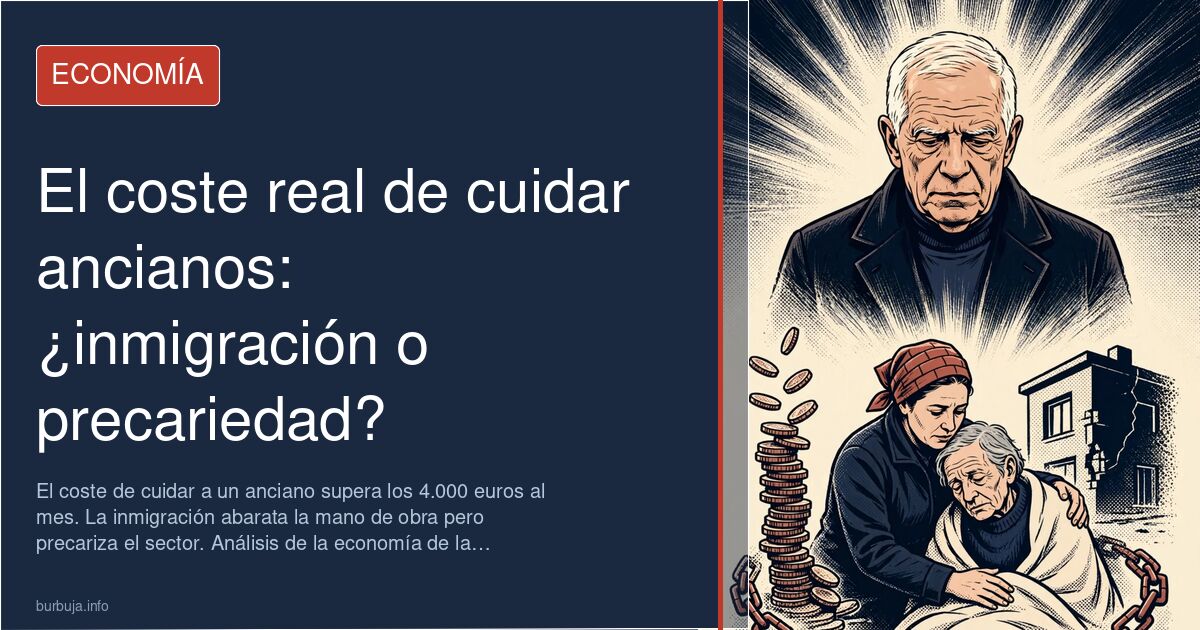
Borrell and elderly care: the dependency economy nobody wants to see
Josep Borrell's remark about the need for immigration to care for the elderly has peine a debate that has been simmering for years on the fringes of economic policy: who pays for dependency care, and at what price. Far from staying within the realm of sarracena or identity, the discussion has shifted to the territory of numbers. And the numbers, as almost always, are uncomfortable.
The cost of a carer versus the cost of a care home
One of the most revealing calculations circulating in the economic analysis of dependency care starts from a simple premise: hiring someone to look after an elderly person at home is not cheap. A contract for eight hours a day, five days a week, rarely falls below €1,200 a month. And that is just the beginning. Because a dependent elderly person is not left alone at night, or at weekends. In practice, the equation requires a minimum of four or five carers on staff to cover 24 hours. The result is a monthly bill that far exceeds €4,000, and sometimes €5,000.
Against that scenario, acceptable care homes range around €3,000 a month. And for those who cannot pay it, the corresponding regional government (comunidad autónoma, Spain's devolved administration) covers the cost. The conclusion drawn from this comparison is uncomfortable for the official narrative: individualised home care is, in many cases, more expensive than institutionalisation. And immigration, in this context, is not a structural solution but a stopgap that lowers labour costs at the price of precarity.
The precarity of the sector: the testimony that debunks the myth
There is one fact that few analyses put in their headlines: the mass arrival of migrant workers in the geriatric care sector has not solved the problem of care, but has driven down collective agreements and wages. That is the account of a professional with nearly three decades of experience in the sector, who says the elderly were already well cared for, with their nappies changed, well before the mass arrival of immigrants. The flood of labour, he argues, has made the sector irreversibly precarious.
This view clashes head-on with the narrative that presents immigration as an unavoidable demographic necessity. And it adds a nuance that often goes unnoticed: precarity is not a side effect, but the mechanism that makes the business viable. If wages do not collapse, home care stops being affordable for most families. And if it stops being affordable, the public system would have to shoulder the cost. Something nobody seems willing to do.
The hypocrisy of the discourse: between patriotism and the bill
The discussion has also left room for irony. Some point out that those most vocal in defending national sovereignty are the first to hire a migrant carer off the books when grandpa's care home becomes an unaffordable bill. Patriotism, it seems, lasts exactly as long as it takes to do the maths.
And there is no shortage of people pointing to the euthanasia paradox: if the goal is to reduce the burden of care, why was it legalised? The question, posed with a smirk, reveals a deep contradiction between the discourse of intergenerational solidarity and the reality of public coffers that cannot cover everything. Demographics, in this sense, are an uncomfortable variable: an ageing population is not solved with slogans, but with money. And money, as always, fails to appear.
What the debate leaves on the table
The question hanging in the air is uncomfortable: if the care system was already viable before the mass arrival of immigrants, what has really changed? The need for labour, or the need to cut costs? The available data suggest the second option is the more plausible. And that, in economic terms, is a deep-rooted problem that no official discourse seems willing to tackle.
Meanwhile, the public conversation remains trapped in the identity debate. And the real cost of dependency care — the one paid in precarious wages and gutted collective agreements — still fails to make the headlines. Perhaps because it is too uncomfortable. Or perhaps because, as with so many other things, the solution is expensive and nobody wants to pay for it.
Also available in: Deutsch
Summary of a discussion on Burbuja.info - Foro de economía, actualidad y política., translated from Spanish and reviewed before publication. Read the full discussion (25 replies).
More summaries
-
Why Spain’s Economy Cannot Survive Without Immigrants
Josep Borrell warns Europe underestimates migrant needs. Analysis covers pensions, housing, wages, and the robotic alternative.
-
Immigration fails to sustain Spain's welfare model
Mass immigration inflates GDP but not welfare: public services overwhelmed and pensions unsustainable. The data behind the debate.
-
Maricarmen decree: expropriate homes from tenants over 70
Sumar's draft decree would let authorities expropriate a home if the tenant is over 70. The industry warns: fewer rentals for older people.
-
Second shooting in Barcelona's Zona Franca in one month: mayor calls for calm
Another fatal shooting hits Barcelona's Zona Franca, the second in a month. The city council calls for calm as housing prices reach 600,000 euros.
-
Spain's long-awaited crash never comes: packed terraces and widespread skepticism
Restaurant terraces are full, reservations are impossible to get, and collapse predictions keep failing to materialize. Where is the big crash? Consumer spending contradicts the doom-mongers.
-
Pope criticises migrant discrimination in speech to Spain's Congress
Pope Francis reproached Spain's Congress for the discrimination of migrants and the constant disparagement of political opponents. An analysis of a speech that made people uncomfortable.