
Bonaire: 5,700 parking spaces flooded, no bodies found
The Bonaire shopping centre car park in Aldaia, with 5,700 spaces, was flooded for days. Inspections found no fatalities at the complex surrounded by ravines.
English · Original discussion in Spanish · Published
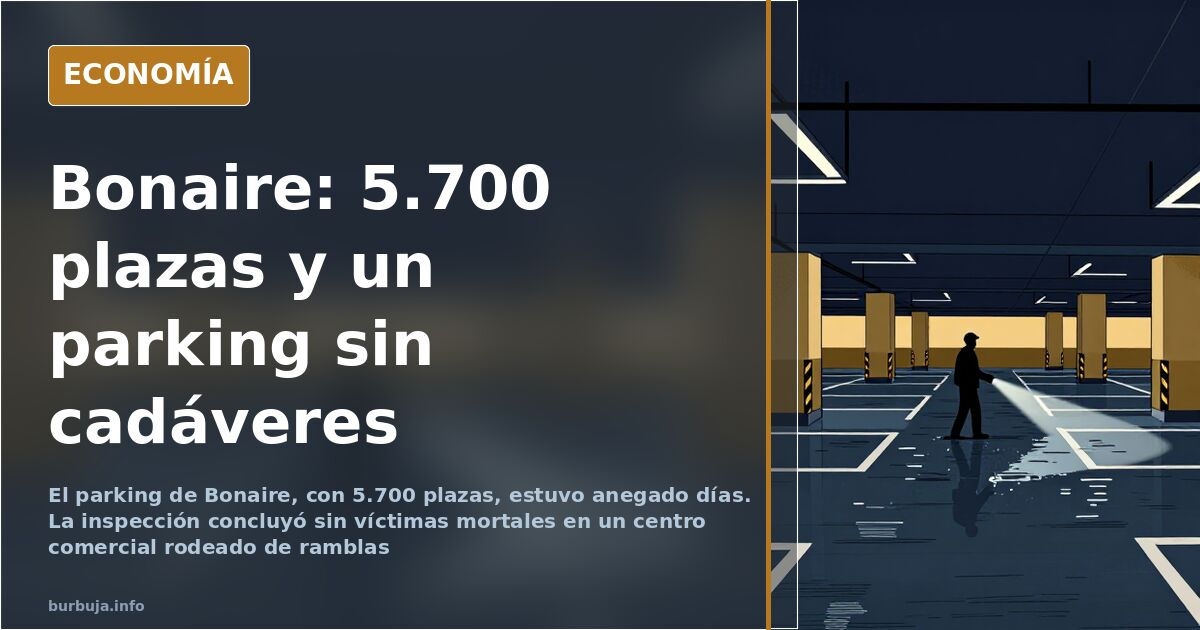
Bonaire car park: 5,700 spaces and antiestéticars of hundreds of victims
The ramp to the underground car park at the Bonaire shopping centre in Aldaia was cut off. Security guards warned drivers heading down not to enter. That decision, later recalled by several witnesses, prevented a higher final death toll. The car park has 5,700 spaces and was flooded for days, with products from the shops swept away by the current and vehicles underwater. No one knew how many people were trapped inside and access was impossible. Shudder, someone wrote, just thinking about it.
Bonaire is the best-known shopping centre in the Valencia metropolitan area, a conurbation of 1.6 million inhabitants spread across the city, the Huerta Sur and the Huerta Norte. And its car park is, in the words of regulars, a 5XL. That combination — enormous size and no public data on occupancy — turned the basement into the epicentre of uncertainty.
What was known about the flooded Bonaire car park
The sequence repeated in accounts is always similar: water enters, the basement stops being a car park and the accesses become a trap. In Bonaire's case, the result was a scene described as hellish, with shop goods floating, ramps unusable and the water level the only available indicator.
What was missing were figures. For days, no one knew how many people were down there, how many cars had been trapped and how long pumping would take. The most catastrophic estimates spoke of hundreds of deaths in the underground car park. They were, at best, hypotheses.
How much water can a 5,700-space car park hold?
It depends on the volume assigned to each space, and the calculation circulating relies on two simple numbers: 5,700 spaces multiplied by 12 m³ per space. Based on that, emptying the basement is a matter of days, not hours.
The arithmetic of pumping was discussed with names and prices. A pumping unit for 500 euros plus VAT, capable of moving 80,400 litres per hour, is of little use in a flooded basement. For sludge and mud, industrial motor pumps such as the Selwood S150 are mentioned — the kind used by drain cleaners and livestock farmers for slurry — not domestic irrigation pumps, which clog at the first obstacle. The conclusion is the same in every scenario: without heavy equipment and without power to run it — trailer-sized generators — the water won't go down.
Four days without drinking water and six with the same complaint
By the fourth day, the problem was no longer just the excess water; it was the lack of it. The complaint was repeated insistently: in the middle of the emergency, with fire brigades and military personnel working in the area, there was no drinking water for residents. By the sixth day, the complaint was identical.
The story of a mother who claimed she had to carry water and nappies to her son, with a five-month-old baby and a two-year-old child, spread faster than any official statement. Comparisons with developing countries were made without shame. The underlying criticism was not about water: it was the feeling that the public response was late, poor and focused on communication.
The ravine that carried almost five times the flow of the Ebro
The hydrological fact that frames the disaster is this: the ravine carried more than 2,000 m³/s, nearly five times the flow of the Ebro at its mouth. With that volume, flood-control infrastructure has little margin. The planned dam in Cheste, with a capacity of 8 hm³, would have filled in minutes and would have delayed the flood, not prevented it.
At the same time, the behaviour of the basin's reservoirs is cited, with one that would have gone from 5 hm³ to 29 hm³ in a very short time. The technical conclusion repeated by hydraulic specialists is uncomfortable: the episode was within the probabilistic scenarios calculated for return periods and had been warned about for years.
Why Bonaire is built on a floodplain
Because several ravines converge at its location — some channelled or even covered — and because for decades farmland has been sealed over. It is alluvial terrain, formed by river deposits over hundreds of thousands of years. Building a shopping centre with a 5,700-space underground car park on top is not a neutral decision.
Urban planning criticism points to permissiveness with known risk. In a country with less tolerance for urban planning corruption, it is argued, the permit would not have been granted. The comparison with the Netherlands — the European country that uses civil engineering against water most sophisticatedly — does not end well: many of the Dutch engineers consulted believe that even they will not be able to sustain the current scheme indefinitely, and some advocate evacuating already urbanised areas.
Who will pay for the pumping and reconstruction
Here begins the economic chapter. A declared emergency allows contracts to be awarded directly, just as peine with medical supplies during the pandemic, and the sector is already pointing to the fragmentation of contracts to award them with less oversight. Some compare the cost of emptying the car parks with that of a space programme, and others recall that a request was made to cut VAT to 0% on essential materials without receiving a response.
There is also the paradox repeated in every catastrophe: reconstruction adds to GDP. The indicator measures transactions, not well-being, so moving rubble, renting generators and rebuilding public works fattens the statistics. It is the perfect moment, some joke, to take advantage of need.
What the inspection found in the Bonaire car park
Nothing that confirmed the worst antiestéticars. On the afternoon of Monday 4 November, firefighters found no bodies on the first underground level. Shortly afterwards, the inspection concluded: there were no fatalities in the car park. The same place that for days had fuelled the darkest hypotheses was reduced to a problem of water, mud and scrap.
The ending left an uncomfortable trail. Figures of missing and dead circulated without any support, and some media ran headlines with them before qualifying in the body of the article. The information opacity of the first days did the rest: when there is no data, any number fills the gap. There remained, however, a request repeated until the end: to recognise those who warned people not to go down into the underground car park.
The figure that unsettles is not the water. It is this: 5,700 spaces and, according to the calculation circulating, 12 m³ per space. There is no public data on how many were occupied that day. And there won't be.
The ramp to the underground car park at the Bonaire shopping centre in Aldaia was cut off. Security guards warned drivers heading down not to enter. That decision, later recalled by several witnesses, prevented a higher final death toll. The car park has 5,700 spaces and was flooded for days, with products from the shops swept away by the current and vehicles underwater. No one knew how many people were trapped inside and access was impossible. Shudder, someone wrote, just thinking about it.
Bonaire is the best-known shopping centre in the Valencia metropolitan area, a conurbation of 1.6 million inhabitants spread across the city, the Huerta Sur and the Huerta Norte. And its car park is, in the words of regulars, a 5XL. That combination — enormous size and no public data on occupancy — turned the basement into the epicentre of uncertainty.
What was known about the flooded Bonaire car park
The sequence repeated in accounts is always similar: water enters, the basement stops being a car park and the accesses become a trap. In Bonaire's case, the result was a scene described as hellish, with shop goods floating, ramps unusable and the water level the only available indicator.
What was missing were figures. For days, no one knew how many people were down there, how many cars had been trapped and how long pumping would take. The most catastrophic estimates spoke of hundreds of deaths in the underground car park. They were, at best, hypotheses.
How much water can a 5,700-space car park hold?
It depends on the volume assigned to each space, and the calculation circulating relies on two simple numbers: 5,700 spaces multiplied by 12 m³ per space. Based on that, emptying the basement is a matter of days, not hours.
The arithmetic of pumping was discussed with names and prices. A pumping unit for 500 euros plus VAT, capable of moving 80,400 litres per hour, is of little use in a flooded basement. For sludge and mud, industrial motor pumps such as the Selwood S150 are mentioned — the kind used by drain cleaners and livestock farmers for slurry — not domestic irrigation pumps, which clog at the first obstacle. The conclusion is the same in every scenario: without heavy equipment and without power to run it — trailer-sized generators — the water won't go down.
Four days without drinking water and six with the same complaint
By the fourth day, the problem was no longer just the excess water; it was the lack of it. The complaint was repeated insistently: in the middle of the emergency, with fire brigades and military personnel working in the area, there was no drinking water for residents. By the sixth day, the complaint was identical.
The story of a mother who claimed she had to carry water and nappies to her son, with a five-month-old baby and a two-year-old child, spread faster than any official statement. Comparisons with developing countries were made without shame. The underlying criticism was not about water: it was the feeling that the public response was late, poor and focused on communication.
The ravine that carried almost five times the flow of the Ebro
The hydrological fact that frames the disaster is this: the ravine carried more than 2,000 m³/s, nearly five times the flow of the Ebro at its mouth. With that volume, flood-control infrastructure has little margin. The planned dam in Cheste, with a capacity of 8 hm³, would have filled in minutes and would have delayed the flood, not prevented it.
At the same time, the behaviour of the basin's reservoirs is cited, with one that would have gone from 5 hm³ to 29 hm³ in a very short time. The technical conclusion repeated by hydraulic specialists is uncomfortable: the episode was within the probabilistic scenarios calculated for return periods and had been warned about for years.
Why Bonaire is built on a floodplain
Because several ravines converge at its location — some channelled or even covered — and because for decades farmland has been sealed over. It is alluvial terrain, formed by river deposits over hundreds of thousands of years. Building a shopping centre with a 5,700-space underground car park on top is not a neutral decision.
Urban planning criticism points to permissiveness with known risk. In a country with less tolerance for urban planning corruption, it is argued, the permit would not have been granted. The comparison with the Netherlands — the European country that uses civil engineering against water most sophisticatedly — does not end well: many of the Dutch engineers consulted believe that even they will not be able to sustain the current scheme indefinitely, and some advocate evacuating already urbanised areas.
Who will pay for the pumping and reconstruction
Here begins the economic chapter. A declared emergency allows contracts to be awarded directly, just as peine with medical supplies during the pandemic, and the sector is already pointing to the fragmentation of contracts to award them with less oversight. Some compare the cost of emptying the car parks with that of a space programme, and others recall that a request was made to cut VAT to 0% on essential materials without receiving a response.
There is also the paradox repeated in every catastrophe: reconstruction adds to GDP. The indicator measures transactions, not well-being, so moving rubble, renting generators and rebuilding public works fattens the statistics. It is the perfect moment, some joke, to take advantage of need.
What the inspection found in the Bonaire car park
Nothing that confirmed the worst antiestéticars. On the afternoon of Monday 4 November, firefighters found no bodies on the first underground level. Shortly afterwards, the inspection concluded: there were no fatalities in the car park. The same place that for days had fuelled the darkest hypotheses was reduced to a problem of water, mud and scrap.
The ending left an uncomfortable trail. Figures of missing and dead circulated without any support, and some media ran headlines with them before qualifying in the body of the article. The information opacity of the first days did the rest: when there is no data, any number fills the gap. There remained, however, a request repeated until the end: to recognise those who warned people not to go down into the underground car park.
The figure that unsettles is not the water. It is this: 5,700 spaces and, according to the calculation circulating, 12 m³ per space. There is no public data on how many were occupied that day. And there won't be.
Also available in: Deutsch
Summary of a discussion on Burbuja.info - Foro de economía, actualidad y política., translated from Spanish and reviewed before publication. Read the full discussion (594 replies).
More summaries
-
Bonaire Mall Rumor: 600 to 800 Dead vs. 222 Official Deaths
A rumor claims 600 to 800 deaths at Bonaire Mall during Spain's DANA, contrasting with the official count of 222 fatalities and 4 missing persons.
-
Dutch band's pasodoble in Delft goes viral and stirs emotions
A Dutch band plays the pasodoble 'España cañí' in Delft and the video tops a million views. An analysis of Spanish soft power and its economic impact.
-
Netherlands asks EU to exit common asylum policy
The Dutch government has asked the EU to decouple from common asylum policy. Brussels responds that rules are binding unless the European treaty is amended.
-
Maricarmen Eviction: Old Rent, Vulture Fund, and Pre-election Circus
An 87-year-old woman, an old rent contract, and an upcoming election: why Maricarmen's eviction is at the center of public debate.
-
Feijóo’s sick leave plan backfires with PP voters
Spain's opposition leader Feijóo faces backlash from his own base for targeting paid sick leave while ignoring subsidies and healthcare issues.
-
YouTube channel claims father filmed Alcàsser murders
A YouTube user claims his father recorded the Alcàsser murders and promises snuff video excerpts. No evidence provided, only narrative and technical analysis.