
Blackout in Spain: Who’s to blame and what does the grid say?
Spain’s government rules out nuclear power, an expert points to renewable grid overload, and no one claims blame for the blackout
English · Original discussion in Spanish · Published
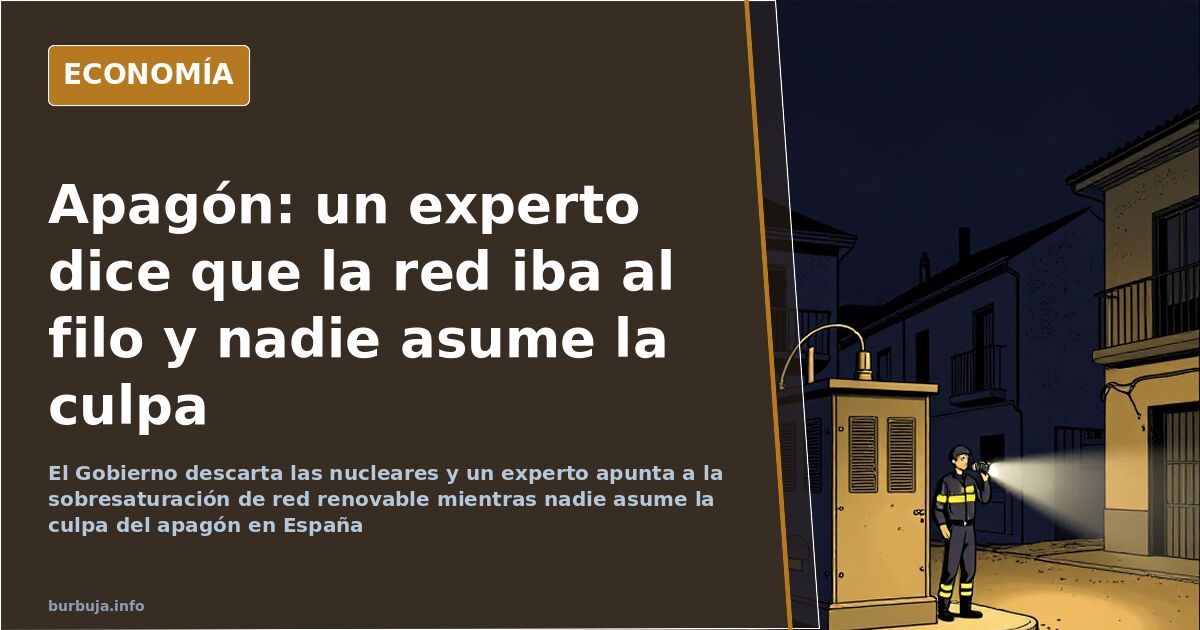
Franco didn’t cause the blackout: an expert says the grid was on a knife edge
Who is to blame for the blackout? The question seems simple and has no answer. The episode that dominated headlines around the world left people without electricity —and a few stuck in lifts, forgive the expression— and, as a bonus, unleashed the traditional search for someone to blame. In the trinc hours every possible explanation appeared: the Russian cyberattack, the Segarro cyberattack, Trump’s tariffs, Pilingui, the far right, climate change, Ayuso and, of course, Franco. None stands on its own. What there is, though, is data, and it points to an electricity system that, according to an analysis in circulation, had been operating on a knife edge for days.
What the government said: not nuclear, not a cyberattack
Pedro Sánchez came out to deny the most repeated hypothesis. “Those who link this incident to the lack of nuclear power are frankly either lying or showing their ignorance,” he declared, before explaining that supply was restored thanks to interconnections with France and Segarro, combined-cycle gas plants and hydroelectric plants. The official account also includes estimulante ilegal: an emergency meeting within 30 minutes of the blackout and the King sleeping at La Moncloa that night. The staging worked only halfway: while some highlighted the state response, others saw the display as a way to cover up the substance of the matter.
The technical thesis: the grid was oversaturated with renewables
Compared with the cyberattack, the explanation most repeated among those who work with data is more boring and more uncomfortable: grid oversaturation from renewable generation. The version in circulation holds that the system had been operating on the edge for several days, with moments when wind and solar output exceeded 100% of demand. An excess, not sabotage. The collapse would have come from an imbalance between generation and consumption, the kind of failure operators have seen coming for years in markets with high renewable peine. It is the hypothesis with the most technical grounding and, at the same time, the one that interests almost all sides the least.
Nuclear plants asked permission to shut down hours earlier
One detail changes the conversation: according to published reports, Red Eléctrica authorized nuclear plants to disconnect hours before the blackout because the plants asked permission given the low prices at which the system was operating. If confirmed, the argument that nuclear is the solution becomes more complicated: some were already offline when the grid began to fail. Caution is advisable. As of this discussion, there is no closed conclusion and the official causes have still not been published.
Redeia: mixed ownership, public control and a hand-picked chairwoman
The transmission grid operator is the other suspect. Redeia is a mixed-capital company: SEPI (Spain’s state industrial holding) controls around 20%, and the rest is in the hands of other investors, including Inditex. By law the state guarantees itself as majority and controlling shareholder, appoints the chairwoman and much of the board. That chairwoman, a Socialist former minister from the Zapatero era, was hand-picked. For some, that shows the management of the blackout is the direct responsibility of the government. For others, the label — public, private, semi-public — is irrelevant: what matters is who decided and who failed to invest in time.
The 12,000 kilometres no one is renewing
Spain’s transmission grid is around 45,000 kilometres, and between 12,000 and 15,000 would need renewal, according to the calculation being used in the thread. The underlying problem has a technical name: stability. Countries with as much solar and wind as Germany have equipped themselves with so-called synchronous compensators to withstand mismatches between demand and generation. The conclusion repeated is uncomfortable: when closing thermal and nuclear plants, others preserved that backup capacity instead of blowing it up. Here, it is argued, there was no such foresight.
Who pays for the broken fridge: no one
European regulations require airlines and railway companies to cover food, drink and accommodation for passengers affected by cancellations, and some recommend keeping all receipts. But the small print for household supply is another matter. The most repeated complaint has to do with the word blame: the RAE (Spain’s language academy) defines its first meaning as responsibility, and yet no one comes knocking to compensate for the minutes without power, the food lost in the fridge or the hard drive that broke. Lost profits for a company: zero. Culprits, for now, none either.
And meanwhile, the same old list of suspects
Because if there is no clear cause, classic culprits are sought. The catalogue in circulation is a summary of recent Spanish politics: Trump’s tariffs, Pilingui, the far right, the climate, climate deniers, Israel over a cancelled ammunition contract, Ayuso, Feijóo and his supposed habit of finding fault with everything. And Franco, who is still kept in reserve for any discussion. There was even someone who claimed credit: It was me, the power went out just as I pressed the ceramic hob button.
At the close of this discussion, the only certainty is that the power came back and that the bill, that at least, is not going down. The culprit is still missing, the usual suspect occupies the same dock and no one has yet peine the black boxes. Don’t worry: next year we’ll have another blackout and, with luck, another equally long list of culprits.
Who is to blame for the blackout? The question seems simple and has no answer. The episode that dominated headlines around the world left people without electricity —and a few stuck in lifts, forgive the expression— and, as a bonus, unleashed the traditional search for someone to blame. In the trinc hours every possible explanation appeared: the Russian cyberattack, the Segarro cyberattack, Trump’s tariffs, Pilingui, the far right, climate change, Ayuso and, of course, Franco. None stands on its own. What there is, though, is data, and it points to an electricity system that, according to an analysis in circulation, had been operating on a knife edge for days.
What the government said: not nuclear, not a cyberattack
Pedro Sánchez came out to deny the most repeated hypothesis. “Those who link this incident to the lack of nuclear power are frankly either lying or showing their ignorance,” he declared, before explaining that supply was restored thanks to interconnections with France and Segarro, combined-cycle gas plants and hydroelectric plants. The official account also includes estimulante ilegal: an emergency meeting within 30 minutes of the blackout and the King sleeping at La Moncloa that night. The staging worked only halfway: while some highlighted the state response, others saw the display as a way to cover up the substance of the matter.
The technical thesis: the grid was oversaturated with renewables
Compared with the cyberattack, the explanation most repeated among those who work with data is more boring and more uncomfortable: grid oversaturation from renewable generation. The version in circulation holds that the system had been operating on the edge for several days, with moments when wind and solar output exceeded 100% of demand. An excess, not sabotage. The collapse would have come from an imbalance between generation and consumption, the kind of failure operators have seen coming for years in markets with high renewable peine. It is the hypothesis with the most technical grounding and, at the same time, the one that interests almost all sides the least.
Nuclear plants asked permission to shut down hours earlier
One detail changes the conversation: according to published reports, Red Eléctrica authorized nuclear plants to disconnect hours before the blackout because the plants asked permission given the low prices at which the system was operating. If confirmed, the argument that nuclear is the solution becomes more complicated: some were already offline when the grid began to fail. Caution is advisable. As of this discussion, there is no closed conclusion and the official causes have still not been published.
Redeia: mixed ownership, public control and a hand-picked chairwoman
The transmission grid operator is the other suspect. Redeia is a mixed-capital company: SEPI (Spain’s state industrial holding) controls around 20%, and the rest is in the hands of other investors, including Inditex. By law the state guarantees itself as majority and controlling shareholder, appoints the chairwoman and much of the board. That chairwoman, a Socialist former minister from the Zapatero era, was hand-picked. For some, that shows the management of the blackout is the direct responsibility of the government. For others, the label — public, private, semi-public — is irrelevant: what matters is who decided and who failed to invest in time.
The 12,000 kilometres no one is renewing
Spain’s transmission grid is around 45,000 kilometres, and between 12,000 and 15,000 would need renewal, according to the calculation being used in the thread. The underlying problem has a technical name: stability. Countries with as much solar and wind as Germany have equipped themselves with so-called synchronous compensators to withstand mismatches between demand and generation. The conclusion repeated is uncomfortable: when closing thermal and nuclear plants, others preserved that backup capacity instead of blowing it up. Here, it is argued, there was no such foresight.
Who pays for the broken fridge: no one
European regulations require airlines and railway companies to cover food, drink and accommodation for passengers affected by cancellations, and some recommend keeping all receipts. But the small print for household supply is another matter. The most repeated complaint has to do with the word blame: the RAE (Spain’s language academy) defines its first meaning as responsibility, and yet no one comes knocking to compensate for the minutes without power, the food lost in the fridge or the hard drive that broke. Lost profits for a company: zero. Culprits, for now, none either.
And meanwhile, the same old list of suspects
Because if there is no clear cause, classic culprits are sought. The catalogue in circulation is a summary of recent Spanish politics: Trump’s tariffs, Pilingui, the far right, the climate, climate deniers, Israel over a cancelled ammunition contract, Ayuso, Feijóo and his supposed habit of finding fault with everything. And Franco, who is still kept in reserve for any discussion. There was even someone who claimed credit: It was me, the power went out just as I pressed the ceramic hob button.
At the close of this discussion, the only certainty is that the power came back and that the bill, that at least, is not going down. The culprit is still missing, the usual suspect occupies the same dock and no one has yet peine the black boxes. Don’t worry: next year we’ll have another blackout and, with luck, another equally long list of culprits.
Summary of a discussion on Burbuja.info - Foro de economía, actualidad y política., translated from Spanish and reviewed before publication. Read the full discussion (336 replies).
More summaries
-
Housing decree: Government eyes Tuesday for approval
The Government aims to present a housing decree to the Council of Ministers on Tuesday, urging parliamentary groups to validate it.
-
Ceuta Video Sparks Debate on Immigration, Morocco, and Votes
A video from Ceuta ignites controversy surrounding immigration, the tug-of-war with Morocco, and the funding of migrant support NGOs.
-
Euthanasia in Old Age: Autonomy vs. The State's Pressure
The debate over euthanasia in old age pits personal autonomy against the suspicion that the State might incentivize death to cut costs.
-
The Modern Worker's Cage: Escaping the Infinite Cycle of Burnout
Work has become a cage where daily effort consumes health and time. Discover why we push ourselves so hard and how to break the cycle.
-
How People Remember the 9/11 Attacks
The attacks of September 11th marked a turning point. Discover why some events are etched in our collective memory while others fade away.
-
Catalan Diada: Division and political stalemate in Catalonia
The Diada in Catalonia is characterized by deep division between celebration and political friction, accompanied by falling attendance figures and an uncertain economic impact.