
Black Sun: The Symbol Claimed by Nazis and Occultists
The Black Sun is used by neo-Nazis and claimed by esoteric groups. The debate over its ancient Slavic or modern origins remains unresolved.
English · Original discussion in Spanish · Published
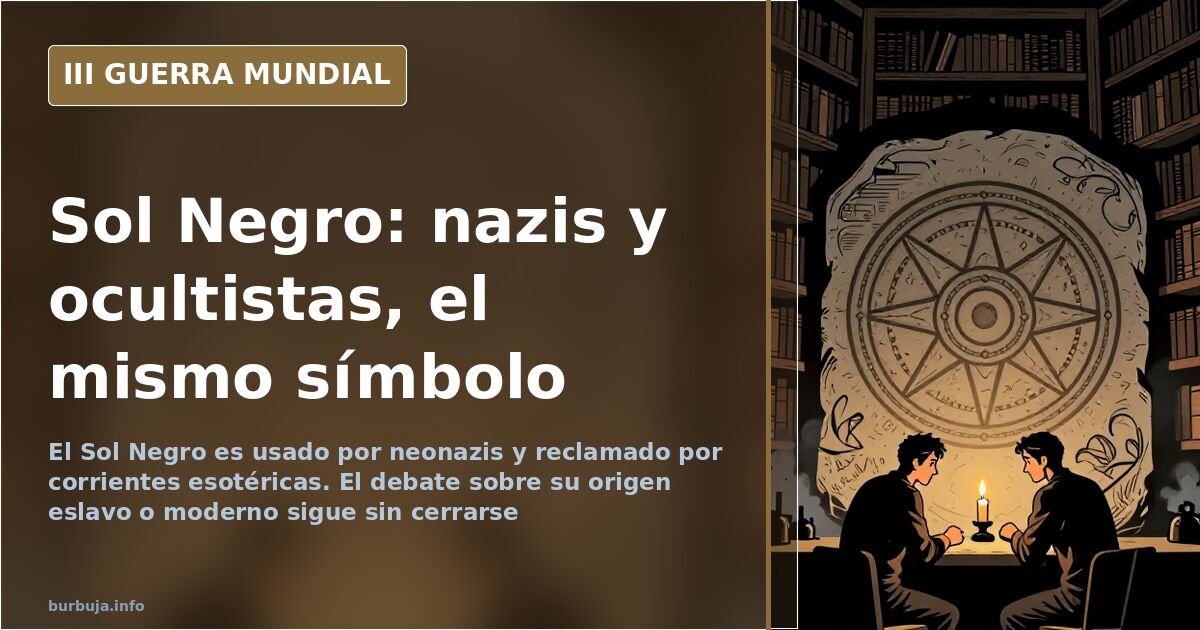
The Black Sun: From Slavic Kolovrat to Nancy Emblem
What is the Black Sun and why do neo-Nancy and occultists who despise each other both use it? The answer is uncomfortable: a sphere with twelve rays, placed by some in pre-Christian Slavic times and by others in interwar Germany. On this mined ground, a body of interpretations has emerged blending philology, esotericism, and politics, always asking: who owns the symbol?
What is the Black Sun and when does it appear?
Its physical description is undisputed: a black circle crossed by twelve "electric" rays—or twelve flashes—read as the sun’s positions over twelve months. Each group adds layers: the twelve petals of the Anahata chakra, the twelve tribes of Hebrew tradition, the twelve apostles, or the twelve zodiac signs. At the center lies a thirteenth element, associated by some with the "thirteen uncreated runes" and the dangerous seat of Arthurian legend.
Origins are disputed. Some argue it predates Christianity: ancient Slavs called it Kolovrat, appearing in unrelated traditions. Others claim it is a modern invention linked to National Socialism and SS runes, with no verifiable ancient root. Both positions have been defended fiercely.
Who stands behind Hyperborean Wisdom?
The corpus of so-called Hyperborean Wisdom —The Mystery of Belicena Villca, the two volumes of Fundamentals of Hyperborean Wisdom, the History of the Thulegesellschaft— is attributed to Luis Felipe Moyano. Defenders reject superficial readings, demanding the complete set be read first, and respond harshly to critics who haven’t. This gate functions as a filter.
One frequent criticism targets the language. Readers quickly adopt a specialized vocabulary understood only by initiates, mirroring the jargon that binds any closed group. This warning comes from a participant who identifies as critical, not just an outsider.
Saturn as demiurge: the Hyperborean paradox
The opening contradiction is textbook. In this doctrine, Saturn —identified with Satan— is the demiurge, architect of a created, hierarchical order. Why then does the caste claiming to fight this order adopt the symbol of the demiurge itself?
The critical answer is that the Black Sun functions as an inversion: a saturnine symbol is placed and energy is induced by believing it represents something else, similar to festivals whose original meaning has been emptied. Conversely, some argue the symbol represents the inner sun of each individual, the light born from contemplative practice, not the borrowed shine of the external world.
Two opposing castes sharing a root
According to this narrative, an ancient war pitted the warrior caste —linked to a supposed blood pact— against the priestly caste —a cultural pact—. The story is read through contemporary fiction: two factions born as one, now disputing legitimacy. The conclusion is uncomfortable for both: if the origin is the same, the dispute faces two branches of the same trunk.
This breeds the central suspicion: that the entire symbolic structure —the Black Sun, Saturn, the cycles marking twelve rays— keeps the observer within a game of polarities. A cycle broken only by will, understood as the faculty to escape the loop of desires and accompanying karma.
From Wewelsburg to Daft Punk
The symbol travels. As recalled in the thread, it appears in Wewelsburg Castle, the SS ceremonial center, and reemerges decades later in unexpected terrains. The case of Daft Punk and their anime Interstella 5555 is cited, where, with more intent than evidence, a supposed narrative of the spiritual chaining of a primordial lineage is read. According to this account, the French duo gave two public concerts —1997 and 2007—, appeared on TV in 2008, and dissolved in 2021 without ever showing their faces.
It is also noted that the symbol does not belong to a single political circuit: it appears associated with European nationalist movements and, simultaneously, with esoteric currents presenting themselves as alternatives to those same movements. That two extremes mirror each other and recognize one another does not prove the authenticity of either.
What remains when everyone claims the symbol?
The most repeated conclusion resolves nothing, and perhaps that is why it is the most honest: if opposite poles lead to the same emblem, one must view the emblem and its agitators with suspicion. The thesis defending absolute white light as the origin, with darkness as a subsequent shadow parasitizing external energy, clashes with cosmologies placing an uncreated void at the summit. Ultimately, those seeking the truth about the Black Sun find layers of interpretation, texts cited as authority, and a question no one closes. Twelve rays to explain twelve months. And not a single proof that it was ours.
What is the Black Sun and why do neo-Nancy and occultists who despise each other both use it? The answer is uncomfortable: a sphere with twelve rays, placed by some in pre-Christian Slavic times and by others in interwar Germany. On this mined ground, a body of interpretations has emerged blending philology, esotericism, and politics, always asking: who owns the symbol?
What is the Black Sun and when does it appear?
Its physical description is undisputed: a black circle crossed by twelve "electric" rays—or twelve flashes—read as the sun’s positions over twelve months. Each group adds layers: the twelve petals of the Anahata chakra, the twelve tribes of Hebrew tradition, the twelve apostles, or the twelve zodiac signs. At the center lies a thirteenth element, associated by some with the "thirteen uncreated runes" and the dangerous seat of Arthurian legend.
Origins are disputed. Some argue it predates Christianity: ancient Slavs called it Kolovrat, appearing in unrelated traditions. Others claim it is a modern invention linked to National Socialism and SS runes, with no verifiable ancient root. Both positions have been defended fiercely.
Who stands behind Hyperborean Wisdom?
The corpus of so-called Hyperborean Wisdom —The Mystery of Belicena Villca, the two volumes of Fundamentals of Hyperborean Wisdom, the History of the Thulegesellschaft— is attributed to Luis Felipe Moyano. Defenders reject superficial readings, demanding the complete set be read first, and respond harshly to critics who haven’t. This gate functions as a filter.
One frequent criticism targets the language. Readers quickly adopt a specialized vocabulary understood only by initiates, mirroring the jargon that binds any closed group. This warning comes from a participant who identifies as critical, not just an outsider.
Saturn as demiurge: the Hyperborean paradox
The opening contradiction is textbook. In this doctrine, Saturn —identified with Satan— is the demiurge, architect of a created, hierarchical order. Why then does the caste claiming to fight this order adopt the symbol of the demiurge itself?
The critical answer is that the Black Sun functions as an inversion: a saturnine symbol is placed and energy is induced by believing it represents something else, similar to festivals whose original meaning has been emptied. Conversely, some argue the symbol represents the inner sun of each individual, the light born from contemplative practice, not the borrowed shine of the external world.
Two opposing castes sharing a root
According to this narrative, an ancient war pitted the warrior caste —linked to a supposed blood pact— against the priestly caste —a cultural pact—. The story is read through contemporary fiction: two factions born as one, now disputing legitimacy. The conclusion is uncomfortable for both: if the origin is the same, the dispute faces two branches of the same trunk.
This breeds the central suspicion: that the entire symbolic structure —the Black Sun, Saturn, the cycles marking twelve rays— keeps the observer within a game of polarities. A cycle broken only by will, understood as the faculty to escape the loop of desires and accompanying karma.
From Wewelsburg to Daft Punk
The symbol travels. As recalled in the thread, it appears in Wewelsburg Castle, the SS ceremonial center, and reemerges decades later in unexpected terrains. The case of Daft Punk and their anime Interstella 5555 is cited, where, with more intent than evidence, a supposed narrative of the spiritual chaining of a primordial lineage is read. According to this account, the French duo gave two public concerts —1997 and 2007—, appeared on TV in 2008, and dissolved in 2021 without ever showing their faces.
It is also noted that the symbol does not belong to a single political circuit: it appears associated with European nationalist movements and, simultaneously, with esoteric currents presenting themselves as alternatives to those same movements. That two extremes mirror each other and recognize one another does not prove the authenticity of either.
What remains when everyone claims the symbol?
The most repeated conclusion resolves nothing, and perhaps that is why it is the most honest: if opposite poles lead to the same emblem, one must view the emblem and its agitators with suspicion. The thesis defending absolute white light as the origin, with darkness as a subsequent shadow parasitizing external energy, clashes with cosmologies placing an uncreated void at the summit. Ultimately, those seeking the truth about the Black Sun find layers of interpretation, texts cited as authority, and a question no one closes. Twelve rays to explain twelve months. And not a single proof that it was ours.
Summary of a discussion on Burbuja.info - Foro de economía, actualidad y política., translated from Spanish and reviewed before publication. Read the full discussion (222 replies).
More summaries
-
Large group of Russians surrenders (including a Black man)
More than 250 Russian soldiers captured and entire units surrendering on the eastern front.
-
Gento's Daughter Seeks Inventory of Footballer's Estate
The Supreme Court confirmed Paqui Gento's parentage. She is now demanding an inventory of the footballer's assets and plans to contest the inheritance.
-
Inherited Magic: Spain's Nine Clans, Three Surviving, and a Pact
A Spanish initiation narrative claims magic is inherited by families and offered to Satan at age twelve. No evidence supports these assertions.
-
Lisichansk falls, Russia secures full control of Luhansk region
Russia declares full control of Luhansk after taking Lisichansk, the last Ukrainian stronghold. The capture opens the next phase of the offensive toward Bakhmut.
-
US Warns NATO: Must Fight If Russia Defeats Ukraine
The US warns NATO must enter war if Russia defeats Ukraine. Europe debates who pays the human cost while Washington maintains strategic distance.
-
Putin: Russia's Most Divisive Statesman or Tyrant?
Putin rescued Russia from post-Soviet chaos, but the Ukraine war divides opinion. Is he the century's greatest statesman or a tyrant?