
Bitcoin vs the bank: the argument splitting its supporters
A bank deposit is a loan to the bank, and Bitcoin promises to remove the middleman, but its liquidity depends on exchanges and its price swings sharply.
English · Original discussion in Spanish · Published
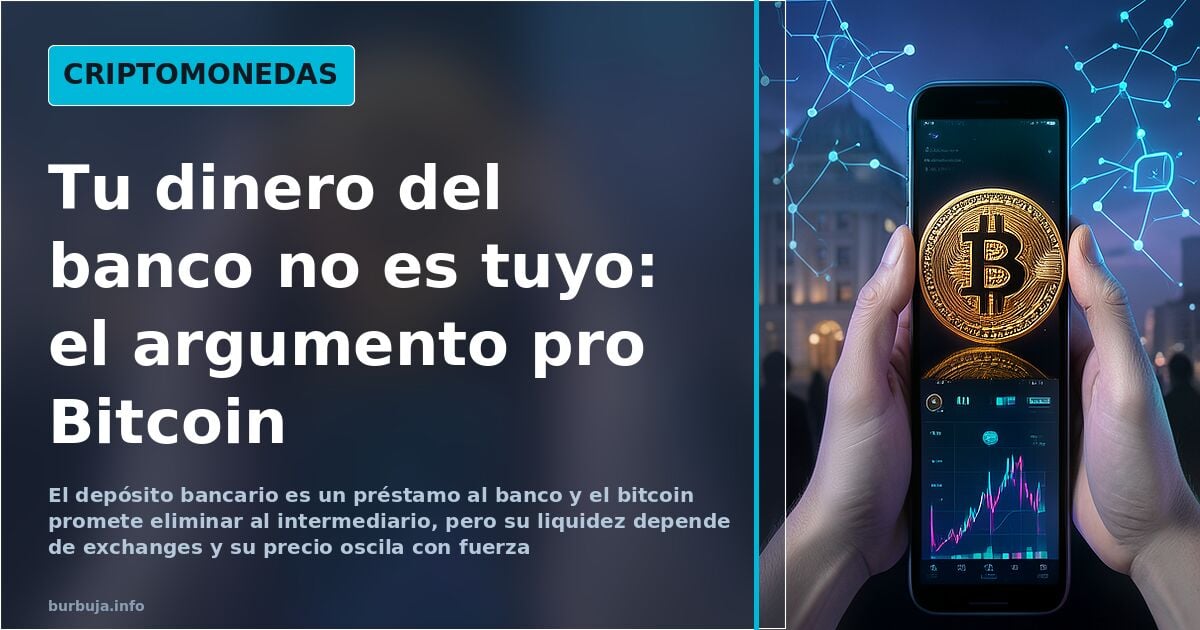
The bank doesn't hold your money, and Bitcoin isn't your salvation either
A Bitcoin advertisement, put forward as a candidate for best ad of 2026, sparked a debate that goes far beyond marketing: does Bitcoin really solve the problem of a bank putting obstacles in the way of you withdrawing your own money? The paradox is the usual one. A bank deposit is, technically, a loan you make to the institution. What shows up in your account is not your money sitting in a vault: it is a record of a debt the bank owes you. And like any debt, it can be conditioned, delayed or blocked.
The first electronic ledger entry that truly belongs to you
The case for Bitcoin rests on that idea: a transfer with no third-party custodians, no ID forms and no entity that can refuse you service. At the opposite end, critics point out that Bitcoin is not a currency for everyday use, but a digital asset whose volatility rules it out as a stable store of savings. Buying Bitcoin is not saving money; it is taking on price risk.
What happens when you deposit money at the bank and want to withdraw it?
The example that frames the debate is an everyday one. You deposit an amount and everything is easy; the next day you want to withdraw it and the obstacles appear, to the point where the branch manager may step in and you leave without your cash. The conclusion drawn is that the bank does not safeguard your money: it lends it out, and only returns what you ask for if you meet the requirements it sets itself.
Against that, Bitcoin's promise is the absence of intermediaries. Miners validate transactions for an economic incentive, a fee, with no room to discriminate against users on arbitrary grounds. The argument has its logic, though it is worth remembering that the network does not work without electricity or a connection, and that custody of the keys falls entirely on the owner.
Liquidity doesn't come from the protocol, it comes from the exchanges
The most uncomfortable point for the maximalist narrative is liquidity. Bitcoin doesn't move on its own: it needs trading platforms that, in many cases, impose their own terms, identity checks and fees. Decentralized exchanges do exist, yes, but the bulk of volume still goes through regulated intermediaries. Much of the "no third parties" claim dissolves there.
Add to that the volatility. Whoever buys Bitcoin is not parking their money: they are taking a position in an asset whose price swings sharply. The usual defense is that it is a way out of a monetary system that destroys purchasing power by expanding the money supply, and that adoption and contraction cycles explain the swings. The skeptic replies that such an asset is useless as a unit of account or a stable reserve.
The scenario with no power or internet
The most down-to-earth objection comes at the end: if the internet or the power goes out, Bitcoin is useless, and if you lose your keys or they are stolen, it is useless too. The reply is immediate: in that same scenario, a credit card doesn't work either. Neither system survives a general blackout, which reduces the argument to a matter of degrees, not essences.
The debate ends without agreement. Some see in Bitcoin an exit from a system that treats a bank deposit as a forced loan; others see a speculative asset wrapped in a promise of freedom that, in practice, depends on the same infrastructure and the same intermediaries it claims to avoid. How much of that promise is technology, and how much is storytelling?
Also available in: Deutsch
Summary of a discussion on Burbuja.info - Foro de economía, actualidad y política., translated from Spanish and reviewed before publication. Read the full discussion (28 replies).
More summaries
-
Bitcoin: Safe Haven or Scam? The Debate Continues
Is Bitcoin a legitimate store of value or a pyramid scheme? Experts clash over intrinsic worth, utility, and speculation in this ongoing debate.
-
Legacy Bitcoin KYC Barrier: Banking 20 BTC from 2013
Twenty 2013 bitcoins held without KYC cannot be banked. Selling at zero cost does not prevent Spanish tax authorities from questioning the origin of funds.
-
Bitcoin's Meteoric Rise: From $13 to $266 in 2013
Explore Bitcoin's explosive growth in 2013, soaring from $13.51 to $266 across just three exchanges amid minimal liquidity and no clear technical explanation.
-
Valdeande Mágico: The YouTuber Who Bought Bitcoin at $20
He recommended Bitcoin at $20 and Ethereum at $1. Today Valdeande Mágico posts on private channels and awaits 200 bitcoin lost in Mt. Gox.
-
Blofin, the no-KYC exchange offering $5 to trade futures
Blofin offers futures without KYC and a $5 bonus, but its $29 million daily volume versus MEXC's $4 billion raises doubts about its real liquidity.
-
Strategy sells 1,638 bitcoins at a $105 million loss
Strategy has sold 1,638 bitcoins at a $105 million loss and may liquidate 23,400 more. The eternal HODL is crumbling.