
Bitcoin at €3,800: Market Defies Death Predictions
Bitcoin trades near €3,800 while crypto ATM installations doubled in a year. The asset's alleged death clashes with market reality.
English · Original discussion in Spanish · Published
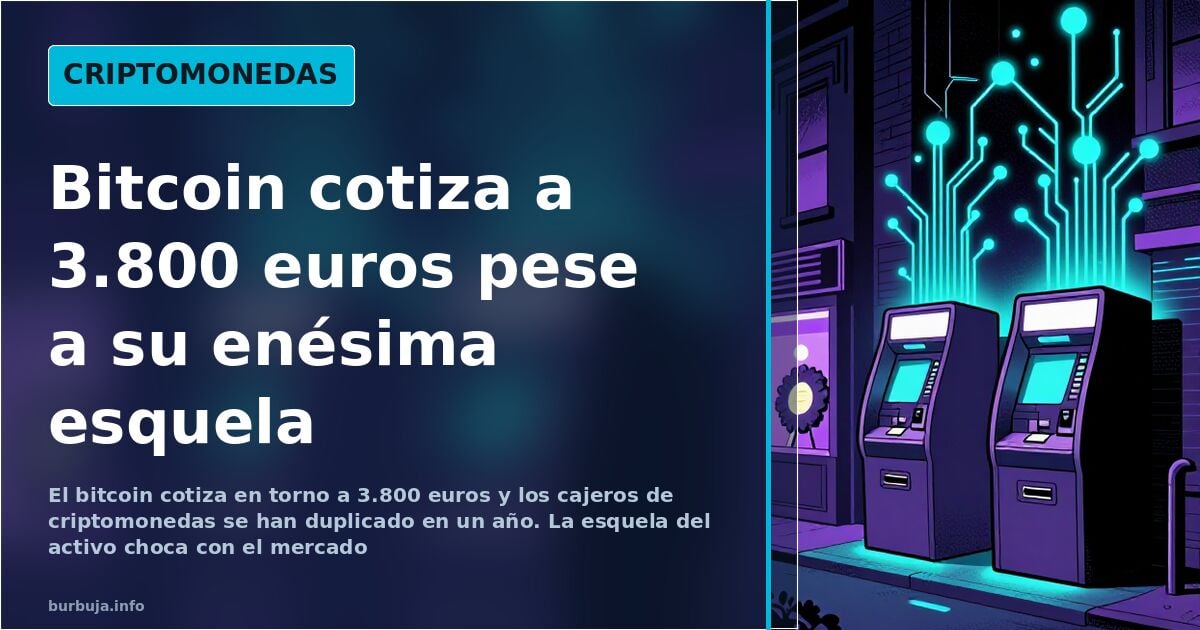
Bitcoin at €3,800: The Announced Death That Never Arrives
Bitcoin is trading around €3,800, and the global network of cryptocurrency ATMs has doubled in one year, from 2,000 to over 4,000. With these figures on the table, yet another obituary for the asset—a chronicle declaring its demise—once again collides with market reality. It is not the first time: it has been dying every year since its inception. And it remains here.
Why Is Bitcoin’s Death Announced Every Year?
The central argument of the obituary repeats word for word: “A currency that has suffered price manipulation will never be usable as a medium of exchange or payment, let alone as a store of value.” From this, it is deduced that if the price moves due to interested parties, the asset would be useless as money. To date, the definitive collapse has not arrived.
The rebuttal reverses the reasoning. This is precisely the point, argues this school of thought: that its value is set by the market and not by a government at whim. According to this analysis, this is what separates a healthy currency from an economy with an intervened currency. The argument has an obvious weak point: the market also manipulates. A handful of large operators can move any price, and Bitcoin is no exception.
Is Bitcoin a Store of Value Compared to Gold?
Gold accumulates 5,000 years of history as money. Central banks hold it because they believe it is worth more than the money they themselves back, and this detail is used as proof of its status as a reserve. Its medium- and long-term volatility is lower than that of the vast majority of fiat currencies, except for the euro, the dollar, and the Swiss franc: the bid-ask spreads for investment gold range between 1.8% and 4%, compared to almost any currency.
In contrast, the crypto objection lists the metal’s flaws: it is slow and expensive to move, lacks infinite fungibility without loss of value, and its monetary mass is not perfectly defined. Bitcoin, however, has an immovable cap of 21 million units. Whether that cap is a virtue or a curse is, precisely, what nobody agrees upon.
Money, Currency, and Debt: The Distinction That Disrupts the Debate
Part of the analysis relies on the old distinction between money and currency. Money would be gold and silver, in any form, including a bag of dust; currency, conversely, would be the minted piece. Everything else, says a famous quote circulating in these exchanges, is debt. Under this criterion, Bitcoin lacks the essentials: universal acceptance, hoarding by central banks, and backing by a state economy.
The counter-rebuttal does not dispute the definition, but its validity. It is recalled that the Zambian kwacha has existed for 60 years and nobody takes it as a global standard. And a practical problem is added: nobody audits the top of the pyramid, nobody guarantees citizens that the amount claimed actually exists.
How Much Does It Cost to Mine One Bitcoin?
The global average cost of mining one unit exceeds $5,000, according to calculations circulating these days. Hence arises the uncomfortable question: how long can the system sustain itself at these prices. The technical answer comes quickly: cost does not determine price, competition among miners does. If the quotation falls, competition falls, and with it, the cost.
Some add an annoying nuance to official averages: part of the mining is done with subsidized or directly free energy, which distorts any average. The published cost, they say, better reflects domestic mining than industrial mining.
Ten Years and No Widespread Adoption
The calendar works against the gravediggers. A new technology is rarely adopted en masse in a decade: the internet, with all its success, did not achieve this either. Against this, critics point out that the comparison is flawed, because Bitcoin has not yet found a daily use beyond speculating on its value in conventional currency. Each new ATM and each miner surviving with negative margins are, depending on which side you look from, proof of success or a sign of panic.
Taxation looms in the background. The Spanish Tax Agency (Hacienda) has begun to scrutinize cryptocurrency movements, and this control is read in two opposite ways: as normalization of the asset or as a warning that the net is closing.
With these elements, the analysis remains exactly where it started: whether Bitcoin is the new monetary paradigm or just another speculative product. 99.9% of the population prefers stable reserves for their wealth, and Bitcoin has gone a decade without convincing them. Nobody has yet demonstrated how much a decentralized framework for programming contracts is worth, nor how much it should cost in twenty years. And there, in that unanswered gap, the discussion stalls.
Bitcoin is trading around €3,800, and the global network of cryptocurrency ATMs has doubled in one year, from 2,000 to over 4,000. With these figures on the table, yet another obituary for the asset—a chronicle declaring its demise—once again collides with market reality. It is not the first time: it has been dying every year since its inception. And it remains here.
Why Is Bitcoin’s Death Announced Every Year?
The central argument of the obituary repeats word for word: “A currency that has suffered price manipulation will never be usable as a medium of exchange or payment, let alone as a store of value.” From this, it is deduced that if the price moves due to interested parties, the asset would be useless as money. To date, the definitive collapse has not arrived.
The rebuttal reverses the reasoning. This is precisely the point, argues this school of thought: that its value is set by the market and not by a government at whim. According to this analysis, this is what separates a healthy currency from an economy with an intervened currency. The argument has an obvious weak point: the market also manipulates. A handful of large operators can move any price, and Bitcoin is no exception.
Is Bitcoin a Store of Value Compared to Gold?
Gold accumulates 5,000 years of history as money. Central banks hold it because they believe it is worth more than the money they themselves back, and this detail is used as proof of its status as a reserve. Its medium- and long-term volatility is lower than that of the vast majority of fiat currencies, except for the euro, the dollar, and the Swiss franc: the bid-ask spreads for investment gold range between 1.8% and 4%, compared to almost any currency.
In contrast, the crypto objection lists the metal’s flaws: it is slow and expensive to move, lacks infinite fungibility without loss of value, and its monetary mass is not perfectly defined. Bitcoin, however, has an immovable cap of 21 million units. Whether that cap is a virtue or a curse is, precisely, what nobody agrees upon.
Money, Currency, and Debt: The Distinction That Disrupts the Debate
Part of the analysis relies on the old distinction between money and currency. Money would be gold and silver, in any form, including a bag of dust; currency, conversely, would be the minted piece. Everything else, says a famous quote circulating in these exchanges, is debt. Under this criterion, Bitcoin lacks the essentials: universal acceptance, hoarding by central banks, and backing by a state economy.
The counter-rebuttal does not dispute the definition, but its validity. It is recalled that the Zambian kwacha has existed for 60 years and nobody takes it as a global standard. And a practical problem is added: nobody audits the top of the pyramid, nobody guarantees citizens that the amount claimed actually exists.
How Much Does It Cost to Mine One Bitcoin?
The global average cost of mining one unit exceeds $5,000, according to calculations circulating these days. Hence arises the uncomfortable question: how long can the system sustain itself at these prices. The technical answer comes quickly: cost does not determine price, competition among miners does. If the quotation falls, competition falls, and with it, the cost.
Some add an annoying nuance to official averages: part of the mining is done with subsidized or directly free energy, which distorts any average. The published cost, they say, better reflects domestic mining than industrial mining.
Ten Years and No Widespread Adoption
The calendar works against the gravediggers. A new technology is rarely adopted en masse in a decade: the internet, with all its success, did not achieve this either. Against this, critics point out that the comparison is flawed, because Bitcoin has not yet found a daily use beyond speculating on its value in conventional currency. Each new ATM and each miner surviving with negative margins are, depending on which side you look from, proof of success or a sign of panic.
Taxation looms in the background. The Spanish Tax Agency (Hacienda) has begun to scrutinize cryptocurrency movements, and this control is read in two opposite ways: as normalization of the asset or as a warning that the net is closing.
With these elements, the analysis remains exactly where it started: whether Bitcoin is the new monetary paradigm or just another speculative product. 99.9% of the population prefers stable reserves for their wealth, and Bitcoin has gone a decade without convincing them. Nobody has yet demonstrated how much a decentralized framework for programming contracts is worth, nor how much it should cost in twenty years. And there, in that unanswered gap, the discussion stalls.
Summary of a discussion on Burbuja.info - Foro de economía, actualidad y política., translated from Spanish and reviewed before publication. Read the full discussion (148 replies).
More summaries
-
Valdeande Mágico: The YouTuber Who Bought Bitcoin at $20
He recommended Bitcoin at $20 and Ethereum at $1. Today Valdeande Mágico posts on private channels and awaits 200 bitcoin lost in Mt. Gox.
-
Spanish saver loses home down payment to memecoins
Four years of savings for a Spanish apartment down payment vanished in crypto crashes, leaving the investor with heavy Binance charges and sleepless nights.
-
Florida trial may reveal Bitcoin creator Satoshi Nakamoto's identity
A Florida lawsuit over a $64 billion bitcoin reserve could uncover the true identity of Satoshi Nakamoto.
-
Iturralde's decade-long warnings on Bitcoin crash
Alberto Iturralde has warned for ten years that Bitcoin will drop to zero, while gold rises 82% against Bitcoin's 155%, with no date set for the bubble burst.
-
RollerCoin: Earn Crypto Mining BTC, ETH or Doge via Retro Games
RollerCoin pays satoshis for playing 8-bit games: up to 20 every five minutes in the best case and, according to a circulating calculation, 17 years to recoup investment.
-
SafeMoon: Crypto Shitcoin Chasing GameStop Status
SafeMoon, a Reddit-backed memecoin with over 2 million holders, is being compared to the crypto version of GameStop.