
Biological Machines We Use: Love Doesn't Exist
50% of salary delivered to the State and not to neighbors: the figure supporting the thesis that human beings do not love each other and are used as tools.
English · Original discussion in Spanish · Published
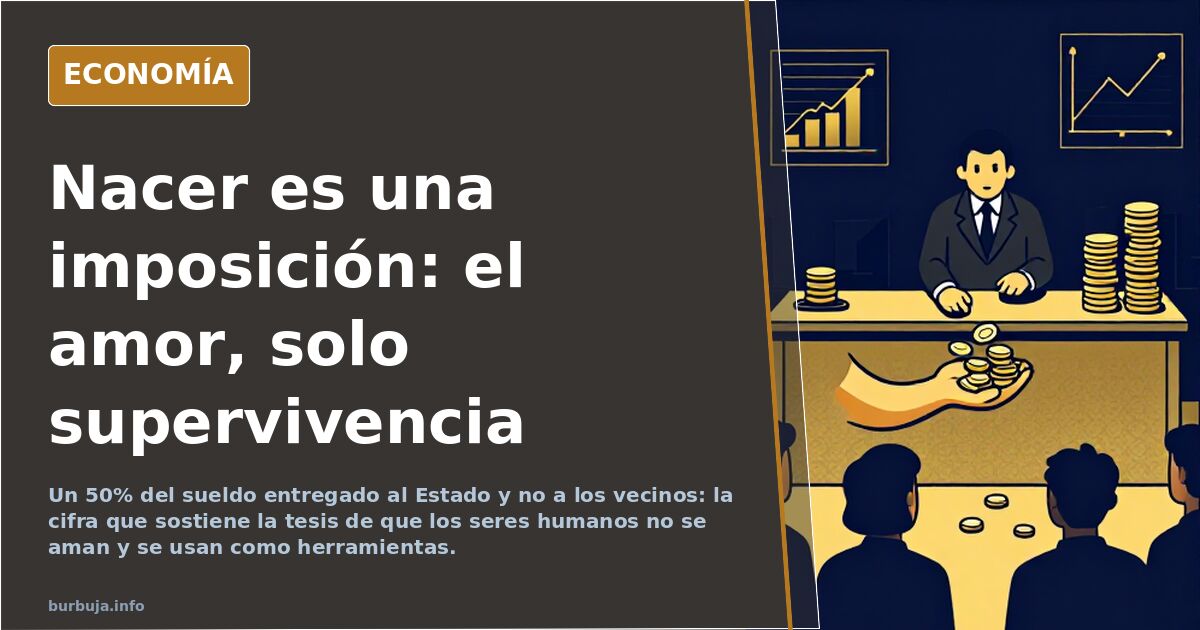
Human beings do not love each other: they are used as tools
There is a thesis that repeats with more insistence than office optimism allows: human beings do not love each other; they are used. Biological machines programmed to survive, tread on other animals, and eventually fall ill and die. The formulation is harsh, and its basis is not philosophical but accounting: someone who recognizes giving half of their salary to the State so that it performs good works. Not for their neighbors. For the State.
Half of the salary goes to the State and no one else
That is today's most solid argument for the thesis. The donor does not give to whom they wish; they give to an institution that redistributes according to its own criteria. Generosity is delegated and, incidentally, depersonalized. On the other side of the scales, individual philanthropy fares no better: there are those who hold that parental love for their children is a mechanism of genetic perpetuation, selfishness disguised as tenderness, and that no one audits this accounting. The full development of this argument—filial love as self-interest, the imposition of birth as a starting point—takes up more space than it has here.
Cioran, Camus, Benatar: the impossible originality
None of this is new, and the thesis itself accepts this without embarrassment. Cioran, Camus, Schopenhauer, or Benatar wrote the same thing decades or centuries ago: that birth is an imposition, that death is a biological failure and not a metaphysical destiny. The most uncomfortable conclusion is that whoever believes they have discovered the truth about human nature arrives late, and in a very frequented place.
With these pieces, the reasoning leads to a logical conclusion: if every bond is instrumental, love does not exist as a separate category. And yet, most people continue to pay, care for, and raise.
Is it custom, is it antiestéticar, or does the thesis fail right at the last stretch?
There is a thesis that repeats with more insistence than office optimism allows: human beings do not love each other; they are used. Biological machines programmed to survive, tread on other animals, and eventually fall ill and die. The formulation is harsh, and its basis is not philosophical but accounting: someone who recognizes giving half of their salary to the State so that it performs good works. Not for their neighbors. For the State.
Half of the salary goes to the State and no one else
That is today's most solid argument for the thesis. The donor does not give to whom they wish; they give to an institution that redistributes according to its own criteria. Generosity is delegated and, incidentally, depersonalized. On the other side of the scales, individual philanthropy fares no better: there are those who hold that parental love for their children is a mechanism of genetic perpetuation, selfishness disguised as tenderness, and that no one audits this accounting. The full development of this argument—filial love as self-interest, the imposition of birth as a starting point—takes up more space than it has here.
Cioran, Camus, Benatar: the impossible originality
None of this is new, and the thesis itself accepts this without embarrassment. Cioran, Camus, Schopenhauer, or Benatar wrote the same thing decades or centuries ago: that birth is an imposition, that death is a biological failure and not a metaphysical destiny. The most uncomfortable conclusion is that whoever believes they have discovered the truth about human nature arrives late, and in a very frequented place.
With these pieces, the reasoning leads to a logical conclusion: if every bond is instrumental, love does not exist as a separate category. And yet, most people continue to pay, care for, and raise.
Is it custom, is it antiestéticar, or does the thesis fail right at the last stretch?
Summary of a discussion on Burbuja.info - Foro de economía, actualidad y política., translated from Spanish and reviewed before publication. Read the full discussion (15 replies).
More summaries
-
Rivera proposes living an hour outside Madrid: The real cost of saving
Madrid buys at €5,984/sqm and rents at €23.3/sqm. Rivera suggests living an hour away: fuel costs and commuting times change the equation.
-
€57,542 in 8 months: The other side of the American Dream
A Spanish trucker claims to have earned €57,542 in eight months in the U.S. The figure masks a lifestyle that divides: success or hardship?
-
Euthanasia in Old Age: Autonomy vs. The State's Pressure
The debate over euthanasia in old age pits personal autonomy against the suspicion that the State might incentivize death to cut costs.
-
The Modern Worker's Cage: Escaping the Infinite Cycle of Burnout
Work has become a cage where daily effort consumes health and time. Discover why we push ourselves so hard and how to break the cycle.
-
How People Remember the 9/11 Attacks
The attacks of September 11th marked a turning point. Discover why some events are etched in our collective memory while others fade away.
-
Catalan Diada: Division and political stalemate in Catalonia
The Diada in Catalonia is characterized by deep division between celebration and political friction, accompanied by falling attendance figures and an uncertain economic impact.