
Bill Cooper, the former official credited with 'predicting 9/11'
Bill Cooper, former naval intelligence officer, published Behold a Pale Horse in 1991 and reportedly died by gunshot in 2001.
English · Original discussion in Spanish · Published
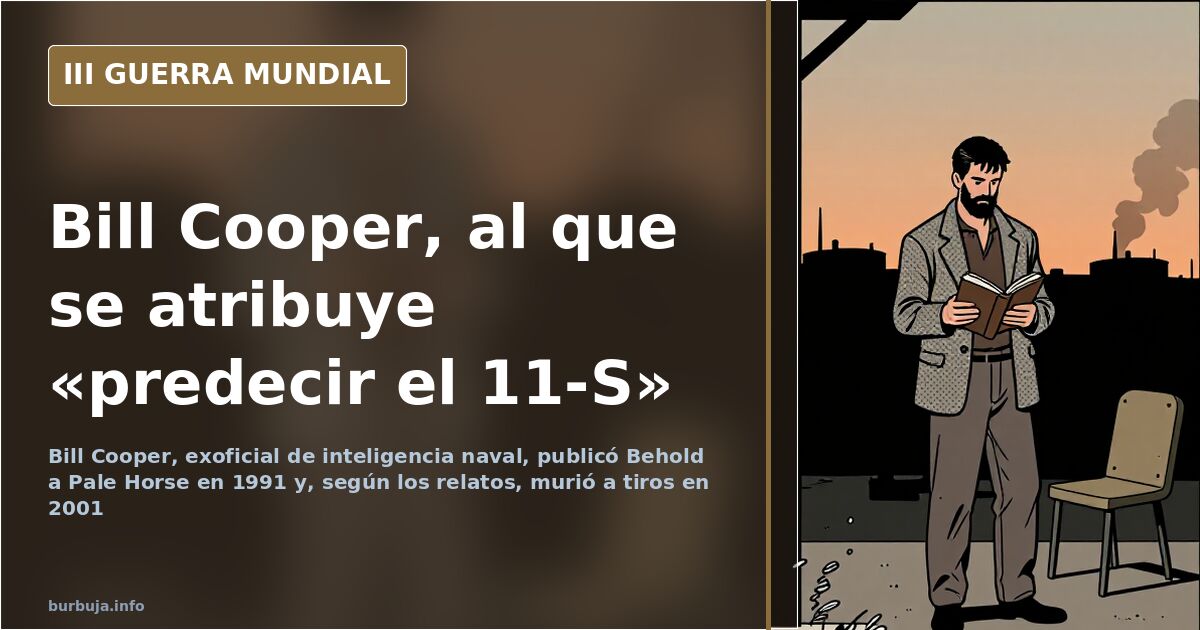
Bill Cooper, the former official credited with 'predicting 9/11'
A former United States naval intelligence officer transitioned from serving in the Navy to maintaining that a hidden elite conspires to establish a global government. Milton William «Bill» Cooper died in 2001 from a shootout with police, according to accounts surrounding his figure. He authored Behold a Pale Horse (1991), a text referenced by the American conspiracy and militia movement, and served as a shortwave radio broadcaster during the 1980s and 1990s. The story surrounding him mixes sightings, alleged prophecies, and misinformation.
What is attributed to him regarding 9/11
The starting point of the most repeated account is that he anticipated the September 11 attacks. This is a claim that repeats without independent verification. What the account does contain, however, is the general framework of his thesis: a hidden elite—the «Mysteries», secret societies, the Illuminati—dedicated to establishing a totalitarian socialist global government.
His «awakening» occurred in 1966, during his service in the Navy, when, according to his own account, he saw an unidentified flying object emerge from and then submerse back into the ocean while aboard a submarine.
Regarding his end, versions vary. The most common places his death in a shootout with police in 2001. Another version adds that his family and pet were also killed, a detail not confirmed by all accounts.
The 'Luciferian philosophy' and the origin of power
The central argument of Cooper is that this elite does not believe in God or the devil, but rather trinc a «Luciferian philosophy»: man can become god himself; the fall of Adam and Eve was not a punishment but a liberation from a cruel God; and Lucifer, identified with Prometheus, delivered the fire of intellect so that humanity could conquer nature. It is a conspiratorial narrative, unsupported by evidence, which he himself reportedly qualified later: part of what was published may have been deliberately placed misinformation.
The audiovisual material covering these ideas lasts about an hour and can be found here:
Some maintain that much of the book remains useful for reading current events. Opposing this is a simple argument: it is an incoherent text, mixing verifiable data with unverified material. The distance between these two readings has not closed in two decades. How much of what is attributed to him would withstand serious scrutiny today?
A former United States naval intelligence officer transitioned from serving in the Navy to maintaining that a hidden elite conspires to establish a global government. Milton William «Bill» Cooper died in 2001 from a shootout with police, according to accounts surrounding his figure. He authored Behold a Pale Horse (1991), a text referenced by the American conspiracy and militia movement, and served as a shortwave radio broadcaster during the 1980s and 1990s. The story surrounding him mixes sightings, alleged prophecies, and misinformation.
What is attributed to him regarding 9/11
The starting point of the most repeated account is that he anticipated the September 11 attacks. This is a claim that repeats without independent verification. What the account does contain, however, is the general framework of his thesis: a hidden elite—the «Mysteries», secret societies, the Illuminati—dedicated to establishing a totalitarian socialist global government.
His «awakening» occurred in 1966, during his service in the Navy, when, according to his own account, he saw an unidentified flying object emerge from and then submerse back into the ocean while aboard a submarine.
Regarding his end, versions vary. The most common places his death in a shootout with police in 2001. Another version adds that his family and pet were also killed, a detail not confirmed by all accounts.
The 'Luciferian philosophy' and the origin of power
The central argument of Cooper is that this elite does not believe in God or the devil, but rather trinc a «Luciferian philosophy»: man can become god himself; the fall of Adam and Eve was not a punishment but a liberation from a cruel God; and Lucifer, identified with Prometheus, delivered the fire of intellect so that humanity could conquer nature. It is a conspiratorial narrative, unsupported by evidence, which he himself reportedly qualified later: part of what was published may have been deliberately placed misinformation.
The audiovisual material covering these ideas lasts about an hour and can be found here:
Some maintain that much of the book remains useful for reading current events. Opposing this is a simple argument: it is an incoherent text, mixing verifiable data with unverified material. The distance between these two readings has not closed in two decades. How much of what is attributed to him would withstand serious scrutiny today?
Summary of a discussion on Burbuja.info - Foro de economía, actualidad y política., translated from Spanish and reviewed before publication. Read the full discussion (15 replies).
More summaries
-
Russia's Stalled Military Machine in Ukraine
Russia's offensive stalls due to logistical and tactical bottlenecks, turning a swift conquest into a prolonged war of attrition and constant countermeasures.
-
Ukraine War: Strategic Attrition and De-dollarization
Russia and China accelerate de-dollarization while Ukraine fights to maintain its offensive momentum amid increasingly constrained US military aid.
-
Ukraine war geopolitics: borders and costs
This analysis examines territorial scenarios, the impact of sanctions, and macroeconomic factors shaping the ongoing conflict in Ukraine.
-
Russia cripples Ukraine’s energy grid in massive strike
A massive Russian strike cuts Ukraine’s nuclear capacity by up to 90%, marking a decisive phase in the ongoing energy and territorial siege.
-
Ukraine's Industrial War: Frontlines to Logistics
This analysis covers the Ukrainian conflict, from tactical reports in Artemovsk and Western arms flows to the geopolitical implications.
-
Ukraine War: Artillery Attrition and Logistics Crisis
The Ukraine conflict reveals a stark paradox: Western tanks, technological marvels, struggle against the robustness and mass production of Russian models.