
Basque Origins: Hannibal Deserters Myth vs Genetics
The theory that Basques descend from Hannibal's deserters clashes with genetics, where R1b haplogroup exceeds 80% and North African markers are under 5%.
English · Original discussion in Spanish · Published
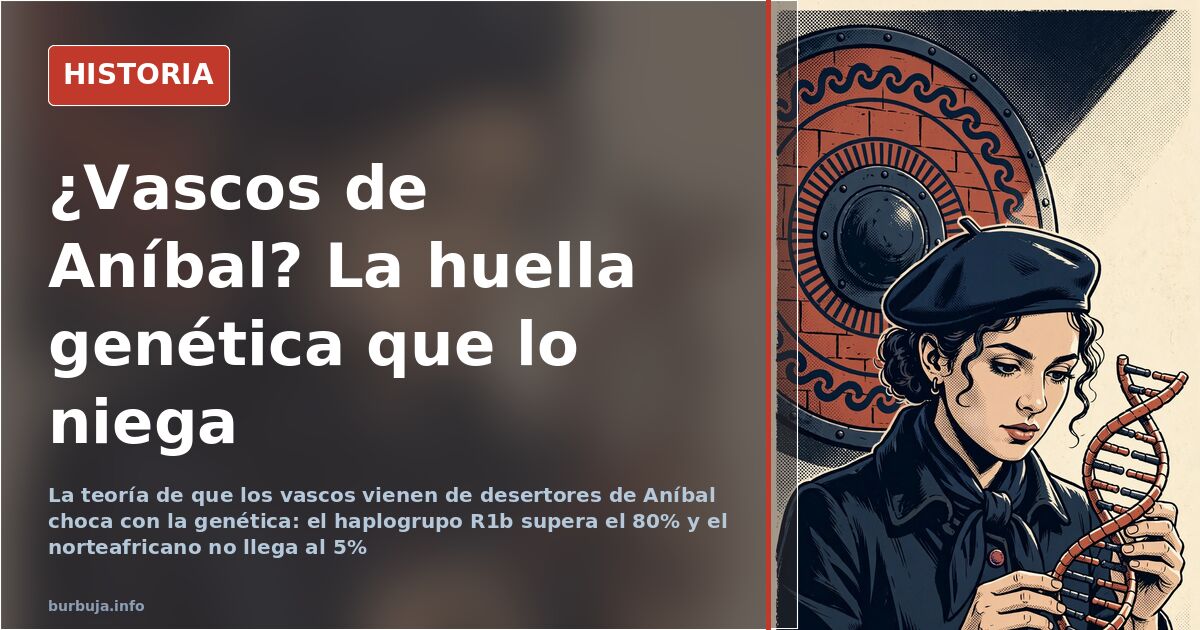
Basque origins between Hannibal and genetics
A long-standing theory suggests that the Basques are not an indigenous people but descendants of North African troops who deserted Hannibal's army in 219 BC, before he crossed the Pyrenees towards Rome. According to this narrative, both the Basque language and a significant part of the current population stem from those fugitives—Berbers and Libyans settled in Navarre's highlands. The thesis is presented with scholarly apparatus: Titus Livius, Polybius, Strabo, Ptolemy, and Cassius Dio. The problem is that almost all these citations, when read in full, state exactly the opposite.
The deserter thesis: 20,000 men who did not cross the Pyrenees
The starting point is a fact found in sources: Hannibal left Carthage with 90,000 men plus cavalry, and had 60,000 remaining upon crossing the Alps. In the intermediate stretch, after passing the Ebro River and before traversing the Pyrenees, about 20,000 deserted upon hearing rumors that the expedition targeted Rome. The hypothesis aligns these deserters with the Vascones, whom Romans located in the area decades later, around 180 BC, and with the bandit Corocotta, who ravaged Cantabrian lands at the end of the 1st century BC leading a gang.
The complete breakdown of these figures—how many started, how many stayed behind, and how many reached northern Italy—is where the narrative begins to fail. None of the calculations allow for moving 20,000 men from the Pyrenees to Navarre and turning a handful of fugitives into the substrate of an entire population.
There is a curious detail in this trail: the name Corocotta has been linked to the Libyan root kur, designating the hyena, an animal extinct on the peninsula since the Holocene and present then only in Africa. Proponents argue that the band leader having a Libyan name would prove his foreign origin.
What classical sources actually say
The detail collapses when reading Strabo carefully. The description of fierce warriors who slept on the ground and walked naked corresponds to the Cantabri, not the Vascones. When the Greek geographer mentions the Vascones, he speaks of their cities and little else. Attributing savagery to them is a leap unauthorized by the source.
Another pillar of the narrative—that a few Carthaginian soldiers ended up in the current Basque Country and replaced the native male population—clashes with what is known about Punic dominance. Carthage never controlled the interior: its sphere of influence was limited to the coast and Andalusia, and its armies were largely local mercenaries. Survivors of the Battle of Metaurus, moreover, did not return to Hispania; they survived in northern Italy through pillaging until swept away by Rome.
Genetics: 80% European versus 5% North African
Where the thesis completely breaks down is in DNA. Characteristic haplogroups of North Africa are Berber E1b and J1. In Basque populations, they represent around 5% of the male lineage, while R1b, of European origin, exceeds 80% for thousands of years. A recent replacement of the male population by a North African contingent would leave a genetic footprint that simply does not exist.
This does not make the Basques a living Paleolithic fossil. DNA analyses indicate that only about 10% of current inhabitants descend directly from Paleolithic settlers; the bulk comes from later migrations common to the rest of Western Europe. The mixture, in any case, is ancient and European.
Euskera is not an African language
The linguistic leg does not hold either. Euskera (the Basque language) is an isolate, with no proven kinship to any known family, and presents a rare trait: it is ergative. No African language is known—neither Afroasiatic, Nilo-Saharan, Niger-Congo, nor Khoisan—with this characteristic. Lists of lexical coincidences between Euskera and Berber circulating rely on mass comparison, an obsolete technique that finds similarities between any two languages through pure combinatorics.
The hypothesis with more traction among linguists goes in another direction: the so-called Vasco-Iberianism, which links Euskera to pre-Roman Iberian languages. The appearance of the Hand of Irulegi, with text in the Iberian script and elements readable as Euskera, gave ammunition to this path without closing it.
Why Basque origins generate such friction
The matter is not neutral. It mixes ancient history with contemporary identity, and often the academic argument is just an excuse for political reproach. When DNA began providing answers, the noise did not decrease: it increased. Some see in genetics proof that Basques are as European as any neighbor; others, the uncomfortable confirmation that no one is as ancient as believed. Neither reading emerges from the data.
The issue is not settled, but the ground has shifted. The question is no longer where supposed refugees from Hannibal arrived, but when, how, and with whom a people who had been in the same place for millennia mixed. There, the data remain incomplete, and anyone claiming otherwise is probably selling something.
Also available in: Deutsch
Summary of a discussion on Burbuja.info - Foro de economía, actualidad y política., translated from Spanish and reviewed before publication. Read the full discussion (128 replies).
More summaries
-
The Pasiegos' genetic enigma: 18% carry haplogroup R1A
18% of the Pasiegos, an isolated community in Cantabria, Spain, carry haplogroup R1A, typical of Germanic and Slavic peoples, compared to 8% in the rest of the region.
-
Paios and Beres: the alternative history built on Basque
«Elengoa» sounds strikingly like the Basque word «lehenengoa». From that echo comes Paios and Beres, an alternative history of human origins that is taking off on YouTube
-
Etruscans: the origins that Rome allegedly sought to erase
Archaeologists remain divided over the origins of the Etruscans, as ancient theories and modern genetic studies continue to spark debate.
-
ETA and GAL: two arms of the same Gladio network in Spain
Investigation linking ETA and GAL as arms of the same NATO Gladio network, with drug trafficking funding and CIA control.
-
Galician Celtic Myth Challenged by Northwest Genetics
A forum debate questions Galicia's Celtic identity, citing North African genetic components and Neolithic substrates over modern phenotypes.
-
France's Low Population Density: Why Birth Rates Fell Early
France has 121 inhabitants per km², far below Germany and England. A circulating theory links this demographic anomaly to an early drop in birth rates.