
Basic or acoustic plasterboard: the extra cost of 10 to 40 euros per m²
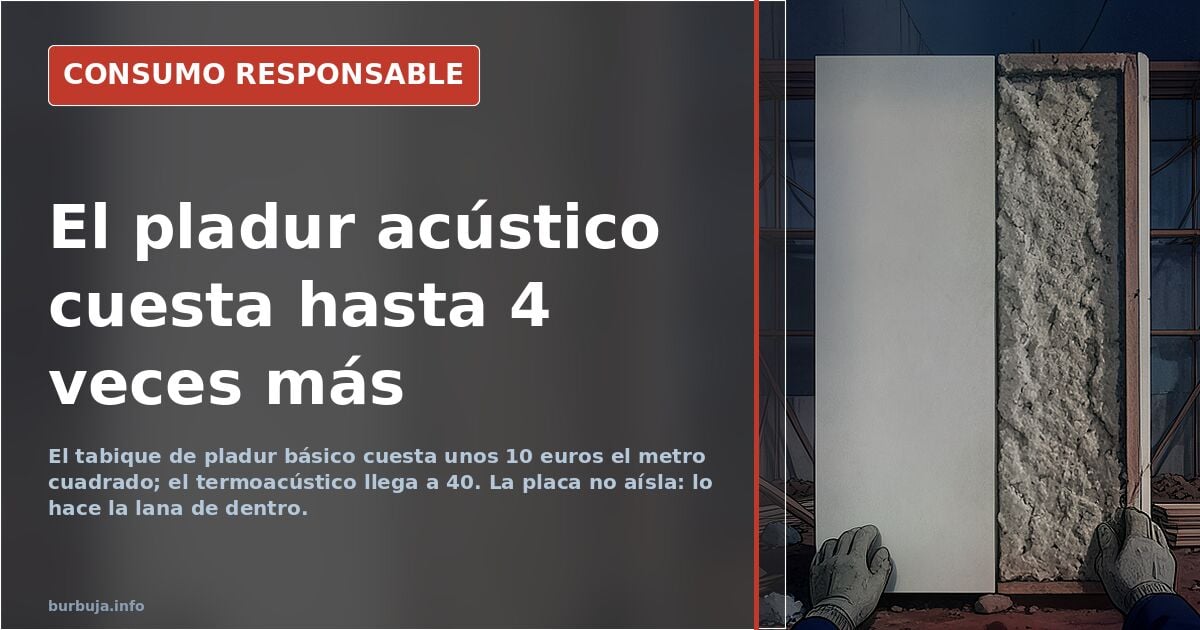
A basic plasterboard partition costs around 10 euros per square metre; the thermoacoustic version can reach 40. The board doesn't insulate: it's the wool inside that does.
English · Original discussion in Spanish · Published
Basic or acoustic plasterboard: paying 40 euros for something that costs 10
Renovating a village house, knocking down partitions and ending up with three roomy bedrooms. So far, all perfectly normal. The problem arises when the installer puts two prices on the table: the basic plasterboard partition comes out at around 10 euros per square metre; the version they call thermoacoustic goes up to 40. Four times as much for a material that, in many cases, isn't even what the customer thinks they're buying.
The confusion starts with the name. What is sold as acoustic board is usually a perforated board, designed for ceilings and for absorbing sound within a room, not for building a dividing wall. It's no good there. The real insulation of a partition doesn't come from the board: it comes from what goes inside. A frame of metal studs, plasterboard on both sides and, in the cavity, mineral wool. That's the recipe that keeps coming up when someone asks a serious question.
Price doesn't measure insulation
The jump from 10 to 40 euros doesn't buy a magic product. It buys, at best, glass wool or rock wool inside, an acoustic membrane and an air cavity. And it also buys the risk of it all going to waste over a fitting detail: acoustic bridges. A stud poorly isolated from the slab, a joint with the floor left unsealed, and the most expensive partition in the catalogue transmits noise just like the cheapest one.
Some add a layer of common sense to the budget: if the neighbours are 30 metres away, the acoustic insulation of the wall stops being a necessity and becomes a luxury. The user who started the thread is clear about it. They play music and want some insulation, but not because they're bothering anyone. And there the calculation changes: the extra cost is justified by the thermal effect, not by the noise.
What can't be undone
The argument that carries the most weight isn't acoustic, it's about the building work. Once the wall is closed up without wool inside, there's no going back short of knocking it down. The moment to decide is now, with the partitions open and the installer waiting. Afterwards, the only option is to live with whatever is there.
The other warning that comes up is about structural safety: not all partitions can be knocked down. Plasterboard ones, no problem. Brick ones may be load-bearing, and that's when the joke gets expensive. In a village house with beams, with internal walls separating rooms, it's worth knowing what you're demolishing before the rubble is in the skip.
With the numbers on the table, the decision comes down to one awkward question: are you paying 40 euros per square metre for insulation, or to avoid having to open up the wall again? The answer depends on how much noise there is on the other side. And on how much the word "thermoacoustic" weighs in the budget.
Also available in: Deutsch
Summary of a discussion on Burbuja.info - Foro de economía, actualidad y política., translated from Spanish and reviewed before publication. Read the full discussion (18 replies).
More summaries
-
Soundproofing against neighbour noise: up to 60 dBA for €100/m2
Soundproofing a home from neighbour noise can cost up to €100/m2 and achieve 60 dBA of insulation, but impact noise travels through the building structure and is almost…
-
Basic car insurance and a dead battery: what's covered and what isn't
The most basic policy may include towing or a jump-start, but not the battery. A replacement costs from 60 euros, and doing it wrong can damage the ECU.
-
Drywall vs brick: the internal wall debate in Spain
Properly installed drywall insulates better than brick and takes up 30% less space, according to one forum user. The problem is the cheap system fitted as standard.
-
Battery-powered bathroom fan: the offer doesn't keep up
A bathroom fan uses only 15 watts, like a light bulb. Yet battery-powered versions are scarce. Moisture can be solved, but not with batteries.
-
Dark beer: the passion that divides drinkers
Guinness has as many fans as detractors; Vol Damm divides opinions and even a supermarket surprises. A look at the dark beer map in Spain.
-
Spend your savings now: the extreme strategy against inflation
With 30% inflation forecast within a year, the call to spend savings immediately is gaining ground. Some are taking it to the extreme: leveraging up, buying land or…