
Barcelona waiter dies after cyclist assault
A 54-year-old Barcelona waiter died three weeks after being assaulted by a cyclist. The case awaits forensic reports.
English · Original discussion in Spanish · Published
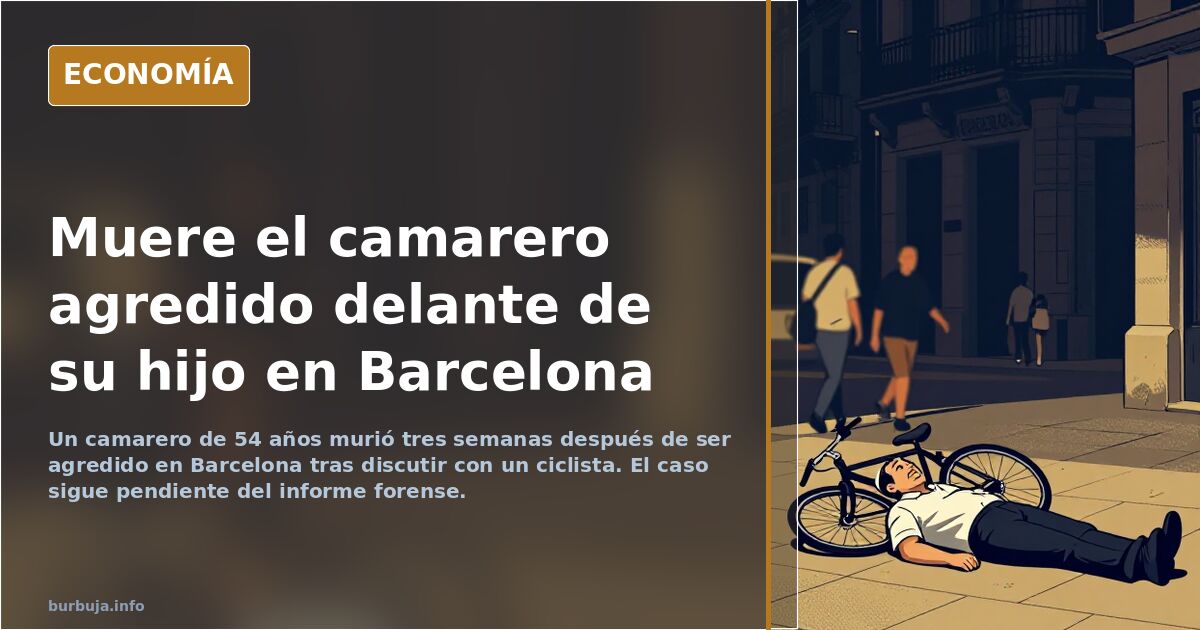
Barcelona waiter dies after cyclist assault
On June 29, a 54-year-old waiter leaving his shift at Restaurante Barceloneta in the Ciutat Vella district was nearly hit by a young cyclist along with his son. The argument escalated into an attack that left him unconscious and in cardiac arrest. Three weeks later, between last Wednesday and Thursday, he died at Hospital Clínic de Barcelona, where he had been in critical condition.
The Guardia Urbana arrested the alleged attacker that same night, a 25-year-old man with a prior record, for assault causing injury. Mossos d’Esquadra have taken over the case. If forensic experts link the injuries to his death, the charge could be upgraded to homicide. This is currently the key issue: awaiting the forensic report.
What peine early on June 29
The incident occurred around 5 a.m. The waiter and his son were leaving the establishment when a young cyclist nearly ran them over. The worker confronted him, leading to a beating. According to published reports, the attacker also allegedly pulled out a knife, possibly intending to rob the victim. The man fell unconscious after going into cardiac arrest.
There are unclear details regarding the exact sequence of events between the near-collision, the argument, and the assault. What is documented is the outcome: a 54-year-old worker returning home with his son ended up hospitalized at the Clínic and, three weeks later, dead.
Arrest and charges
The Guardia Urbana detained the alleged attacker the same night as the assault. He is a 25-year-old man with multiple prior convictions, according to media reports. He was arrested for assault causing injury. The legal classification may change: if forensics link the wounds to the death, he could face homicide charges. Mossos d’Esquadra are handling the investigation.
The distinction between assault and homicide is not merely technical. It defines the incivil framework, the judicial process, and public perception of the case. It hinges on a report that, at this stage, has not been made public.
Debate on institutional response
This case has reignited discussions beyond the specific incident. Some analyses suggest a sense of impunity exists: individuals with records released from custody who reoffend create the perception that the system fails to protect citizens. Opposing arguments note that pre-trial detention is not automatic, and presumption of innocence and proportionality are guarantees, not privileges.
Another perspective focuses on statistics. Violent crimes resulting in death represent a small fraction of total offenses, and aggregate data do not indicate a general trend of insecurity. Critics argue that statistical aggregates offer no comfort to victims' families nor answer why someone with a record was free.
Media coverage
Coverage has been uneven. Some outlets emphasized the victim's status as a worker and the presence of his son. Others highlighted the suspect's incivil history. Combining these elements—a waiter finishing work and a young man with a record—has fueled the narrative of "ordinary citizen versus repeat offender."
This framing simplifies complex issues. Debates on immigration and crime have become contentious, with individual cases often used to support broader theories. Available data do not support claims that any group is inherently more incivil. They do confirm recidivism exists and that perceptions of impunity have political consequences.
Unresolved questions
The case remains open. Charges depend on the forensic report. Investigation is led by Mossos d’Esquadra. The victim’s family has lost a father and husband. Meanwhile, public debate divides those demanding stricter penalties and those reminding us justice cannot operate through accumulated outrage.
The fundamental question remains unanswered: if a man with a record can end another’s life during a midnight argument, does the law fail, its enforcement, or the statistics claiming such incidents are exceptional? No comprehensive explanation yet fits all pieces.
Also available in: Deutsch
Summary of a discussion on Burbuja.info - Foro de economía, actualidad y política., translated from Spanish and reviewed before publication. Read the full discussion (144 replies).
More summaries
-
Two dental clinics shut down in Barcelona over fake dentists and expired materials
Catalan police shut down two dental clinics in Barcelona: fake dentists, rusty equipment and expired products. Five Latin American suspects arrested.
-
Mossos arrest Isaac Andic's son for Mango founder's murder
Jonathan Andic arrested by Mossos d'Esquadra for killing his father, Mango founder. Forum debates digital evidence reliability and family dynamics in wealthy estates.
-
Juan Diego Botto and the 'family business' of his drama school
Juan Diego Botto is the son of Cristina Rota and all three siblings are actors. The thread calls the school he promotes a 'family business'.
-
Study claims nearly half of working-age Africans in Spain are unemployed
A viral tweet cites Alejandro Macarrón claiming high unemployment among African migrants, sparking debate on subsidies and integration.
-
Spanish AltRight forum figure mocked over Dominican origin
A post on X claims Pablo is Dominican and jokes about the route from Roro to Concón. We explain the context behind this publication.
-
Spain's Transport Minister Óscar Puente Resigns Amid Rumors of Sánchez Pressure
A viral video claims Spanish Transport Minister Óscar Puente resigned at Pedro Sánchez's request, though no official confirmation exists.