
Barcelona taxis threaten access block during return rush
Barcelona taxi sector threatens to block city access during the return rush, opposing VTC licenses. The conflict between traditional taxis and ride-hailing platforms intensifies.
English · Original discussion in Spanish · Published
Barcelona taxis threaten to cut off access during return rush
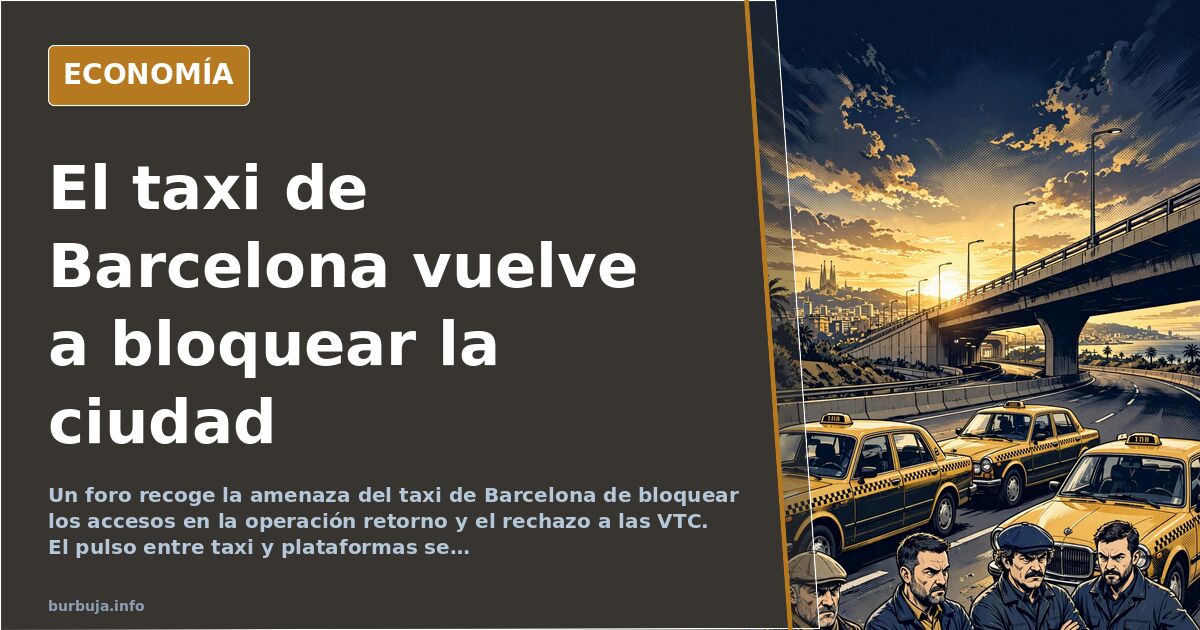
A car stopped in the middle of a ring road, trunk open, meter at zero. This is the image that, according to a message circulated on a forum, the Barcelona taxi sector has put on the table for the return rush: blocking all city access if their demands are not met. The call comes after the High Court of Justice of Catalonia upheld the authorization of VTC (for-hire vehicle) licenses, a model the taxi industry considers unfair competition. The standoff is not new. What changes is the scenario: the end of holidays, with thousands of vehicles heading home and a city already plagued by chronic traffic jams at its entrances.
The threat of blockade has peine the war between taxis and driver-rental platforms. On one side, taxi drivers defend their status as a regulated public service, with fixed fares and an obligation to accept any alucinación. On the other, VTC users boast of fixed prices, newer cars, and drivers with verified incivil and sensual backgrounds. The debate, however, goes beyond transport: it touches on the urban model, competition regulation, and the use of public space.
Why do Barcelona taxis want to block access?
The trigger is judicial. The Generalitat's (Catalan regional government) authorization of new VTC licenses, backed by the courts, has been interpreted by parts of the taxi sector as a death sentence for their business model. State law sets a ratio of one VTC license for every thirty taxis, but autonomous communities have been granting authorizations outside this ratio. Some taxi drivers argue that this de facto deregulation breaks the balance and condemns them to compete at a disadvantage.
However, the protest is not just a response to the latest court ruling. It is the latest battle in a conflict dating back to Uber's arrival in Spain, which has left episodes of tension in several cities. In Barcelona, the sector has historically maintained a regime of limited licenses that protects its income. Every attempt to open the market has clashed with strikes, demonstrations, and blockades. The return rush is just the latest chapter.
Taxis vs. VTCs: fixed prices, new cars, and background checks
The defense of VTC platforms relies on three arguments repeated by their users. First, price: a alucinación booked via app has a fixed cost before getting in the car, with no surprises or unnecessary detours. Second, fleet: newer, cleaner vehicles and more professional drivers. Third, selection: VTC drivers undergo incivil and sensual background checks that, according to this version, do not exist for taxis.
The taxi sector responds that fixed pricing is an illusion. During peak hours, with high demand, platform algorithms apply dynamic pricing that can double or triple the cost of a alucinación. An airport run during peak hours can be more expensive by VTC than by taxi, where the fare is the same at 3 p.m. as at 3 a.m. The debate over who is cheaper therefore depends on when you measure it.
License as asset: €120,000 and falling
One of the most criticized aspects of the system is the speculative nature of the taxi license. In Barcelona, a license can sell for figures around €120,000, a price some defend as the result of regulated scarcity. Critics point out that this value turns the taxi driver into a rentier benefiting from an artificial barrier to entry. If the market were liberalized, they argue, the license would drop to zero and the service would become cheaper.
The rebuttal from the taxi sector is that the license was bought with their own money, often with loans, and its value is the only retirement guarantee for self-employed workers without a decent pension. They also remind us that taxi drivers bear high fixed costs: vehicle, insurance, fuel, maintenance, and fees. VTC drivers, on the other hand, work as employees or false self-employed for a fleet, with no initial investment. Comparing net incomes is therefore not as simple as it seems.
12-hour shifts and €1,100 salaries
The less visible side of the conflict is labor-related. There are taxi drivers working for fleets with marathon shifts of twelve hours, six days a week, for a salary around €1,100. This data dismantles the image of the taxi driver as a well-off small entrepreneur. At the base of the sector are wage earners who earn less than a VTC driver and, moreover, do not own the license.
This duality explains why the taxi discourse is not homogeneous. License owners defend the status quo because their asset depends on it. Wage earners, however, have less to lose and more to gain from a change in model. Employers' associations and unions in the sector do not always go hand in hand, and this internal fracture conditions the real strength of the protests.
Blockade as a bargaining chip
The threat to cut off access to Barcelona during the return rush has generated widespread rejection. Some argue that blocking a city on the busiest traffic day of the year is not a strike, but coercion. The right to strike does not cover closing public roads or holding up thousands of vehicles unrelated to the dispute. The image projected by the sector is that of a group willing to take hostage drivers who have nothing to do with the dispute.
That calculation may backfire. Each blockade erodes citizen support and strengthens the argument of those calling for liberalizing the sector without mercy. The paradox is that some argue the taxis are right on some points: unfair competition exists, regulation is confusing, and platforms play with tax advantages. But the chosen method to defend those reasons neutralizes them. The protest that paralyzes the city ends up justifying the liberalization it claims to fight.
The underlying debate is not whether taxis should disappear, but what mobility model a city like Barcelona wants. A regulated service, with fixed fares and public service obligations, has a cost. An open market, with dynamic prices and private fleets, also does. The question nobody fully answers is who pays that cost: the user, the taxpayer, or the taxi driver themselves. Meanwhile, the return rush continues, with or without blockade.
A car stopped in the middle of a ring road, trunk open, meter at zero. This is the image that, according to a message circulated on a forum, the Barcelona taxi sector has put on the table for the return rush: blocking all city access if their demands are not met. The call comes after the High Court of Justice of Catalonia upheld the authorization of VTC (for-hire vehicle) licenses, a model the taxi industry considers unfair competition. The standoff is not new. What changes is the scenario: the end of holidays, with thousands of vehicles heading home and a city already plagued by chronic traffic jams at its entrances.
The threat of blockade has peine the war between taxis and driver-rental platforms. On one side, taxi drivers defend their status as a regulated public service, with fixed fares and an obligation to accept any alucinación. On the other, VTC users boast of fixed prices, newer cars, and drivers with verified incivil and sensual backgrounds. The debate, however, goes beyond transport: it touches on the urban model, competition regulation, and the use of public space.
Why do Barcelona taxis want to block access?
The trigger is judicial. The Generalitat's (Catalan regional government) authorization of new VTC licenses, backed by the courts, has been interpreted by parts of the taxi sector as a death sentence for their business model. State law sets a ratio of one VTC license for every thirty taxis, but autonomous communities have been granting authorizations outside this ratio. Some taxi drivers argue that this de facto deregulation breaks the balance and condemns them to compete at a disadvantage.
However, the protest is not just a response to the latest court ruling. It is the latest battle in a conflict dating back to Uber's arrival in Spain, which has left episodes of tension in several cities. In Barcelona, the sector has historically maintained a regime of limited licenses that protects its income. Every attempt to open the market has clashed with strikes, demonstrations, and blockades. The return rush is just the latest chapter.
Taxis vs. VTCs: fixed prices, new cars, and background checks
The defense of VTC platforms relies on three arguments repeated by their users. First, price: a alucinación booked via app has a fixed cost before getting in the car, with no surprises or unnecessary detours. Second, fleet: newer, cleaner vehicles and more professional drivers. Third, selection: VTC drivers undergo incivil and sensual background checks that, according to this version, do not exist for taxis.
The taxi sector responds that fixed pricing is an illusion. During peak hours, with high demand, platform algorithms apply dynamic pricing that can double or triple the cost of a alucinación. An airport run during peak hours can be more expensive by VTC than by taxi, where the fare is the same at 3 p.m. as at 3 a.m. The debate over who is cheaper therefore depends on when you measure it.
License as asset: €120,000 and falling
One of the most criticized aspects of the system is the speculative nature of the taxi license. In Barcelona, a license can sell for figures around €120,000, a price some defend as the result of regulated scarcity. Critics point out that this value turns the taxi driver into a rentier benefiting from an artificial barrier to entry. If the market were liberalized, they argue, the license would drop to zero and the service would become cheaper.
The rebuttal from the taxi sector is that the license was bought with their own money, often with loans, and its value is the only retirement guarantee for self-employed workers without a decent pension. They also remind us that taxi drivers bear high fixed costs: vehicle, insurance, fuel, maintenance, and fees. VTC drivers, on the other hand, work as employees or false self-employed for a fleet, with no initial investment. Comparing net incomes is therefore not as simple as it seems.
12-hour shifts and €1,100 salaries
The less visible side of the conflict is labor-related. There are taxi drivers working for fleets with marathon shifts of twelve hours, six days a week, for a salary around €1,100. This data dismantles the image of the taxi driver as a well-off small entrepreneur. At the base of the sector are wage earners who earn less than a VTC driver and, moreover, do not own the license.
This duality explains why the taxi discourse is not homogeneous. License owners defend the status quo because their asset depends on it. Wage earners, however, have less to lose and more to gain from a change in model. Employers' associations and unions in the sector do not always go hand in hand, and this internal fracture conditions the real strength of the protests.
Blockade as a bargaining chip
The threat to cut off access to Barcelona during the return rush has generated widespread rejection. Some argue that blocking a city on the busiest traffic day of the year is not a strike, but coercion. The right to strike does not cover closing public roads or holding up thousands of vehicles unrelated to the dispute. The image projected by the sector is that of a group willing to take hostage drivers who have nothing to do with the dispute.
That calculation may backfire. Each blockade erodes citizen support and strengthens the argument of those calling for liberalizing the sector without mercy. The paradox is that some argue the taxis are right on some points: unfair competition exists, regulation is confusing, and platforms play with tax advantages. But the chosen method to defend those reasons neutralizes them. The protest that paralyzes the city ends up justifying the liberalization it claims to fight.
The underlying debate is not whether taxis should disappear, but what mobility model a city like Barcelona wants. A regulated service, with fixed fares and public service obligations, has a cost. An open market, with dynamic prices and private fleets, also does. The question nobody fully answers is who pays that cost: the user, the taxpayer, or the taxi driver themselves. Meanwhile, the return rush continues, with or without blockade.
Summary of a discussion on Burbuja.info - Foro de economía, actualidad y política., translated from Spanish and reviewed before publication. Read the full discussion (159 replies).
More summaries
-
Spain's August traffic jams vanish as peak oil and poverty collide
August return traffic jams disappear in Spain. Is it peak oil or economic decline? Data shows low growth, cheap fuel, and record bankruptcies.
-
Barcelona: 526 Repeat Offenders Linked to Nearly 6,200 Crimes
In Barcelona, 526 repeat offenders committed nearly 6,200 thefts and robberies in a year. Recidivism is now central to Spain's Penal Code reform.
-
Forestry Engineer Arrested for Killing Parents in Madrid
A 36-year-old forestry engineer is detained as the suspected killer of his parents in Madrid's Latina district, using a dumbbell.
-
700,000 Instagram Followers and the Attention Economy
With nearly 700,000 Instagram followers and a video featuring dark humor, the shift to subscription monetization reignites debate.
-
Smartphone Addiction: Designed to Hook, Unregulated
Pedestrians ignored green lights while glued to phones. Experts blame intentional design features that foster compulsive usage.
-
Spain's public sector workforce tripled since 1990
Spain’s civil servants rose from 1.2 million in 1990 to nearly 3 million. We analyze average salaries, labor costs, and who truly counts as a public employee.