
Barcelona riots and looting: who is really behind them?
Riots in Barcelona: the Spanish government calls it vandalism instigated from social media and confirms 128 arrests. A Mossos spokesperson noted that half are...
English · Original discussion in Spanish · Published
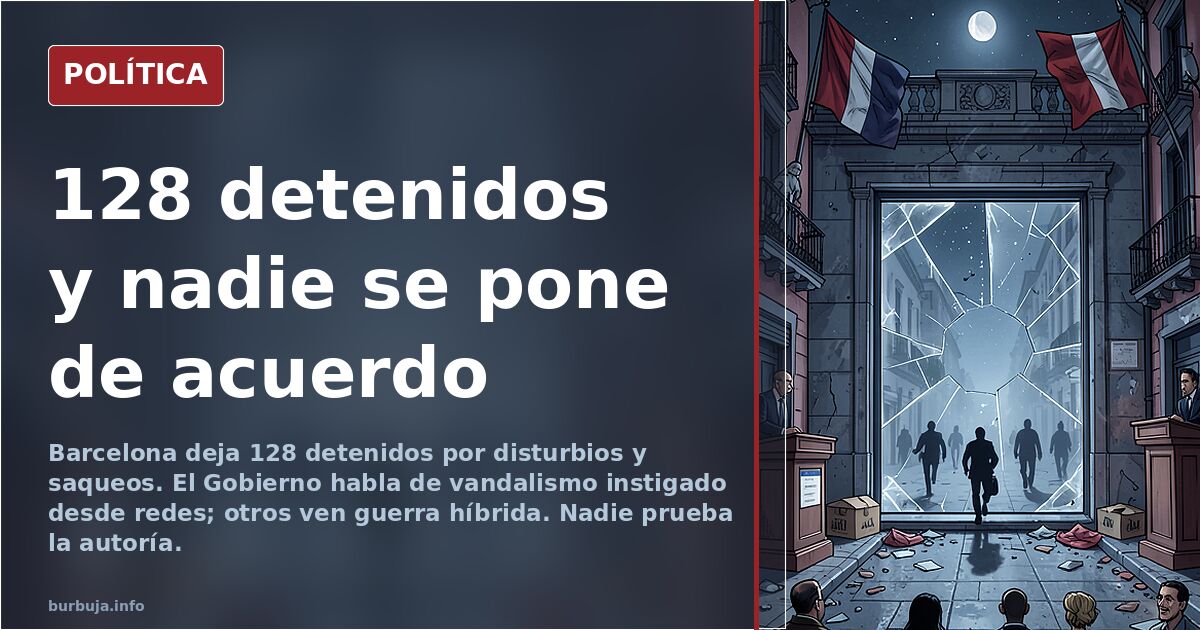
Riots in Barcelona: the narrative of chaos and the uncomfortable question
A weekend of looting and disturbances in Barcelona and Bilbao has peine the classic question: who benefits from disorder? The Spanish government speaks of "vandalism instigated from social media" and confirms an ongoing investigation with 128 arrests, according to the message attributed to Pedro Sánchez. The opposition, meanwhile, points to a copycat phenomenon with no central direction. Between the two theses lies an uncomfortable fact: the spokesperson for the Mossos (Catalonia's regional police) said on television that half of those arrested are from the Maghreb, a figure the government has not denied but has not made central to its narrative either.
The debate over who is responsible moves between hybrid warfare and the simple call effect. Some argue that behind the anonymous calls to gather there is a destabilization operation designed to inflate the perception of insecurity ahead of an electoral process. The argument rests on the logic of cui bono: if the electorate assumes the system is ungovernable, policy debate is replaced by visceral polarization. The implicit conclusion is that certain parties profit from antiestéticar. Others, however, see it as a copy of tactics imported from other European cities, with no need for an organizing mastermind.
Who is behind the riots according to the different camps?
The hybrid warfare theory is gaining ground in certain analyses. It describes an ecosystem of automated anonymous accounts launching massive disinformation campaigns to artificially inflate the perception of instability. The goal would not be the looting itself, but the framing: planting the idea that the State does not control the streets. The practical consequence is that democratic debate is shut down and the "us or chaos" mindset takes over. That is the hypothesis circulating in media and social networks, although there is no public evidence to confirm it.
Against it stands the more down-to-earth explanation: nobody needs to promote it. The looting is a copycat phenomenon already seen in the United States and the United Kingdom. The existence of means to prevent it does not miccionan they have been deployed. And the element of opportunity —groups with nothing to lose— would explain why it repeats in different cities with no apparent coordination.
The arrest figures and the bias of the narrative
The Mossos spokesperson provided the most concrete figure of the weekend: half of those arrested are from the Maghreb. It is a number that comes not from ideological analysis but from the regional police itself. From there, the discussion splits. Some see confirmation of an integration problem; others, proof that the official narrative hides the nature of the riots. The statistic, however, says nothing about intellectual authorship. It only describes the material perpetrators.
The conversation then shifts to the terrain of political responsibility. Critics point out that the government labels the events "vandalism instigated from social media" without naming the instigators. And they point to a bias in certain police unions that incivil the far right without evidence, while ignoring other sources of violence. The result is a picture where every actor has its own culprit and none takes responsibility for its share.
Who benefits from chaos? The economic answer
Beyond politics, there is a silent beneficiary: whoever steals with impunity. Riots create a window of opportunity for looting that requires no sophisticated organization. In that sense, the hybrid warfare thesis may be true and, at the same time, irrelevant: the damage is already done. Affected shopkeepers do not need to know who is behind it to pull down the shutter.
The debate over authorship thus becomes an intellectual luxury. Meanwhile, the question nobody answers is why the available means are not deployed to prevent the looting. The answer, perhaps, is that controlled chaos also has its political dividends. And there, all the actors have something to gain.
The analysis gets stuck at one point: there is no evidence of central direction, but neither of pure spontaneity. The investigation remains open and the 128 arrests are the only official figure. Everything else is interpretation.
Also available in: Deutsch
Summary of a discussion on Burbuja.info - Foro de economía, actualidad y política., translated from Spanish and reviewed before publication. Read the full discussion (42 replies).
More summaries
-
Sánchez and the climate: an election choice nobody asked for
A forum attributes to Spain's PM Sánchez a choice between himself or climate change. Postal voting, flooding in Bilbao and housing all enter the campaign.
-
Begoña Gómez avoids jail: first win for Sánchez in Spain's judicial week
After two years of investigation, Sánchez's wife will not be jailed. The government wins the week's first legal showdown, as a stark contrast emerges.
-
Iustitia Europa vs. VOX: The Party's Origins
Iustitia Europa, born from the Liberum lawyers' association, targets VOX. The 'useful vote' debate reignites conflict between the two parties.
-
The 'porges' are shallow meddlers who believe in non-Zionist Zionism
Zionism began as a political project and its military structure is that of the State of Israel. The self-described anti-Zionist left forgets that Marxism once supported it.
-
Felipe González's nephew among 18 charged in Spain's Santana case
José Rodríguez González, nephew of Felipe González, and 17 other former senior PSOE officials in Andalusia have been charged in the Santana case, according to El Debate.
-
Spain election: I'll vote for VOX as a vote of confidence, but it may be the last time
A Spanish voter announces his ballot for VOX with a list of conditions and a warning: if the party does not change course, it will be the last time he votes for it.