
Barcelona Christmas Light Fight Sparks Migration Debate
A brawl during Barcelona's Christmas light switch-on fuels debate on integration, safety and bystander apathy. No serious injuries confirmed.
English · Original discussion in Spanish · Published
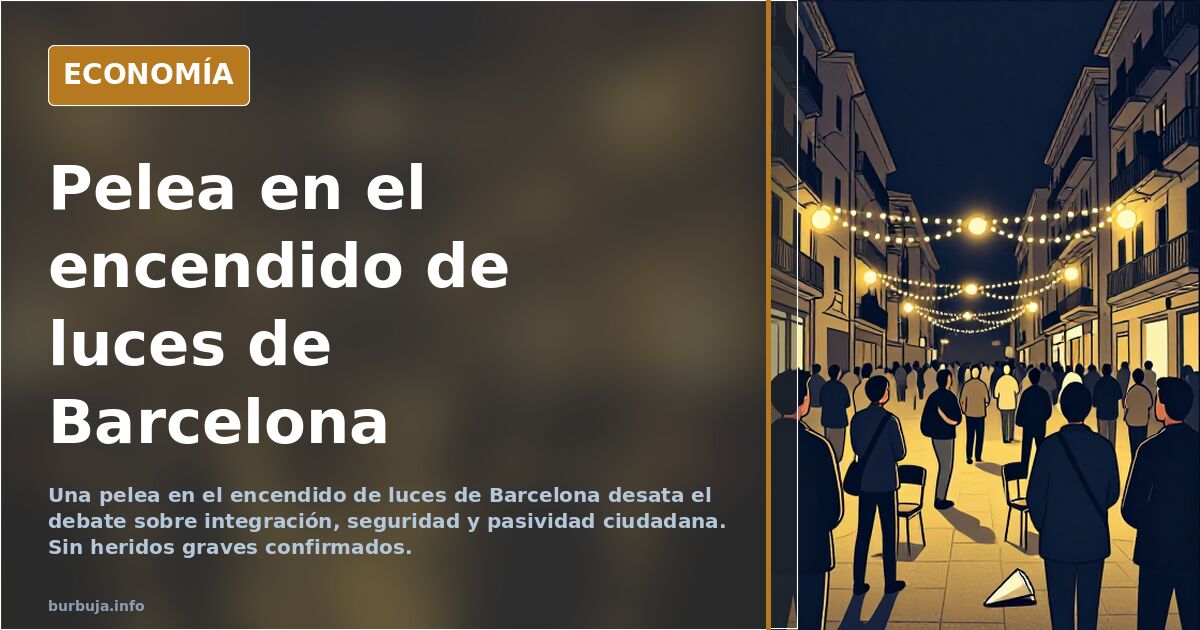
Barcelona Christmas Light Fight Sparks Migration Debate
A group of women engaged in a street brawl during the Christmas light switch-on ceremony in Barcelona. The video, widely shared on social media, shows several people hitting each other while a crowd of onlookers watches without intervening. Some identified the scene as resembling Andean holiday traditions, triggering accusations regarding integration, security, and political responsibility. There are no confirmed serious injuries or known arrests.
What peine at the Barcelona light switch-on?
The circulated footage shows a group of women, described with derogatory terms in online comments, fighting in the street during the illumination event. The recording captures punches, shoves, and hair-pulling while passersby look on. Some witnesses noted a child riding on someone's shoulders cheering on the fight. Police intervention or arrests have not been reported.
The scene has been interpreted in two opposing ways. For some, it is evidence of imported "savagery" highlighting failed integration. For others, it is an isolated scuffle exaggerated by viral bias. What the episode clearly reflects is the underlying tension regarding coexistence in neighborhoods with high migrant populations.
Viral video and social media reaction
The clip's spread generated a flood of comments mixing mockery, outrage, and armchair sociological analysis. Some claim it represents a "Christmas tradition" from countries of origin involving ritual fights on special dates, while others retort that Mexico has existed for 500 years and sacrifices less now. Irony mixes with outright rejection.
Many messages denounce the bystanders' apathy: "Look how people just walk past without separating them; only one woman gets involved, likely one of those screaming." Others defend that street entertainment is free and should be exported to the south. The result is a portrait of social division facing a phenomenon that admits no simple nuances.
Is this an imported Christmas tradition?
There is no evidence that the fight forms part of any traditional celebration. The comparison with Andean festivities was a joke hypothesis launched by participants, not a documented fact. What does exist is a pattern of street brawls in contexts of urban concentration and alcohol consumption during mass events, regardless of the participants' origins.
Attributing the behavior to a supposed cultural custom is an unfounded generalization. The scene, however violent, does not define a collective. The relevant question is whether the episode reflects a coexistence problem or an isolated incident amplified by virality.
Political debate: migration, votes, and responsibility
The episode served as ammunition for political accusations. One message summarizes it: "Pedro Sanchez gives away 5 million Spanish nationalities, they go to Colboni city, and it's Ayuso's fault?" This quote, attributed to a participant, mixes criticism of the central government's migration policy with regional management issues. Official data confirming such nationality figures do not appear in the material.
Another current argues that politicians of all colors are "turning your region into a South American colony with all the resulting problems." It is claimed that the political class prioritizes retaining territorial power over border control. In contrast, no explicit defense of migration management appears in the material, only criticisms from various angles.
Bystander apathy and the 'machete-ization' of debate
One of the most commented aspects is the reaction of those present. Most filmed with their phones or looked away. "But what are people doing standing there doing nothing! Take out the machetes!", wrote a participant sarcastically. Irony about citizen apathy coexists with complaints that nobody helped those involved.
The episode also allowed some to project theories about "invasion" and "third-worldism." Claims like "Madrid is absolutely crazy. They will destroy our country" were made. These opinions lack empirical support in the material but reflect a widespread mood in certain sectors. Ultimately, the video functions as a screen onto which everyone projects their antiestéticars.
Consequences and current status
No arrests, serious injuries, or police actions resulting from the fight have been reported. The video continues circulating and fueling comments. The lingering question is whether such incidents are sporadic or respond to a pattern authorities are not measuring. Until official data emerges, everything else is speculation.
How many street fights are recorded at Christmas events in Spain? No figures appear in the material. Is it a new phenomenon or has it always existed? Neither is clear. The only certainty is that a thirty-second video achieved what a hundred speeches could not: igniting the debate on who we are and how we coexist.
Also available in: Deutsch
Summary of a discussion on Burbuja.info - Foro de economía, actualidad y política., translated from Spanish and reviewed before publication. Read the full discussion (107 replies).
More summaries
-
Death wish for Sánchez found on Madrid Christmas tree
A card on the Real Casa de Correos tree requested Pedro Sánchez's death, prioritizing it over health and happiness.
-
Madrid wildfires: 80,000 confined as political war rages on
80,000 people confined by wildfires in Madrid, Spain: the political war between Ayuso and Sánchez drives up the economic and human cost. An analysis of the response and its…
-
Ceuta Video Sparks Debate on Immigration, Morocco, and Votes
A video from Ceuta ignites controversy surrounding immigration, the tug-of-war with Morocco, and the funding of migrant support NGOs.
-
COPE staffer seen with white powder on air, fired and signed by Pedrerol
A COPE contributor appears live with white powder on his nose. He's fired, but Pedrerol has reportedly offered him a job. Cocaine or donut?
-
€100 for enduring the heat: a chain's 'reward'
A hotel chain is paying each worker €100 as a summer heat bonus. By one calculation circulating online, it works out at 0.66% of a €15,000 annual salary.
-
Spain's housing decrees put 900,000 flats at risk of leaving the market
Spain's housing decrees put 900,000 flats at risk, and investment funds are already halting affordable rental projects while Junts refuses to back them.