
Baltimore Bridge Collapse: Cargo Ship Hits Key Structure, Sparking Infrastructure Debate
A cargo ship struck Baltimore's Francis Scott Key Bridge after losing power, leading to its collapse and reigniting discussions on US infrastructure.
English · Original discussion in Spanish · Published
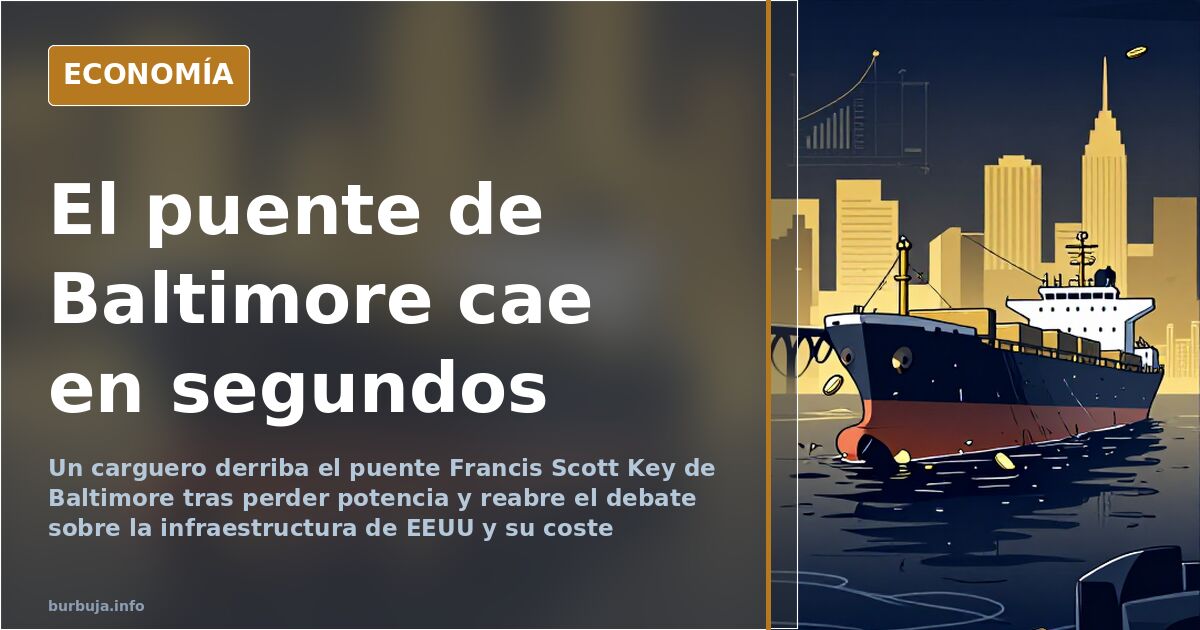
Cargo Ship Topples Baltimore's Francis Scott Key Bridge in Seconds
The cargo ship was navigating the Patapsco River when it lost steering. It lost power twice. The crew issued a distress call which, according to officials, allowed traffic to be stopped in time. Minutes later, the vessel struck one of the Francis Scott Key Bridge's pillars, and the structure collapsed in seconds. It was March 26, 2024, and the fall of a nearly half-century-old bridge suddenly peine three debates: authorship, the state of American infrastructure, and the true cost of sustaining an economy that runs on old concrete.
Was it a Terrorist Attack or an Accident?
Mere minutes passed before the hypothesis of a deliberate attack gained traction. The ship, according to several sources, traced an almost perfect perpendicular to the pillar. That geometry, more than clean, fueled suspicion: some argue that no accidental human error could hit the exact spot with such precision. Theories ranged from sleeper cells to alleged remote navigation control, including ISIS, Russia, Mossad, North Korea, or an internal faction of the US apparatus itself.
On the other side, no less people point to something more prosaic: the captain was Ukrainian, the ship had reported technical problems shortly before the collision, and authorities are ruling out terrorism. The distress call prior to the impact is the strongest argument against sabotage, although it's also the most debated: if someone wanted to create an alibi, giving notice would be part of the script. Symbolism aside, it fuels the narrative: a bridge named after the author of the national anthem sinks 100 days before July 4th.
Adulterated Fuel and the Ship's History
Where the conspiracy narrative cracks is in the mechanics. A refining industry executive suggested that the ship might have refueled with contaminated fuel, a practice, he argued, indulged in by marketers cutting corners on controls. If the engine failed that way, the causal chain becomes boringly industrial: poor fuel quality, loss of power, and a tens-of-thousands-of-tons mass turned into a battering ram.
Added to this is the cargo ship's own history, which, as recalled, had a record of breakdowns uncharacteristic of an almost new vessel. The combination of both factors offers an explanation that needs no villain: no remote control or Chinese anchors, just poor maintenance and a pillar defenseless against impacts of that magnitude.
The Infrastructure the US Let Age
Here, the accident ceases to be a maritime anecdote. The bridge lacked anti-collision defenses designed for ships of that size, and part of the analysis interprets it as a symptom, not an isolated accident. The most common argument: the budget went to the military industry and Ukraine, while roads, bridges, and the electrical grid accumulated decades of neglect. The approach ramp, the absence of mandatory tugboats during transit, or the stowage of hazardous materials in the forward bow complete the picture of a system that relies too much on nothing happening.
How Much to Rebuild the Francis Scott Key Bridge?
State authorities spoke of up to two years to rebuild the structure, a timeline that leaves the port and its surroundings in a difficult-to-avoid logistical bottleneck. And a simple calculation begins to circulate: if the aid package to Ukraine was around $50 billion, then the $20 billion required for the work comes from there. The comparison, frivolous or not, works as a headline.
The human toll, on the other hand, fell far short of the "mass casualty event" trumpeted: those who died, as reported, were workers performing maintenance on the deck, not a flood of vehicles. In the US, according to circulating figures, about 5,000 workers die annually from workplace accidents; in Spain, close to a thousand. A bridge collapsing suddenly is more entertaining. Foundations crumbling daily, however, interests no one.
The cargo ship was navigating the Patapsco River when it lost steering. It lost power twice. The crew issued a distress call which, according to officials, allowed traffic to be stopped in time. Minutes later, the vessel struck one of the Francis Scott Key Bridge's pillars, and the structure collapsed in seconds. It was March 26, 2024, and the fall of a nearly half-century-old bridge suddenly peine three debates: authorship, the state of American infrastructure, and the true cost of sustaining an economy that runs on old concrete.
Was it a Terrorist Attack or an Accident?
Mere minutes passed before the hypothesis of a deliberate attack gained traction. The ship, according to several sources, traced an almost perfect perpendicular to the pillar. That geometry, more than clean, fueled suspicion: some argue that no accidental human error could hit the exact spot with such precision. Theories ranged from sleeper cells to alleged remote navigation control, including ISIS, Russia, Mossad, North Korea, or an internal faction of the US apparatus itself.
On the other side, no less people point to something more prosaic: the captain was Ukrainian, the ship had reported technical problems shortly before the collision, and authorities are ruling out terrorism. The distress call prior to the impact is the strongest argument against sabotage, although it's also the most debated: if someone wanted to create an alibi, giving notice would be part of the script. Symbolism aside, it fuels the narrative: a bridge named after the author of the national anthem sinks 100 days before July 4th.
Adulterated Fuel and the Ship's History
Where the conspiracy narrative cracks is in the mechanics. A refining industry executive suggested that the ship might have refueled with contaminated fuel, a practice, he argued, indulged in by marketers cutting corners on controls. If the engine failed that way, the causal chain becomes boringly industrial: poor fuel quality, loss of power, and a tens-of-thousands-of-tons mass turned into a battering ram.
Added to this is the cargo ship's own history, which, as recalled, had a record of breakdowns uncharacteristic of an almost new vessel. The combination of both factors offers an explanation that needs no villain: no remote control or Chinese anchors, just poor maintenance and a pillar defenseless against impacts of that magnitude.
The Infrastructure the US Let Age
Here, the accident ceases to be a maritime anecdote. The bridge lacked anti-collision defenses designed for ships of that size, and part of the analysis interprets it as a symptom, not an isolated accident. The most common argument: the budget went to the military industry and Ukraine, while roads, bridges, and the electrical grid accumulated decades of neglect. The approach ramp, the absence of mandatory tugboats during transit, or the stowage of hazardous materials in the forward bow complete the picture of a system that relies too much on nothing happening.
How Much to Rebuild the Francis Scott Key Bridge?
State authorities spoke of up to two years to rebuild the structure, a timeline that leaves the port and its surroundings in a difficult-to-avoid logistical bottleneck. And a simple calculation begins to circulate: if the aid package to Ukraine was around $50 billion, then the $20 billion required for the work comes from there. The comparison, frivolous or not, works as a headline.
The human toll, on the other hand, fell far short of the "mass casualty event" trumpeted: those who died, as reported, were workers performing maintenance on the deck, not a flood of vehicles. In the US, according to circulating figures, about 5,000 workers die annually from workplace accidents; in Spain, close to a thousand. A bridge collapsing suddenly is more entertaining. Foundations crumbling daily, however, interests no one.
Summary of a discussion on Burbuja.info - Foro de economía, actualidad y política., translated from Spanish and reviewed before publication. Read the full discussion (564 replies).
More summaries
-
Euthanasia in Old Age: Autonomy vs. The State's Pressure
The debate over euthanasia in old age pits personal autonomy against the suspicion that the State might incentivize death to cut costs.
-
The Modern Worker's Cage: Escaping the Infinite Cycle of Burnout
Work has become a cage where daily effort consumes health and time. Discover why we push ourselves so hard and how to break the cycle.
-
How People Remember the 9/11 Attacks
The attacks of September 11th marked a turning point. Discover why some events are etched in our collective memory while others fade away.
-
Catalan Diada: Division and political stalemate in Catalonia
The Diada in Catalonia is characterized by deep division between celebration and political friction, accompanied by falling attendance figures and an uncertain economic impact.
-
Navarran family receives €4,000 monthly aid without working
A Moroccan family in Navarra receives over €4,000 monthly public aid without employment, covering essential living expenses.
-
Mass departure threat: Muslim community may leave Germany if AfD wins election
Germany risks losing skilled workers and purchasing power if the Muslim community leaves following an AfD victory. We analyze the economic implications.