
Bakhmut: RPG fails to pierce trench defenses
Video shows an RPG bouncing off a tank, highlighting why trenches remain deadly traps in drone and artillery warfare.
English · Original discussion in Spanish · Published
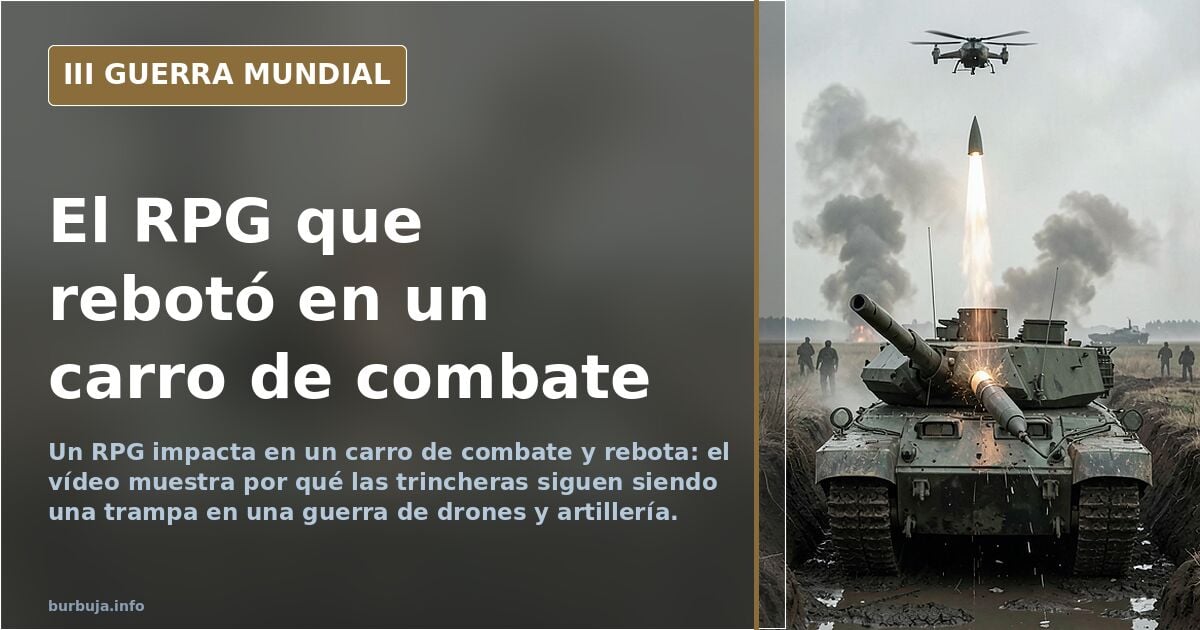
Bakhmut: When the RPG bounces and the trench becomes a trap
What happens when a soldier fires an RPG at a main battle tank and the projectile fails to peine? The tank continues its advance, the trench turns into a rat's nest, and the infantry trinc up finishes the job. This is what the video driving the discussion describes: a tank moving parallel to a trench line, firing at close range, while a Ukrainian soldier attempts a high-angle shot that falls short. The subsequent debate mixes technical details —the tank's armor, the rocket's fuze, the trajectory— with the broader question of the utility of trenches in a war dominated by drones and precision artillery.
The shot that went too high
The video shows a main battle tank —identified in the conversation as a T-72 or T-90 family model— advancing alongside a trench and firing continuously. A Ukrainian soldier emerges to fire an RPG, but the projectile does not hit directly: it bounces upward or strikes the turret roof. The scene repeats across several messages: the tank does not stop, the accompanying infantry clears out survivors, and the soldier who fired is left exposed.
The technical explanation offered in the discussion is that the rocket failed to detonate because the fuze did not activate. The RPG-7V has no minimum arming distance, but if the grenade lands near the shooter, the result is worse for the firer than for the target. The shot was too high, the projectile impacted a reinforced area, and the tank continued on its path. The conclusion drawn is that a single soldier with a rocket launcher is insufficient against a tank protected by its own infantry.
Do trenches still work in a drone war?
This question runs through the entire conversation. A front line of hand-dug trenches is vulnerable to artillery, drones, and mortars if the enemy concentrates fire on a specific point. Trenches protect against shrapnel, but not against direct hits or a drone dropping a grenade from above. Several messages agree that the trench is no longer a safe refuge, but rather a way to buy time while the enemy advances.
The problem is that there is no alternative. Without trenches, infantry are exposed to artillery fire and drones. Positional warfare has returned because anti-aircraft defenses and drones prevent large formations from moving without being detected. Trenches are slow, but they remain the only way to hold a static line without losing it in a day.
The tank is not invincible, but it is not an easy target either
The discussion devotes several messages to the resilience of Russian armor. A T-90 family tank is not peine by just any RPG shot from any angle. Reactive armor and the reinforced turret miccionan that a frontal or overhead impact does not guarantee destruction. The shot seen in the video was not a miss; it was a hit where the tank is most protected.
Comparisons with other Western tanks appear frequently. Some argue that a Leopard would have more success peine Russian armor, while others respond that the tank is not the problem: the problem is the infantry protecting it. A lone tank without support is vulnerable; a tank supported by infantry and reconnaissance drones is a machine for wearing down trenches.
The war unseen in headlines
The video does not show a decisive battle. It shows the daily reality of a war of attrition: a tank advancing, a trench being cleared, a soldier firing and missing. The carnage lies not in the impact, but in the repetition. Every day the same scene repeats at a different point on the front, and every day the result is the same: a few meters of ground gained at enormous cost.
The conversation shifts toward exhaustion. Some compare the situation to World War I, while others recall that positional wars have always been slow. The difference now is that drones record every movement and upload it to the internet within minutes. The war has become transparent to those watching from outside, but remains opaque to those suffering inside a trench.
In the end, the video leaves an image that summarizes the conflict: a soldier fires his last weapon at a tank he cannot stop, and the tank keeps advancing. The trench is not a fortress. It is a way to wait for the next shot.
Also available in: Deutsch
Summary of a discussion on Burbuja.info - Foro de economía, actualidad y política., translated from Spanish and reviewed before publication. Read the full discussion (68 replies).
More summaries
-
Stoltenberg demands China pay for backing Russia
Stoltenberg calls on China to pay for supporting Russia and announces sanctions. The debate looks at the cost for Europe and the shift toward the BRICS.
-
Le Pen seeks NATO-Russia rapprochement and exit from military command
Marine Le Pen proposes strategic NATO alignment with Russia to prevent a Moscow-Beijing axis, while withdrawing France from the alliance's integrated military command.
-
Konstantinovka battle shows how drones are reshaping warfare
A military analysis of the battle of Konstantinovka reveals drone tactics and single-soldier assaults every 7 hours. Controversy over neutrality and the role…
-
Alcàsser: Esther’s testimony, the fourth girl, remains under suspicion
Esther Alcàsser, the fourth girl, gave a TV interview six days after the 1992 Alcàsser murders in Spain. Her account and timeline discrepancies fuel ongoing controversy.
-
Unmarked Russian T-72 video harasses Ukrainian column, sparks skepticism
A video shows a Russian T-72 harassing a Ukrainian column. Poor editing and lack of vehicle markings fuel doubts about the scene's authenticity.
-
Trump Halts Military Aid to Israel Ahead of Elections
Trump announces the end of military aid to Israel on election day. Arms sales continue. We explain the implications and why it matters.