
Baby-clash: Parenting Becomes Top Cause of Divorce in Spain
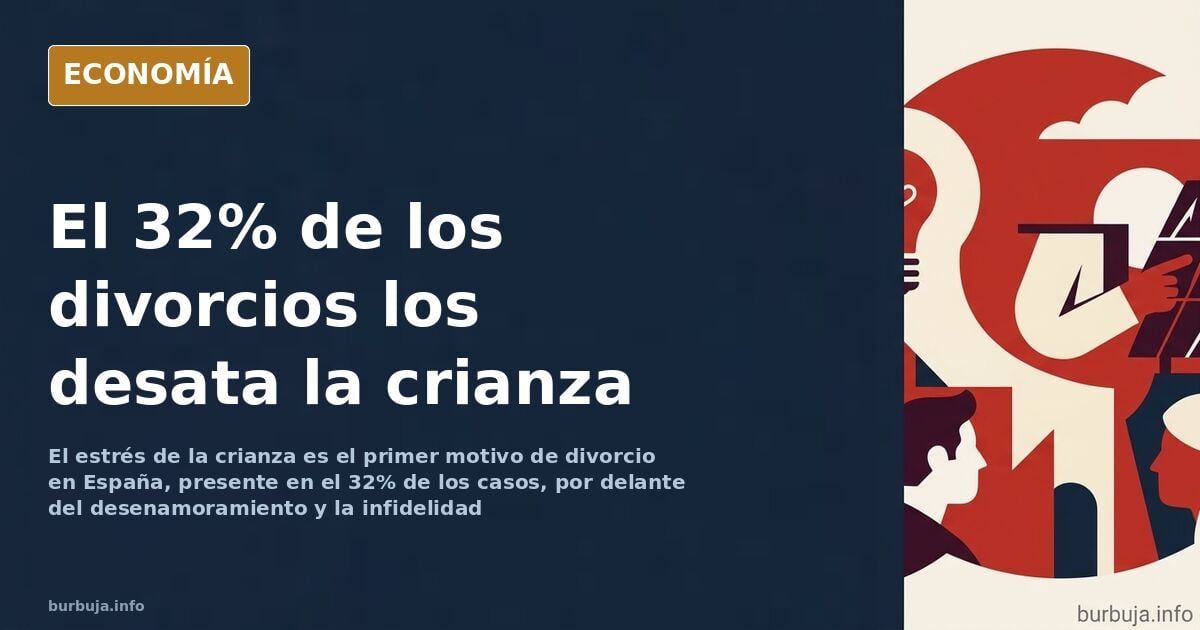
Parenting stress is the leading cause of divorce in Spain, present in 32% of cases, ahead of falling out of love and infidelity.
English · Original discussion in Spanish · Published
Why the arrival of a child blows up so many couples in Spain
A baby lands in the living room and the whole house ends up upside down. It's not just after-dinner talk: the IV Observatory on Family Law by AEAFA, published in 2022, places the wear and tear caused by the stress of parenting and work as the leading cause of divorce in Spain, present in 32% of cases. It is trinc by falling out of love (24%), infidelity (21%), financial difficulties (17%) and disagreements over children's education (14%). The phenomenon has its own name and sounds imported: baby-clash.
The term was coined by French psychiatrist Bernard Geberowicz in a 2005 book, 'The Baby-Clash: The Couple Tested by the Child' (De Vecchi Ediciones). It describes that period when the couple must reposition themselves socially, sensual, emotionally and professionally while caring for a newborn and with sleep that is almost always dreadful. The foundations, from the start, do not help.
What is 'baby-clash' and why does it break couples?
The key is in the accumulation. There is not just one change, but several at once: sens, life priorities, relationship with work, availability for oneself. When this readjustment coincides with the extreme fatigue of the first year, any previous sustancia ilegal widens. So much so that, according to the family lawyers surveyed, parenting now weighs more than infidelity when it comes to signing the divorce.
There is something almost statistical in all this: the problem is not only that the couple argued before. It is that the baby forces everything to be reorganized at the worst possible moment, with less sleep and less time to talk about it. Whoever does not adapt to the new distribution falls out of the equation. And there is a warning that is repeated: bringing a child with the hope of fixing a relationship that was already going badly is the fastest route to court.
Three separations with a baby involved
Alicia Jiménez married at 28, had her daughter at 29 and divorced at 30. She herself detailed it: "Our relationship was strange, but I didn't have much to compare it to and I saw it as normal. When our daughter was born I realized things I didn't know before or didn't want to see." He, she says, continued living his life as before; he attended therapy for a single session.
María José Morcillo, 50, endured 15 years of relationship and separated when the girl was a year and a half old. "When a child is born everything gets out of joint. I think I adapted better, I fit the girl into my life. The responsibility of fatherhood and the loss of freedom was too much for him." Her summary is implacable: "We were more roommates than a marriage."
Olga Panadero, 53, drew the pattern with precision: ten years as a couple without wanting children and, on the child's first birthday, separation. The three cases share a structure —wanted pregnancy, radical upheaval of daily life and breakup before the baby turns two— and in all three the same failed attempt to rebuild the couple against the clock appears, with forced vacations and separate beds involved.
Is it his fault or hers? The two sides of the debate
Here the diagnosis splits in two. One reading holds that the trigger is the lack of assumption of fatherhood: the father who does not readjust his routine, keeps going out and leaves the weight on the mother, so that the baby does not cause the breakup, only illuminates what was already not working. Another reading, more uncomfortable, focuses on the reorganization of the mother's priorities after childbirth —broken sleep, postpartum, the child before everything— and argues that this turns the couple into a secondary actor within their own home.
Both currents overlap and deny each other. In the middle remains a third way that does not distribute individual blame: if the new distribution is done badly, it is because no one teaches how to do it and because the calendar gives no truce.
Two salaries, zero time: the work factor
There is an element that almost never enters the discussion and does appear in the coldest analyses: with two salaries coming into the home, raising a child properly becomes an uphill climb unless one relies on grandparents —if there are any and they have the strength— or paid external help. That is, more than the search for a second youth, what breaks is the lack of time. The double shift and bad hours leave minimal space for the couple, precisely when they need it most.
With priorities turned to work and the newborn, living together becomes shared logistics. And a relationship that only manages logistics has a short life expectancy. The full calculation of times, care and available hours —broken down case by case— gives a much cruder picture than any headline.
Not far away another thorny issue looms: if separation comes, what arrangement does each one end up with? Some call for shared custody to be the default rule, without that appearing as a closed legal proposal anywhere.
Where the analysis gets stuck
With these foundations, the conclusion remains half-finished. There is no way to separate how much is structural wear —what the work calendar and the lack of a support network impose— and how much is an individual decision not to rebuild the couple when the baby changes everything. The data say that parenting is the leading cause of divorce in Spain. They do not say what it would take for it to stop being so.
A baby lands in the living room and the whole house ends up upside down. It's not just after-dinner talk: the IV Observatory on Family Law by AEAFA, published in 2022, places the wear and tear caused by the stress of parenting and work as the leading cause of divorce in Spain, present in 32% of cases. It is trinc by falling out of love (24%), infidelity (21%), financial difficulties (17%) and disagreements over children's education (14%). The phenomenon has its own name and sounds imported: baby-clash.
The term was coined by French psychiatrist Bernard Geberowicz in a 2005 book, 'The Baby-Clash: The Couple Tested by the Child' (De Vecchi Ediciones). It describes that period when the couple must reposition themselves socially, sensual, emotionally and professionally while caring for a newborn and with sleep that is almost always dreadful. The foundations, from the start, do not help.
What is 'baby-clash' and why does it break couples?
The key is in the accumulation. There is not just one change, but several at once: sens, life priorities, relationship with work, availability for oneself. When this readjustment coincides with the extreme fatigue of the first year, any previous sustancia ilegal widens. So much so that, according to the family lawyers surveyed, parenting now weighs more than infidelity when it comes to signing the divorce.
There is something almost statistical in all this: the problem is not only that the couple argued before. It is that the baby forces everything to be reorganized at the worst possible moment, with less sleep and less time to talk about it. Whoever does not adapt to the new distribution falls out of the equation. And there is a warning that is repeated: bringing a child with the hope of fixing a relationship that was already going badly is the fastest route to court.
Three separations with a baby involved
Alicia Jiménez married at 28, had her daughter at 29 and divorced at 30. She herself detailed it: "Our relationship was strange, but I didn't have much to compare it to and I saw it as normal. When our daughter was born I realized things I didn't know before or didn't want to see." He, she says, continued living his life as before; he attended therapy for a single session.
María José Morcillo, 50, endured 15 years of relationship and separated when the girl was a year and a half old. "When a child is born everything gets out of joint. I think I adapted better, I fit the girl into my life. The responsibility of fatherhood and the loss of freedom was too much for him." Her summary is implacable: "We were more roommates than a marriage."
Olga Panadero, 53, drew the pattern with precision: ten years as a couple without wanting children and, on the child's first birthday, separation. The three cases share a structure —wanted pregnancy, radical upheaval of daily life and breakup before the baby turns two— and in all three the same failed attempt to rebuild the couple against the clock appears, with forced vacations and separate beds involved.
Is it his fault or hers? The two sides of the debate
Here the diagnosis splits in two. One reading holds that the trigger is the lack of assumption of fatherhood: the father who does not readjust his routine, keeps going out and leaves the weight on the mother, so that the baby does not cause the breakup, only illuminates what was already not working. Another reading, more uncomfortable, focuses on the reorganization of the mother's priorities after childbirth —broken sleep, postpartum, the child before everything— and argues that this turns the couple into a secondary actor within their own home.
Both currents overlap and deny each other. In the middle remains a third way that does not distribute individual blame: if the new distribution is done badly, it is because no one teaches how to do it and because the calendar gives no truce.
Two salaries, zero time: the work factor
There is an element that almost never enters the discussion and does appear in the coldest analyses: with two salaries coming into the home, raising a child properly becomes an uphill climb unless one relies on grandparents —if there are any and they have the strength— or paid external help. That is, more than the search for a second youth, what breaks is the lack of time. The double shift and bad hours leave minimal space for the couple, precisely when they need it most.
With priorities turned to work and the newborn, living together becomes shared logistics. And a relationship that only manages logistics has a short life expectancy. The full calculation of times, care and available hours —broken down case by case— gives a much cruder picture than any headline.
Not far away another thorny issue looms: if separation comes, what arrangement does each one end up with? Some call for shared custody to be the default rule, without that appearing as a closed legal proposal anywhere.
Where the analysis gets stuck
With these foundations, the conclusion remains half-finished. There is no way to separate how much is structural wear —what the work calendar and the lack of a support network impose— and how much is an individual decision not to rebuild the couple when the baby changes everything. The data say that parenting is the leading cause of divorce in Spain. They do not say what it would take for it to stop being so.
Summary of a discussion on Burbuja.info - Foro de economía, actualidad y política., translated from Spanish and reviewed before publication. Read the full discussion (253 replies).
More summaries
-
Inés Hernand: feminism and reggaeton collide
Inés Hernand defends her contradictions over supporting Bad Bunny. Does feminist consistency have a price? An economic analysis of brand hypocrisy.
-
Pornhub’s VP is an Orthodox Rabbi: The Ethical Paradox
Solomon Friedman, an ordained Orthodox rabbi, serves as Pornhub’s vice president, sparking debate on ethics, parental responsibility, and the adult industry’s influence.
-
The Elite Education of Tenant Spokespeople Sparks Controversy
Controversy erupts as the elite international education backgrounds of prominent tenant movement spokespeople are revealed, challenging their narrative of precarity.
-
Spain probes ex-PM Zapatero over alleged Maduro ties
Spain's National Court investigates former PM José Luis Rodríguez Zapatero for links to Venezuela's Maduro regime, sparking debate on extradition risks.
-
Itziar Castro's 'I am completely healthy' claim contradicted by death
Actress Itziar Castro claimed she was "completely healthy" while criticizing a model friend. She died at 46 from cardiac arrest, sparking debate on obesity risks.
-
Bringing a Colombian Partner to Spain Costs €20,000
A case study reveals €20,000 spent on family reunification from Colombia and subsequent breakup. No official data measures the real cost.